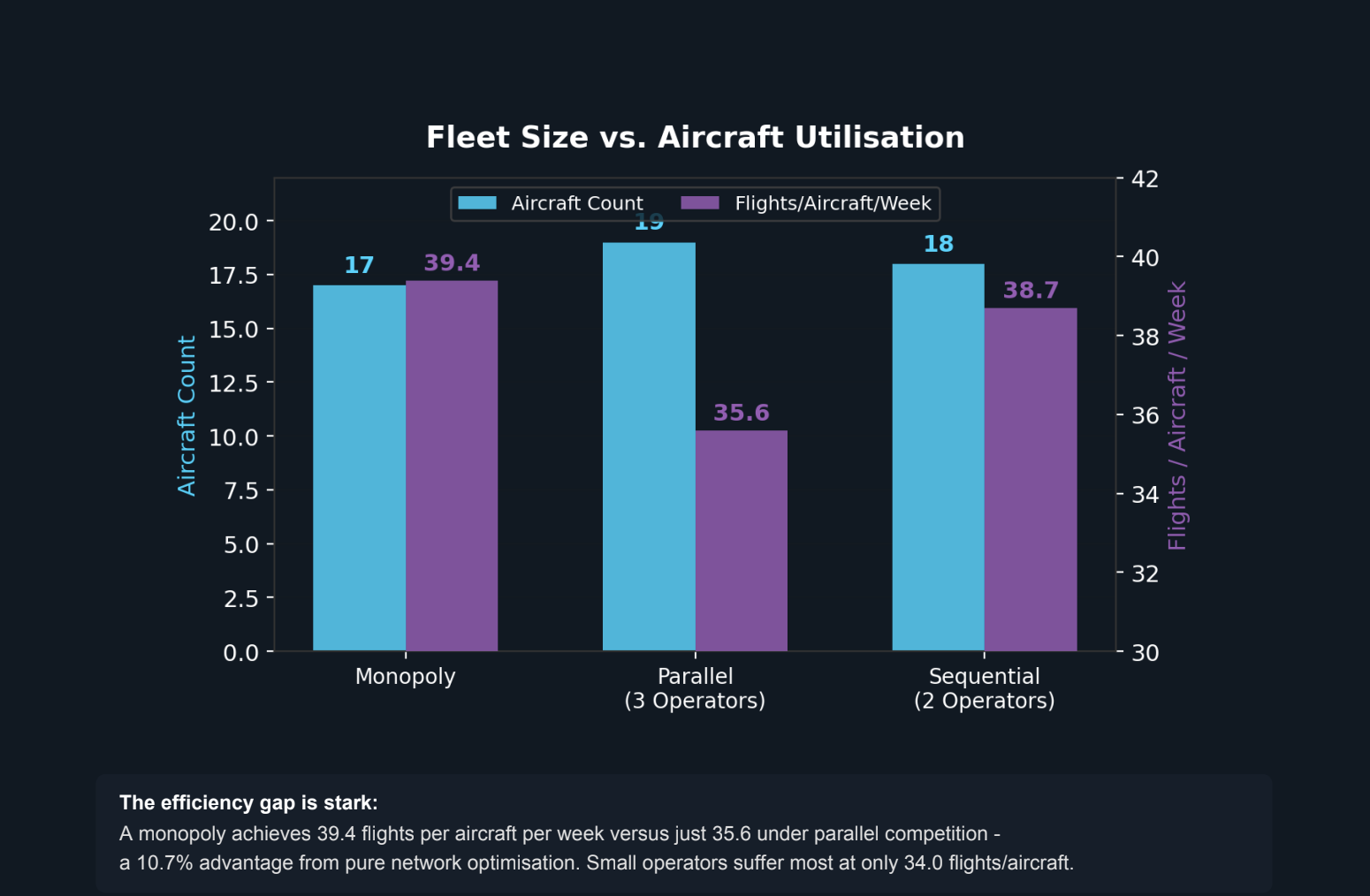
Analysis from EA Maven Suggests A Single Operator Market Could Boost Early Electric Air Taxi Profits by 15.7 per cent
A new market analysis from EA Maven argues that early Urban Air Mobility (UAM) markets may be better served by a single operator rather than immediate competition, challenging a long-held assumption that competitive structures automatically produce better outcomes.
Using its AeroTesseract modelling platform, the co-founders Darrell Swanson and Jarek Zych ran a series of network simulations based on a hypothetical 10-route eVTOL network centred on the city of Cambridge in the UK.
The study modelled operations carrying roughly 2,600 passengers per week using four-seat aircraft, testing three different market structures: a single operator monopoly, parallel competition between three operators, and a sequential route split between two operators.
The results suggest the monopoly configuration delivered the strongest operational performance across nearly every metric. According to the modelling, a single operator network generated 15.7 per cent higher profits than a competitive structure, while also improving fleet utilisation by 10.7 per cent and increasing passenger load factors by 7.5 percentage points.
One of the key drivers was network optimisation. In the monopoly scenario, 17 aircraft were sufficient to operate the network efficiently, achieving about 39.4 flights per aircraft per week.
Under parallel competition, however, the same demand required 19 aircraft but produced only marginally more flights. Smaller operators in the competitive scenario struggled the most, averaging just 34 flights per aircraft per week.
Demand fragmentation also played a major role. The modelling found that the monopoly operator achieved a 90.9 per cent load factor and captured 95 per cent of total demand, while parallel competition reduced these figures to 83.4 per cent and 83.8 per cent respectively. Smaller competing operators experienced load factors as low as 76.1 per cent, raising questions about their long-term financial viability.
Infrastructure efficiency was another important differentiator. While individual flight energy consumption remained broadly similar across scenarios, the system-level energy picture changed significantly.
A single operator was able to maximise charging infrastructure usage, achieving 47.9 flights per charger per week compared with 39.8 under parallel competition. Fragmented scheduling also resulted in higher total energy use and increased grid demand under competitive structures.
Environmental performance followed a similar trend. The study estimates that a monopoly structure could deliver around 514 tonnes of annual CO₂ savings compared with 449 tonnes under competitive operations, primarily due to higher load factors and fewer aircraft required to meet demand.
EA Maven notes that the findings do not suggest competition should be excluded permanently. Instead, the analysis points to a staged market approach, where early UAM networks operate under regulated monopoly or franchise structures before introducing competition as demand, infrastructure and energy capacity scale.
The conclusion reflects a broader theme emerging in advanced air mobility: in the early years of deployment, network optimisation and infrastructure efficiency may matter more than market fragmentation.
You can read the full PDF by clicking here