
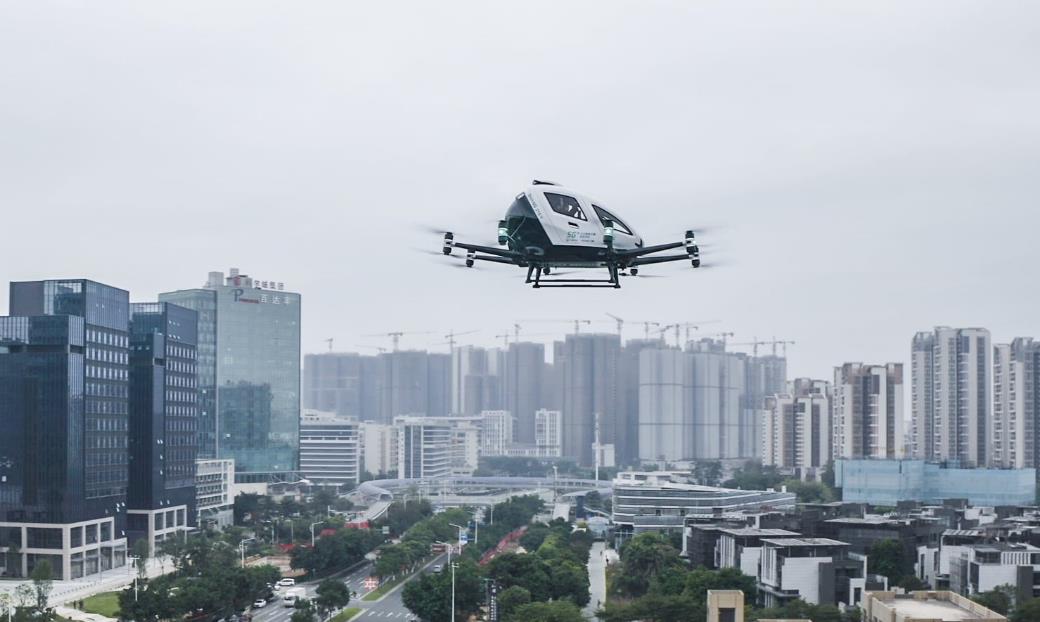
EHang: “Chinese UAM Global Dominance Looming?”
Eleven days have passed since the momentous news broke that EHang had gained Type Certification (TC) from the Civil Aviation Administration of China (CAAC), making it the first eVTOL company in the world to achieve such an accolade.
After a dramatic week when on the Monday (October 9th) the Chinese company announced its proposal to voluntarily suspend share trading had been approved by Nasdaq “in anticipation of an upcoming announcement concerning a very significant development regarding its business operations,” investors had a nail-biting week pondering what the news might be.
Yet, four days later (October 13th), few were surprised by the disclosure. EHang had been flagging the potential TC headline to the market for over a year.
Understandably, the share price was all over the place on that Friday. At one point the futures price briefly struck USD37 during pre-market trading, only to settle at USD20.30 by the close of play. Since, it has gradually declined closing yesterday (October 23rd) at USD16.25. Investors have sold on the news after an 88 percent or more share price rise during the year.
On October 17th, defenseworld.com posted that Goldman Sachs had upgraded EHang (EH) from a neutral to buy rating in a research note issued to investors. The financial colossus offers a USD30.50 price objective.
The website also points out that a number of hedge funds have recently bought shares of EH. GTS Securities LLC purchased a new stake in the second quarter valued at USD163,000, while Goldman raised its stake by 3.9 percent. The company now owns 530,903 shares of EHang’s stock valued at around USD8,054,000.
Other investment companies who also raised their stakes include Quadrature Capital Ltd, Itau Unibanco Holding S.A and Schonfeld Strategic Advisors LLC. Currently, 16.49 percent of EHang’s stock is owned by institutional investors.
Aviation journalist of more than thirty years, Philip Butterworth-Hayes, posted on his UAMN website (October 16th) a feature entitled, ‘What EHang’s EH216 Type Certification Means for the Global Aviation Industry’.
He writes, “The announcement will have a profound impact on the industry.” And goes on, “The company plan for a rapid ramp-up in production and delivery – first to around 2,000 tourist hot spots in China and then to neighbouring nations in Asia. This means that the country will be introducing autonomous advanced and urban air mobility services before any eVTOLs have been certified in Europe and North America and ten to fifteen years before these regions plan for uncrewed versions, on a trial basis.”

Philip Butterworth-Hayes
Butterworth-Hayes points out, “While regulators in the West struggle to implement even first generation UAS traffic management (UTM) system for drones, EHang has developed and certified not just an autonomous aircraft, but an entire AAM eco-system.”
According to the company, the Unmanned Aircraft Cloud System (UACS), also certified by the CAAC, includes a traffic management system, flight plan processing, aircraft command and control, systems monitoring and flow-control functions, “enabling cluster management of multiple aircrafts within the same airspace, and ensuring safer and more reliable operations.”
He again points out, “Unlike other eVTOL manufacturers, EHang can market this entire eco-system to countries and cities prepared to align their certification processes to that of the CAAC.” Along with other potential Chinese flying taxi companies, this gives “an extraordinary lead in this vast global market. It will mean EHang will be able to deliver affordable AAM services at a scale and pace beyond the reach of any competitors in the West.”
Understandably, critics from Europe and North America are sceptical. Butterworth-Hayes comments, “The operational and business plans do not add up, they argue. The cabin size is too small and two hours to fully charge an EH216 is too long. They worry about the safety and reliability cases.”
The reality suggests there are now three ways the EHang AAM programme may go. He continues, “Complete success and mass distribution around the world; a minor hiccup of two which slows the program down, but does not fundamentally detract from the company’s longer term business plans; and a third, where there are more serious incidents, which will introduce more significant delays and obstacles.”
The growing distrust of China even allows a few critics to believe that any such accidents will be simply covered up by the authorities, anyway.
Butterworth-Hayes then drills down to the fundamentals of the Type Certification. He writes, “The success of the certification process has been the alignment between the CAAC with its low altitude economy and general aviation plan and China’s eVTOL and drone sectors. This will mean the CAAC is about to play a more significant global role, as China will be able to set the standards for autonomous passenger services for years to come, as it will have unique sources of operational data on which new rules and operating procedures for autonomous aviation will rely.”
The aviation expert concludes, “The certification of the EH216‑S is a huge deal, for a number of reasons. The gut reaction of many in the West, among regulators and industry, will be to regard the program as a uniquely Chinese experiment, without relevance to the crawl-walk-run development plans of their own domestic industries. But they will also know that the coordination of activity between industry and regulator which has resulted in the type certification of the EH-216‑S, rather than the technology, is the key factor which has produced this milestone.”
Meanwhile, Chinese website, news.sohu.com, released important information this week concerning EHang which appears to have drifted below the news radar.
While the article states China’s first eVTOL route is expected to be opened in Shenzhen this year, “The EH216‑S will also undergo operational qualification review and be officially put into commercial operation after meeting relevant requirements.”
It seems that now EHang has successfully gone through the most difficult Type Certification process, the company will make efforts to obtain a production license (PC) and a stand-alone airworthiness certificate (AC). The report states, “The next step of obtaining a PC means that the regulatory agency recognises the quality and management system of the aircraft manufacturer.” While the craft can be mass produced, the completed aircraft “cannot yet be put into commercial operation until obtaining an AC.” This represents an airworthiness certificate applied by the customer after the aircraft is produced and before it is officially delivered to the customer.
Yet, this is actually good news for EHang.
sohu.com ends with a quote from Chinese Aviation Legal Expert, Lin Zhong. “Previously, after the domestic large aircraft C919 obtained TC certification, it only took 70 days from TC to PC, and then only 20 days from PC to AC. Therefore, it is likely that large quantities of EH216‑S will be put into the market much faster than expected.”
So, where is the negative EHang news, then?
Apart from the doom and gloom doom-sayers, there doesn’t appear to be much. While such critics believe EHang is just “a Chinese thing”, news released late last week announced that the company will inaugurate the first autonomous Air Vehicle Operations Centre in Europe on October 31st.

EHang and Spanish Police Collaborate to Explore AAV Use Cases in Emergency and Security Missions (Displayed at Cuatro Vientos Aerodrome, Madrid)
Spanish website, www.hispaviacion.es, writes, “This inauguration represents a milestone in the deployment of Urban Air Mobility in Europe, by integrating the operation of electric vehicles with autonomous eVTOL capacity, alongside infrastructure, air traffic management systems, procedures and information technologies, of a European international airport.”
The article goes on. “The creation of this operations centre, a pioneer in the world, arises from the collaboration agreement signed between EHang and Aeroports de Catalunya, and allows the national aeronautical and airport sectors to be positioned at the forefront of Advanced Air Mobility.”
It concludes, “The EH216‑S aircraft deployed at the centre will allow the accumulation of extensive operational experience and the generation of knowledge, data and information, of inestimable value, for the development of technological solutions, regulations and procedures, for the safe and efficient integration of eVTOLs in airport environments.”
The warning of potential Chinese UAM global dominance suggested by Butterworth-Hayes is, perhaps, more realistic than Western critics may have you believe.
For more information
(Top image: EHang 216‑S Flying Over Europe)
