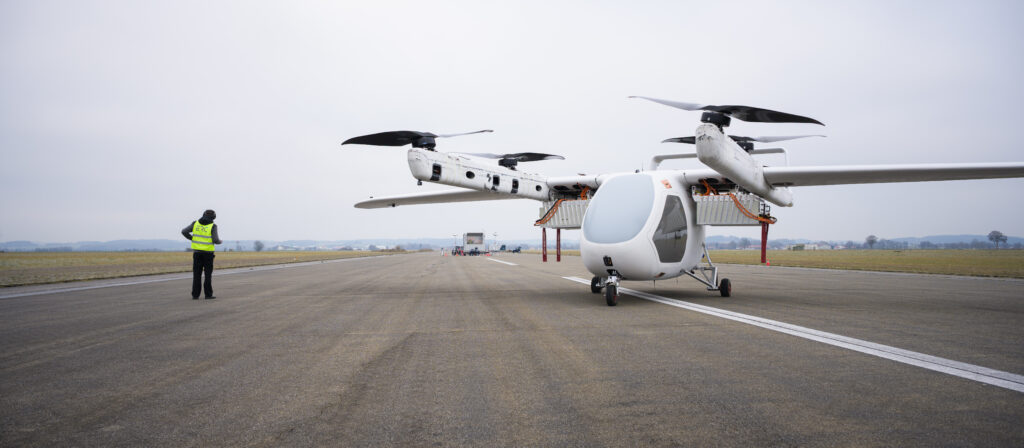
ERC System begins flight testing its full-size Romeo prototype, one of Europe’s heaviest and largest eVTOL aircraft
Munich startup ERC System has begun flight testing of its full-size, third-generation prototype of its eVTOL aircraft prototype, known as Romeo.
Weighing nearly three tonnes and sporting a 16-metre wingspan, ERC says Romeo is among the largest and heaviest eVTOL aircraft flown in Europe so far. Flight testing initially began back in November 2025.
Dr. David Löbl, Co-Founder and CEO of ERC System, said: “We are excited to have reached this key milestone in our mission to make aerial transportation more economically feasible, especially for critical missions.
“The crewed aircraft we intend to certify in 2031 is hybrid-electric. It takes off and lands vertically like a helicopter but uses wings to cruise efficiently like an airplane. This allows us to operate at a fraction of the cost of helicopters, while reducing transport times significantly compared to less costly, but slower ground-based vehicles. A clear benefit for critical missions, such as in interhospital patient transports.”
Its successful maiden flight comes as the startup intensifies strategic partnerships with airrescue and HEMS operators and prepares an extension into the uncrewed aerial logistics market.
ERC’s flight tests on full-size, full-mass prototypes are intended to tackle the challenges of flying heavy
eVTOL aircraft as early as possible in the development process.
This approach represents an underlying development philosophy, which ERC has implemented since the first full-mass prototype ‘Echo’ took to the air in 2023. The learnings generated during the current flight test campaign will inform the development of ERC’s first commercially available aircraft.

Leading HEMS operators from Germany, Switzerland, Austria, and beyond are already on board. DRF
Luftrettung, a global leader in this field, has committed to a strategic partnership.
Dr. Krystian Pracz, CEO of DRF Luftrettung, said: ”The prototype’s successful maiden flight represents the transition from concept to practical testing. As a key strategic partner of ERC System, DRF Luftrettung is contributing medical, technical, and flight operations expertise from over five decades of air rescue experience.
“Together, we are developing an additional option for patient transport and emergency medical services. Current trends in healthcare – the reduction and specialization of clinics, longer distances, and an increasing shortage of skilled workers – require new solutions.
“That is why we are convinced that the ERC aircraft will have a permanent place in our fleet in the 2030s – as a useful addition to established air rescue with rescue helicopters.”
ERC’s flagship product will be a crewed, hybrid-electric lift-and-cruise aircraft optimized for inter-hospital patient transport. Founded in 2020 by experienced aerospace professionals, ERC currently has approximately 60 employees and is backed by aerospace powerhouse IABG, a leading provider of testing and certification services for aircraft, spacecraft, and defense solutions.
The company has confirmed it intends to add an uncrewed cargo aircraft (UAS) to its portfolio, capitalizing on its five-year experience of building and testing heavy uncrewed prototypes. The company is expected to release details of the uncrewed product by Q2 2026.
One Test at a Time: ERC’S current flight test campaign
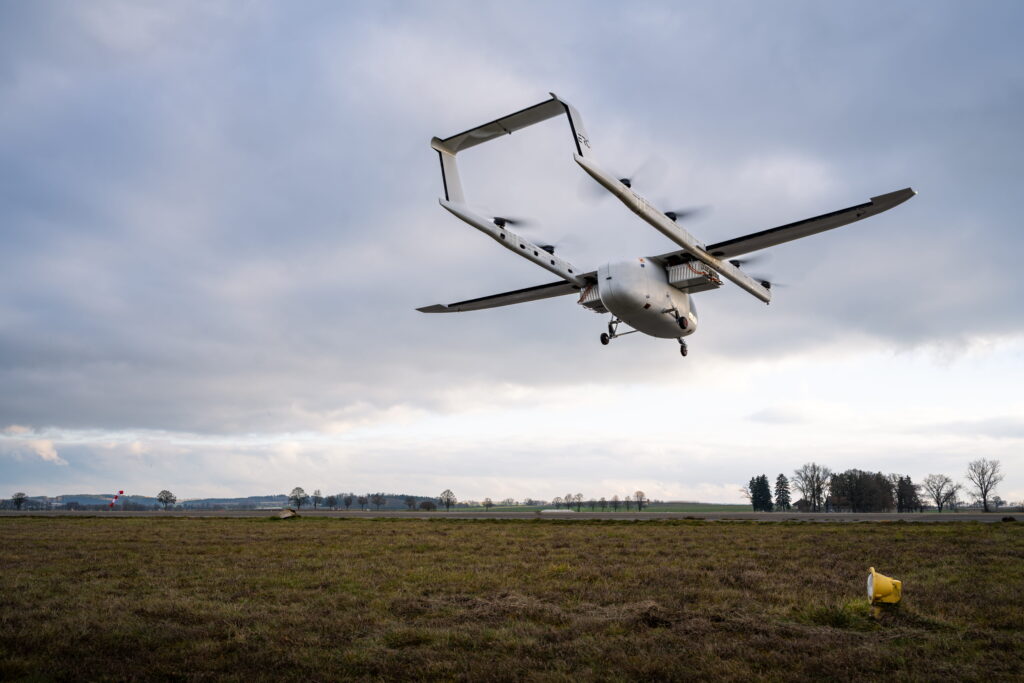
ERC System’s third-generation prototype “Romeo” first took to the air in November 2025 at the ERC Flight Test Center near Munich, Germany.
The aircraft’s maiden flight marked the start of the company’s latest flight test campaign, which serves to validate the core flight characteristics of the ERC’s vehicle architecture under representative mass and system conditions. A particular focus of the current test phase is placed on vertical takeoff, slow and controlled maneuvers, and vertical landing
Romeo is the heaviest fully electric eVTOL flown to date in the European Union, based on publicly available information. The aircraft features eight electrically driven vertical lift units powering rotors of approximately 2.4 meters in diameter, as well as a large cabin representative of ERC’s future medical transport configuration.
It is fully electric, in contrast to the hybrid-electric production aircraft set to enter service in 2031, as the focus of the flight test campaign is on the take-off and landing phases. Both will be executed in fully electric mode going forward
While the future production aircraft will be operated with a pilot on board, the current flight testing is executed in an uncrewed configuration. The test pilot controls the aircraft remotely from a ground control station. Remotely piloted flight testing is an effective way to increase safety and reduce costs in the early phases of development and testing.
The current flight test campaign will provide critical insights that pave the way for both the technical foundation and certification of the future manned production aircraft