
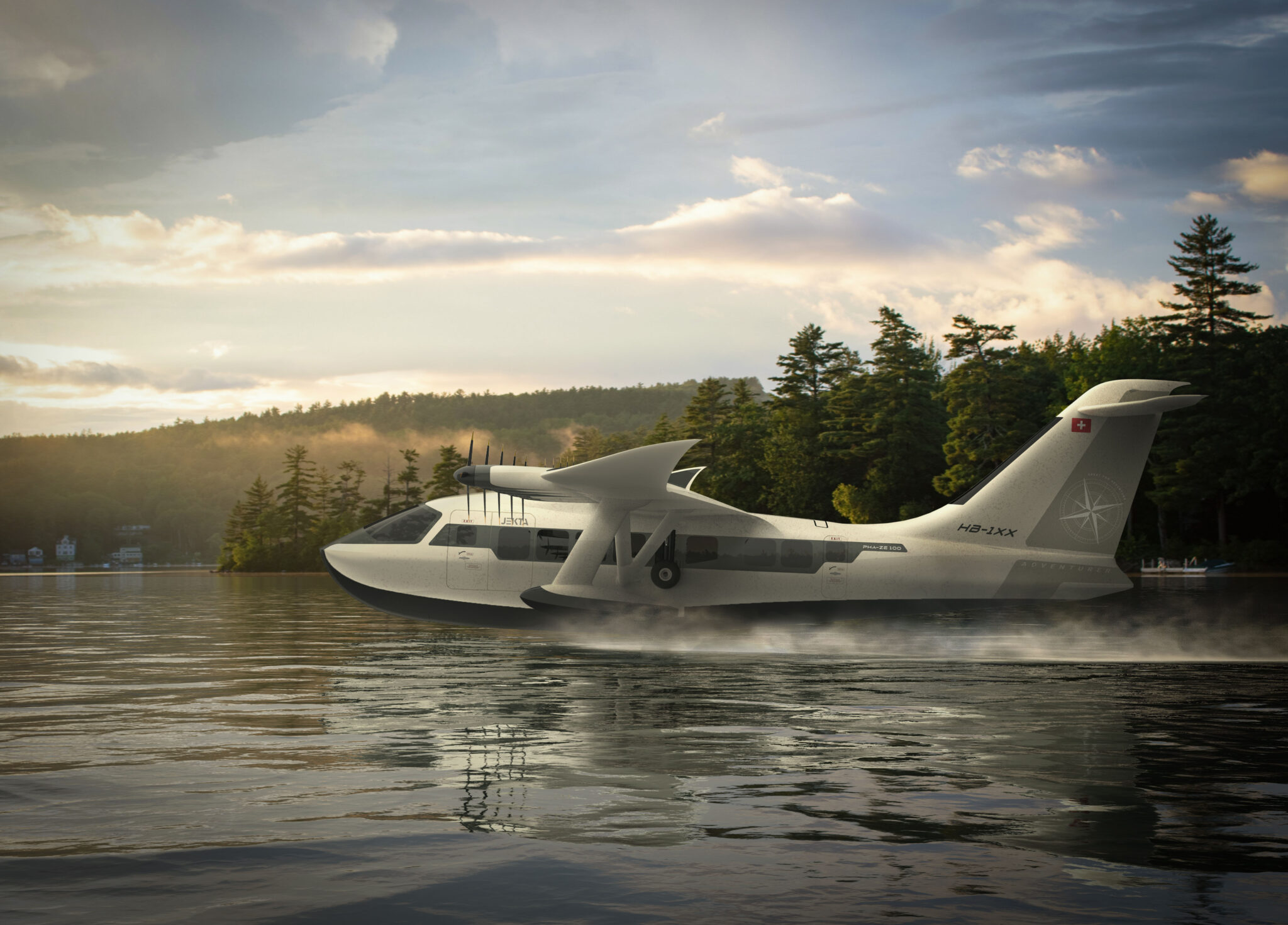
Jekta Signs LOI with Gayo Aviation for “Ten PHA-ZE 100 Flying Boats”
Swiss-based Jekta, a manufacturer of an electrically-powered passenger “Hydro Aircraft Zero Emission 100 (PHA-ZE 100) Flying Boat” announced this week the signing of a Letter of Intent (LOI) for the acquisition by Gayo Aviation of ten electrically-powered amphibious craft, reports a press release. This is Jekta’s first potential deal.
With main offices in Sweden and Dubai, Gayo Aviation is a global provider of private and specialist aviation services and will aim to optimise the flying boats to support existing and new market opportunities.
The release explains, “The airframe will be delivered in a baseline configuration for 19 passengers, with the deal including ground support equipment for charging and replacing the PHA-ZE 100’s batteries; tools and component support for the first year of operation; training for two pilots and two technicians; and a three-year airframe warranty.”
It continues, “Gayo Aviation plans to make the aircraft available for environmental and experiential tourism and charter operators wishing to bolster their sustainable transport options. Gayo will also offer the aircraft on lease for scheduled affordable regional services in underserved communities.”
Gisle Dueland, CEO of Gayo Aviation, commented, “We want to be among the first to provide our customers with a truly sustainable option to transport their passengers. With the potential to reduce per-passenger-per-hour costs by more than 70 percent compared to current seaplanes we can satisfy that need.”
He continued, “The trend for the top end of the tourism community is towards sustainable and experiential travel, so we wanted to be ahead of the curve and first in line to serve this evolving sector. This opens up more opportunities to supply sustainable tourism options and Gayo is committed to supporting this expansion. We anticipate that interest in travel on these airframes will be high.”
This potential deal demonstrates industry faith in the PHA-ZE 100 as Jekta CEO George Alafinov continues negotiations with a second potential customer from the Gulf.
Alafinov said, “Sustainability does not have to mean a compromise in comfort or capability and the PHA-ZE 100 has been designed to meet these needs. It also satisfies the increasing demand and opportunity to use water as infrastructure, the expansion of seaplane routes, and provides a sustainable, optimised solution to replace ageing seaplanes.”

The PHA-ZE 100 flying boat is to be certified to EASA CS-23 and US FAA FAR-23 standards for fixed-wing passenger aircraft. The craft will serve coastal and island communities, regional routes currently limited by operational costs, and support new low-cost, sustainable services between cities without the need for the installation of expensive land infrastructure.
It also has a configuration to suit the particular needs of experiential vacations being large enough to carry kayaks, scuba equipment, and other gear required to support adventure sports. Flexible configurations, including 19-seat, mixed economy/freight, VIP, and ambulance options, make the most of the PHA-ZE 100’s spacious, stand-up cabin. Low maintenance and fuel costs, much-reduced noise, no pollution impact, and minimal aviation infrastructure requirements combine to make the PHA-ZE 100 an optimal platform for sustainable and new operations.
Background
Led by George Alafinov, the Jekta team has more than two decades of experience designing and building flying boats, including the eight-seat, composite LA‑8 and D‑Borey ultralight. The company is creating a modern, 26,901 m² production and flight test facility within the Swiss Aeropole Cluster in the canton of Vaud, Switzerland. It will include design, certification, logistics, maintenance and sales departments as well as an assembly hall, quality control laboratory, flight test organisation and administrative offices.

George Alafinov ® Talks to Potential Saudi Customers (credit: Jekta)
The PHA-ZE 100 is powered by ten electric motors supplied with energy from either batteries or hydrogen fuel cells. Its initial flight endurance on battery power is projected at one hour, with a 30-minute reserve.
The flying boat will operate from coastal waters, lakes and general waterways and can operate in waves up to 1.2m high. Jekta is aiming to reduce per-passenger-per-hour costs by more than 70 percent compared to current seaplanes
For more information
