
MIDDLE EAST: XPENG AEROHT’s Flying Car Receives Special Flight Permit In Ras Al Khaimah, UAE
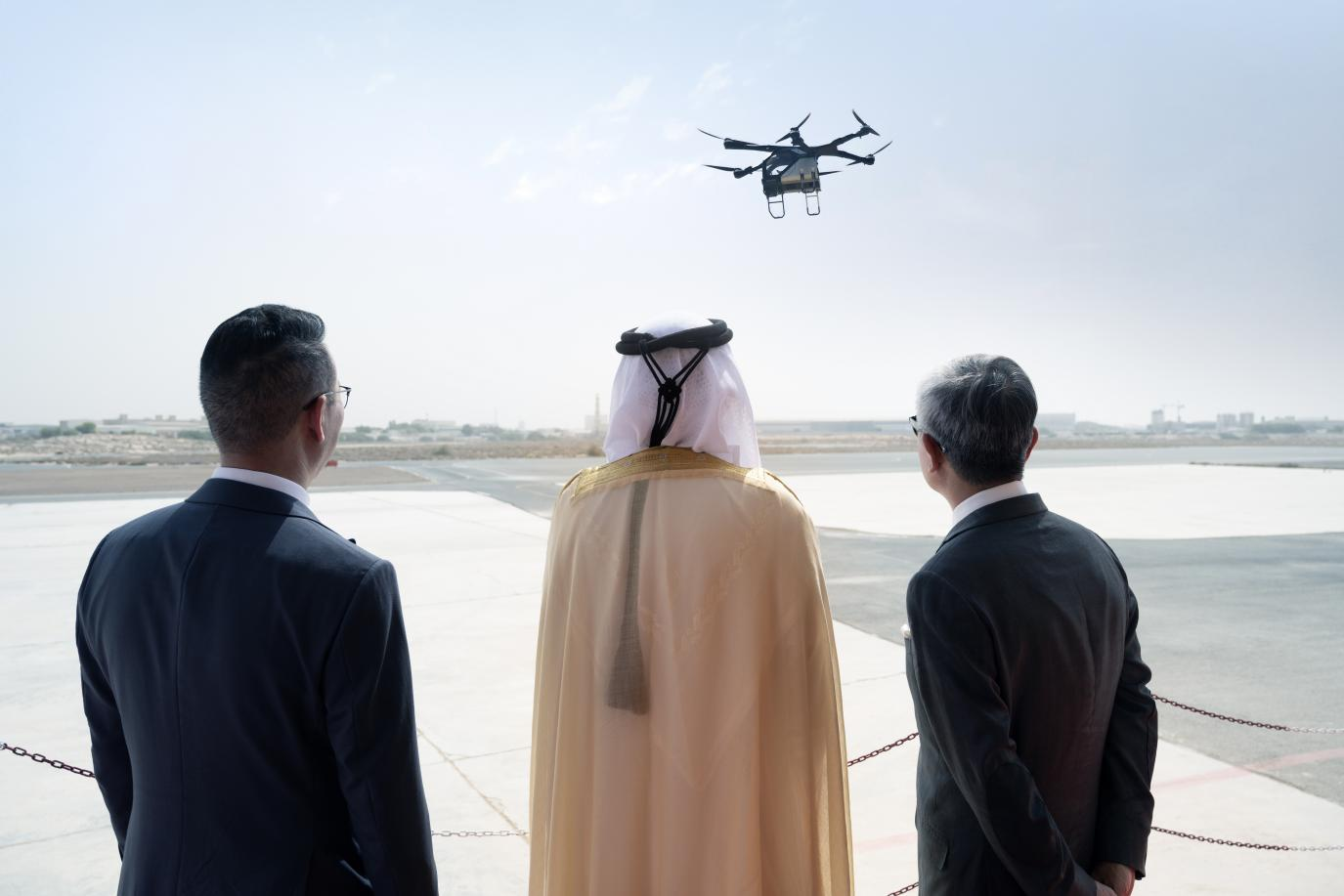
Chinese flying car company XPENG AEROHT has recently received a special flight permit for its “Land Aircraft Carrier” in Ras Al Khaimah, the northernmost emirate of the United Arab Emirates (UAE).
The approval was granted during a certification ceremony on Wednesday, marking a significant step in testing and deploying electric vertical mobility in the region.
The event was attended by Sheikh Saud bin Saqr Al Qasimi, ruler of Ras Al Khaimah and member of the UAE Supreme Council, along with Zhang Yiming, the Chinese ambassador to the UAE, and other senior officials. The permit was formally presented to Zhao Deli, founder of XPENG AEROHT.
Zhao praised the UAE’s innovation ecosystem, noting that its “open innovation environment provides an ideal platform for validating flying car technology.”
Strategic Agreement Signed
Alongside the certification, the Ras Al Khaimah Transport Authority signed a memorandum of understanding with XPENG AEROHT.
The agreement outlines cooperation on flight testing certification, scenario applications, and the broader promotion of flying cars across several sectors, including government transport, tourism, and emergency rescue.
Esmaeel Al Blooshi, director general of the transport authority, said the partnership underscores the UAE’s ambition in the smart mobility sector.
“Integrating Chinese flying vehicle technology enhances the UAE’s position in global smart mobility and low-carbon transportation, serving as a demonstration for the Middle East,” he said.
The “Land Aircraft Carrier” is a fully electric vehicle designed for urban air mobility. It features an intelligent large display and a single-stick control system, supporting both automatic and manual operation.
According to XPENG AEROHT, its advanced flight control system is designed to enhance operational safety, while low noise levels and environmentally friendly technology make it suitable for city use.
The announcement aligns with the UAE’s broader efforts to develop its low-altitude economy. The country has been implementing policies aimed at attracting global companies in smart transportation and accelerating the adoption of sustainable, next-generation mobility solutions.

