
NASA grant funds aeroacoustic research to develop quieter vertical lift air vehicles
NASA has awarded $5.7 million to a multi-university partnership as part of the agency’s University Leadership Initiative.
The project, led by Boston University over the next three years, will bring together researchers and engineers from Virginia Tech, Embry-Riddle University, Tuskegee University, and industry partner Joby Aviation to focus on developing quieter vertical lift air vehicles.
The grant will support research into the technical and environmental challenges of flying in urban environments. As populations in urban areas continue to grow, increased traffic and industrial activity is causing cities to become louder and louder. Factoring in new modes of transportation, such as vertical lift air vehicles, will contribute to already existing noise pollution.
The research will develop methods to better predict low noise operations of such vehicles within the urban canyon. The research team will explore how much the ingestion of large-scale disturbances during flight, such as gusts of winds, will affect rotor noise.
“This is a complicated problem because while a helicopter has one main rotor, these vehicles have multiple rotors,” said Nathan Alexander, assistant professor in the Kevin Crofton Department of Aerospace and Ocean Engineering.
“This provides additional degrees of freedom to control sound through individual rotor speed and tilt, but it also makes the problem more complex. The goal is to determine the optimal configuration for safe operations in unsteady environments that also produce low noise.”
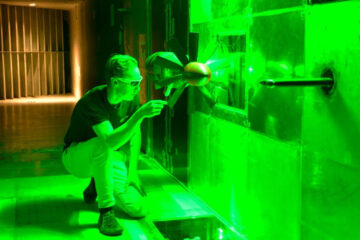
Both computational and experimental methods will be used to satisfy the research objectives. Virginia Tech has been awarded $1.3 million from the total NASA grant. Alexander, an expert in fluid dynamics, flow-structure interaction, and flow generated noise, will team with Nanyaporn Intaratep, research assistant professor, to plan and execute testing in the Stability Wind Tunnel.
The Stability Wind Tunnel is one of the leading university-owned research facilities of its kind specializing in aerodynamic and aeroacoustic testing. In addition to low background noise, the facility boasts state-of-the-art instrumentation and capabilities for measuring aeroacoustic flow, such as its 251-channel microphone array and stereoscopic particle image velocimetry systems.
Working with Joby Aviation, Alexander and Intaratep will design and conduct experiments to assess the aerodynamic and acoustic performances of multirotor configurations.
The team’s experiments will focus on the rotors themselves – studying their interaction in gusty environments, and measuring the speed, thrust, torque, and noise from a variety of angles, as well as the flow field in and around those rotors.
The data captured will help validate computational models from university partners to predict the steady state noise as well as a vehicle’s response to disturbances in an urban setting. Throughout the experimentation phase, Alexander and Intaratep will also develop a virtual lab to increase the research’s educational impact.
“Most institutions do not have a facility like the Stability Wind Tunnel,” Alexander added. “By using what we learned over the COVID-19 pandemic in delivering a meaningful, online lab experience, we will be able to offer students at our partner universities the ability to participate in real flow and noise data acquisition and processing.”
The methods and data derived from this study will be open-sourced, aiding in the industry advancement of vertical lift air vehicles. The research will also provide graduate and undergraduate students hands-on research experience related to the urban air mobility industry.

