
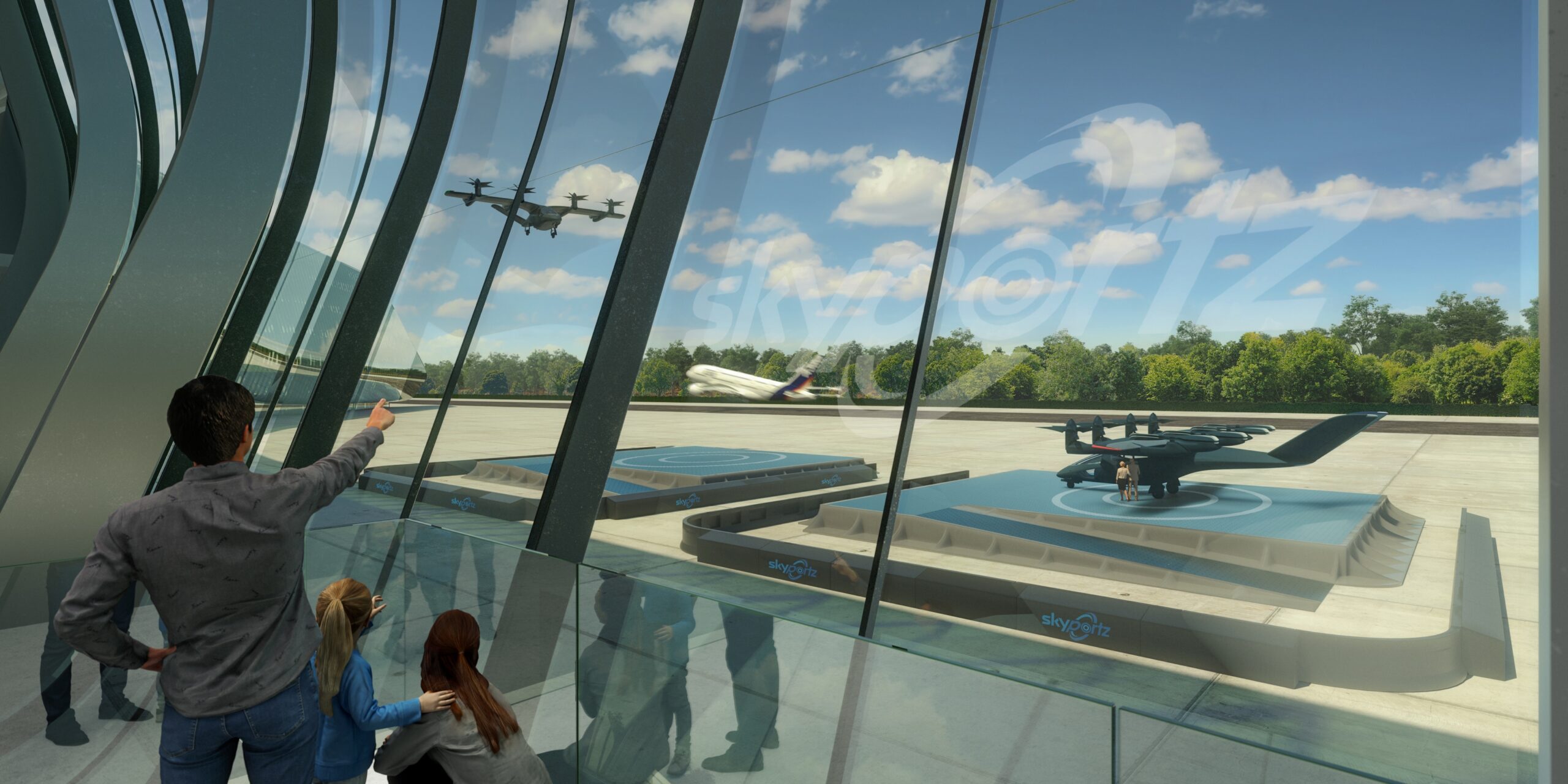
Skyportz Releases “Vertipad Patent”, Enables New Urban Landing Sites for Air Taxis
Skyportz, a leading Australian vertiport developer, will release at the Melbourne Avalon International Airshow (March 28th-30th), its innovative vertipad patent that alleviates downwash and outwash, reports a press release.
The patent addresses one of the stand-out issues for Advanced Air Mobility (AAM) in urban locations — the alleviation of downwash and outwash from the aircraft.
This issue was highlighted by the FAA in January within its Engineering Brief 105A, where the U.S air regulator pointed out that vertipads will need to have a wind safety zone beyond the landing surface. This zone has only been defined when the windspeed exceeds 34.5 mph.
The actual required physical dimensions of the safety zone will likely differ between aircraft, but may result in significant additional footprint requirements.
The release explains, “The Swinburne University study released today has indicated that the Skyportz modular vertipad may dissipate energy up to 250 percent faster than an air taxi landing on a flat tarmac.”
Clem Newton-Brown, CEO of Skyportz, remarked, “The Skyportz vertipad patent has some very real applications as cities move to establishing vertiport networks outside of existing airports and helipads. It means that with our vertipad you can safely use less land or fit more pads onto smaller plots.”
International air regulators and future air taxi and vertiport operators have expressed interest in the Skyportz vertipad patent, which is to be made available in emerging global markets under licence in the future.
Skyportz says it aims to break the nexus between aviation and airports and enable commercial and industrial property developers to host vertiports.

Newton-Brown continued, “The vertiport infrastructure is the missing piece of the puzzle for this industry. Without a multitude of new vertipad landing sites in places people want to go, the aircraft can never fulfil their potential.” He added, “We believe those properties with vertipads could attract higher rents as businesses seek to provide air taxi services for customers.”
Professor Justin Leontini Department of Mechanical and Product Design Engineering at Swinburne University of Technology, commented, “The design concept of the Skyportz vertipad could dissipate power up to two and a half times faster than if an air taxi were to use a flat concrete landing surface.
The first iteration of the modelling conducted by Swinburne University has experimented with different landing surface treatments described in the patent.
Leontini added, “Our next step will involve adding mechanical devices detailed in the patent under and around the vertipad which we expect will induce a Magnus effect and dissipate energy at an even higher rate while directing flows to desired zones away from waiting passengers.”
The practical implications for this research are that safety area requirements around a vertipad may be reduced, safely enabling operations from smaller footprints.
Skyportz intends to licence manufacturing and distribution of the vertipad into all global markets as they emerge.
Meanwhile, the Australian air regulator, CASA recently released vertiport guidelines, signalling a commitment to facilitate Advanced Air Mobility in Australia. EASA and FAA have also released vertiport guidelines, signalling the wide policy support for new landing sites globally.
For more information
(Images: Skyportz)
For the latest news, insights and content regarding the global Advanced Air Mobility market, please join the following eVTOL Insights channels: WhatsApp, Facebook, Instagram, Spotify, Apple Podcasts, YouTube, X and LinkedIn.
