
US DOT Unveils Its AAM National Strategy with Initial Flights Planned for 2027, Strong Industry Support from eVTOL OEMs
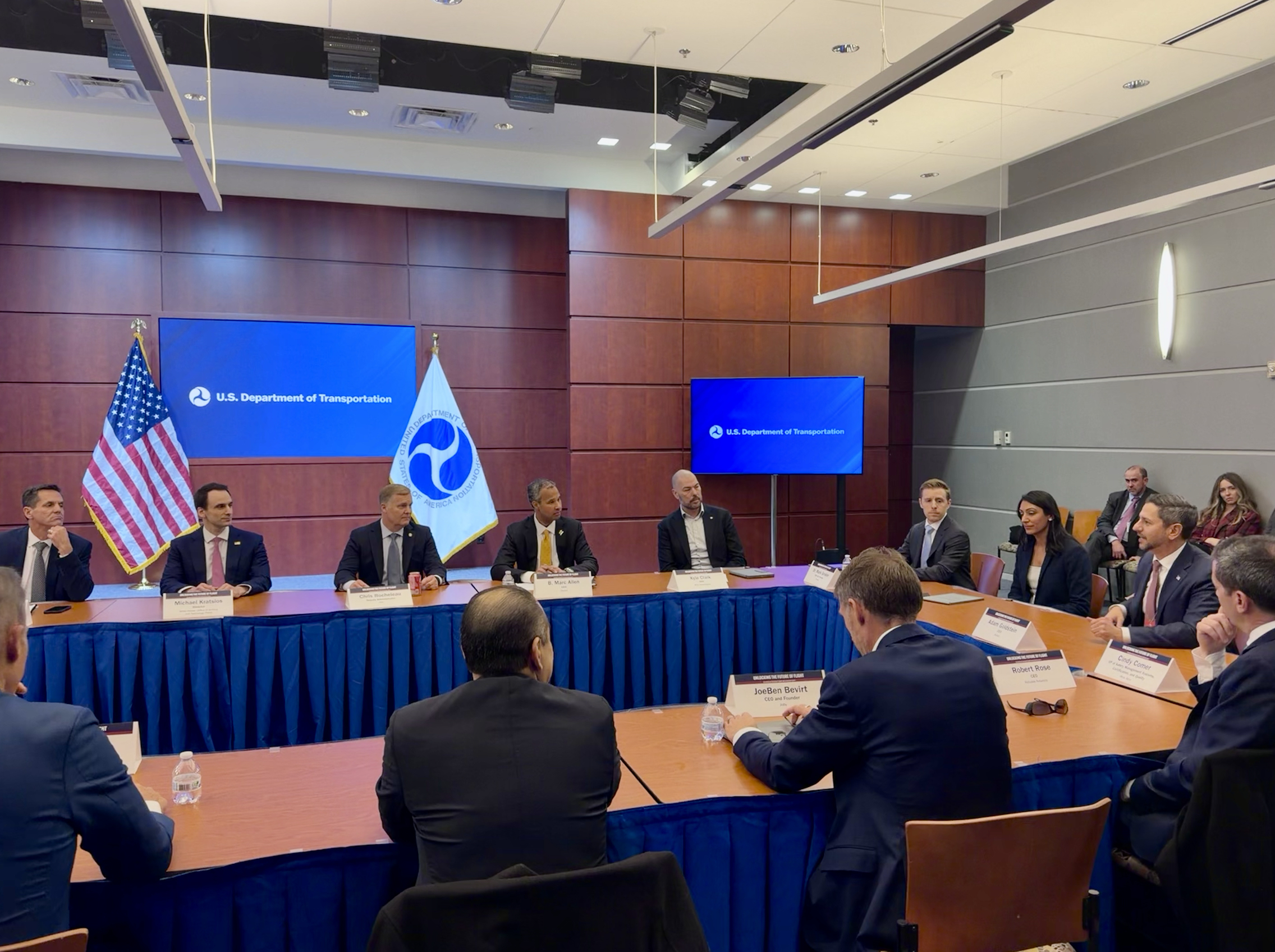
Senior leaders from OEMs including Archer, BETA Technologies, Eve Air Mobility, Joby Aviation and Wisk have shown their support to the U.S. Department of Transportation’s (DOT) Advanced Air Mobility (AAM) National Strategy, which was unveiled yesterday (Wednesday) in Washington D.C. by Transportation Secretary Sean Duffy.
Advanced Air Mobility National Strategy: A Bold Policy Vision for 2026–2036, signals a clear and coordinated commitment to accelerate the development and deployment of Advanced Air Mobility aircraft and systems across the United States.
The plan seeks to leverage existing infrastructure, modernise air traffic management, prioritize US manufacturing and develop a domestic workforce to meaningfully scale operations in the country.
Additionally, it envisions initial flights in 2027 and new operations in rural and urban areas by 2030. The plan also points to the many applications for AAM technology, which include inter-community and regional passenger flights connecting small towns to large cities and enhancing cargo, military and emergency missions.
Among those who were sat around the table for the briefing included Archer founder and CEO, Adam Goldstein, Kyle Clark, Founder and CEO of BETA Technologies, Megha Bhatia, CCO of Eve Air Mobility, JoeBen Bevirt, Founder and CEO of Joby Aviation, and Sebastien Vigneron, CEO of Wisk.
Archer
For several years, Archer has worked closely with the DOT, the FAA and other federal, state and local agencies to help shape this path to market.
That collaboration has included participation in the Advanced Air Mobility Interagency Working Group, contributions to the development of the Special Federal Aviation Regulation (SFAR) covering air taxis and engagement through the crafting of the eVTOL Integration Pilot Program.
Also announced yesterday, Archer has partnered with cities across the U.S. to submit multiple applications to launch initial air taxi operations under the White House’s eVTOL Integration Pilot Program (eIPP).
Established via President Trump’s “Unleashing Drone Dominance” Executive Order, the eIPP is designed to accelerate adoption of electric air taxis in major cities across the country by creating operational pathways for the top American eVTOL companies.
Archer’s applications focus on establishing the foundation required for long-term electric air taxi services in select U.S. cities. This includes building local operations teams, developing or upgrading infrastructure to support eVTOL flights and coordinating closely with public safety and emergency response agencies.
These applications to the eIPP are proposed public-private partnerships with cities across California, Texas, Florida, Georgia and New York.
Archer’s application with the City of Huntington Beach, California is exclusive, meaning it is the only air taxi OEM that is a part of that application. This bid supports Archer’s plans for early air taxi operations in and around Los Angeles as part of its role as the Official Air Taxi Provider of the 2028 Olympic Games.
Goldstein said: “We’re past the question of ‘if’ and firmly into ‘when and how. Through our close work with the Administration, DOT, FAA and other federal agencies, we now have the clearest path to market this industry has ever had. The focus now is execution—building, deploying and flying these aircraft here in the United States.”
BETA Technologies
This approach from the US DOT complements BETA’s mission to create access and deliver enduring impact for both rural and urban communities across America and beyond through minor improvement to existing infrastructure for safe, reliable, low-cost electric aviation.
BETA’s integrated model – which spans aircraft, charging infrastructure, training and components – uniquely positions the company as a partner in advancing the U.S. DOT’s goals of strengthening the domestic industrial base and creating high-quality aviation jobs.
Kyle Clark, Founder and CEO of BETA Technologies, said: “Global leadership in advanced air mobility will be held by those who build, certify, and deploy first. This National strategy, which lays out a bold, long-term vision for the future of this industry, puts the U.S. on that path, and BETA’s products are positioned to help deliver it.
“This creates a clear pathway for us to continue producing American-made, next generation technology to support both the needs of civilian communities and the mobility needs of our troops.”
Through ongoing demonstrations, utility-scale charging deployments, and collaboration with airport operators and communities nationwide, BETA is actively working to ensure that AAM complements existing transportation systems and delivers tangible public benefits such as improved connectivity, emergency response capabilities, and economic development.
Eve Air Mobility
Like most of the other OEMs in the US, Eve Air Mobility were actively involved in discussions surrounding the Strategy. The company is currently in the late stages of integrating a full-scale prototype of its eVTOL aircraft, with ground testing largely complete and the first flight expected by late 2025 or early 2026.
Bhatia added: “The AAM National Strategy is more than just a roadmap. It is a bold step forward in changing how people travel. At Eve Air Mobility, we see a future where the skies are not only busier but also smarter, greener, and better connected. This is our chance to open up a future where advanced air mobility changes cities, supports communities, and encourages future generations to look beyond roads and runways.”
Eve is preparing multiple conforming prototypes to support an extensive flight test and certification campaign throughout next year and although working towards type certification with Brazil’s ANAC, it plans to dual certify with the FAA so it can start planning global operations.
Once its eVTOL aircraft is certified, Eve aims to begin commercial operations, targeting initial services likely concentrated on urban and regional point-to-point routes.
Eve isn’t just building aircraft. It’s also developing Vector, an urban air traffic management (ATM) software platform designed to manage mixed fleet operations and integrate vertiports, operators, and service providers. The real-world deployment of Vector at the 2025 São Paulo Grand Prix showed progress toward a scalable operational system. A broader Fleet Operations Module is planned for launch in 2026.
Joby Aviation
Joby’s advanced progress towards certification and operational maturity uniquely positions the company to immediately engage on the Strategy’s core recommendations:
- Leverage Existing or Repurposed Infrastructure: Joby’s operational strategy has always focused on using a blend of existing and new infrastructure to deploy its air taxi services. The Strategy’s emphasis on facilitating the use of “existing or repurposed infrastructure for near- and medium-term AAM operations” directly aligns with Joby’s plan to initiate commercial services without requiring significant upfront investment in infrastructure
- Data Sharing with Respective Government Agencies: Joby has led the industry’s regulatory path, becoming the first eVTOL company to finalize its certification blueprint (G‑1) with the FAA, and is now entering the final stages of validating all necessary design, flight and manufacturing data. Combined with flying over 50,000 miles — including 850 flights in 2025 and operating test flights within the National Airspace System — means Joby has a significant amount of data needed for the Strategy
- Building the Workforce: Careers in aviation unlock opportunities for economic mobility and Joby has been actively engaged in building a skilled AAM workforce here in the United States. The company employs more than 2,000 people globally, including through Joby’s apprenticeship program. Joby’s manufacturing workforce continues to grow at the company’s scaled production site in Dayton, Ohio and its pilot production line in Marina, California. Through its aviation academy, the company is also building a talent pipeline of pilots and aircraft mechanics. The Strategy’s focus on developing workforce pipelines, including leveraging military experience, supports Joby’s integrated manufacturing and operating strategy, as well as its development of dual-use technologies for U.S. defense
- Autonomy & Safety: The commitment to developing an aviation autonomy roadmap aligns with work already underway at Joby. Joby’s Superpilot™ autonomous flight technology, validated over thousands of flight miles, provides critical operational data to advance the Strategy’s goals for increasingly autonomous and scaled operations. In addition, Joby has participated in two simulations with the FAA and NASA to validate integration of eVTOL operations using existing air traffic control procedures into the National Airspace System around Los Angeles International Airport, Dallas Love Field and DFW airports
JoeBen Bevirt, founder and CEO of Joby, said: “This strategy is tangible proof that the U.S. government recognizes the value of the AAM industry, and it comes as we’re preparing for early air taxi operations in U.S. cities through the eIPP program, created by an Executive Order this summer.
“It’s a powerful signal that our federal government, in coordination with state, local and tribal communities, is prepared to usher in the next generation of U.S. leadership in aviation.”
Wisk
Wisk has also strongly endorsed the publication of the Strategy and the company’s Certification and Policy team were present in Washington D.C. to hear how it will provide the national framework needed to accelerate the safe, efficient and equitable integration of autonomous and piloted AAM into the National Airspace System (NAS).
Wisk’s foundational perspective on autonomy was directly integrated into the National Strategy, reinforcing the company’s vision that autonomy is a critical enabler for safety and the industry’s success.
Wisk CEO Sebastien Vigneron, said: “The release of this National Strategy is a historic and pivotal moment for the entire AAM industry and for the future of U.S. aerospace leadership.
“For Wisk, the Strategy recognizes that autonomy is the key to unlocking the full potential of AAM. Autonomy can enhance safety, facilitate scaling to meet public demand, and help reduce operational costs. This federal recognition aligns with our mission, and we’re eager to prove out our technologies.”
Wisk views the Strategy as an essential umbrella framework that will coordinate and prioritize all subsequent federal AAM initiatives that Wisk plans to participate in, such as the FAA/DOT’s eVTOL and AAM Integration Pilot Program (eIPP). This unified approach is crucial for the U.S. to maintain its global leadership in aviation and establish a robust domestic industry that will expand globally.
The Strategy also reinforces the federal government’s commitment to modernization efforts currently underway to support high-volume and autonomous operations.
These efforts include the Brand New ATC System, the establishment of the Center for Advanced Aviation Technologies (CAAT)—where Wisk and its affiliate, SkyGrid, were present at the inaugural meeting—and ongoing work to implement the 2024 FAA Reauthorization.
GAMA
Also present in Washington D.C. was James Viola, president and CEO of the General Aviation Manufacturers Association (GAMA). He said:
“This strategy will ensure that the U.S. will be a global leader in AAM through the sector’s integration into the national airspace system with a focus on adapting and improving infrastructure; strengthening the aviation workforce; adapting and improving infrastructure; expanding security, safety and automation; and furthering community planning and engagement.
“The growth of the AAM sector will facilitate additional transportation options, create jobs, stimulate economic activity and competitiveness, and foster further advancement in aerospace technology.
The AAM Interagency Working Group was established by Congress through the Advanced Air Mobility Coordination and Leadership Act, which was signed into law in 2022.
GAMA led the industry effort for this legislation. The law authorized the Secretary of Transportation to establish an interagency working group composed of leaders from key government agencies to plan for and coordinate efforts for the advancement of the AAM industry.
The working group has been tasked to review and make recommendations for the federal role in the AAM sector, beyond the initial critical stage of aircraft certification and operations, with a focus on economic and workforce opportunities, potential physical and digital security risks and mitigations, and infrastructure development.
NBAA
With advanced air mobility technologies rapidly maturing, NBAA’s Emerging Technologies Committee and the NBAA AAM Roundtable have continually encouraged policymakers to develop pathways to ensure AAM aircraft can make a safe, smooth transition into aviation systems.
Matt Byrd, vice of NBAA’s Board of Directors and president and CEO of Hillwood Aviation, said: “On behalf of NBAA and the association’s Advanced Air Mobility Roundtable, I want to thank Congress for directing this plan, and the DOT for delivering a national strategy, coordinated across 25 federal agencies, which blazes a path forward for the safe integration of AAM into the national airspace system
“These aircraft will bring enormous benefits to the U.S. – more manufacturing, more exports and jobs, greater mobility and an improved ability to access remote locations. We commend the administration for its commitment to AAM, and we look forward to working with government and industry leaders to make this strategic vision a reality.”
Over the past year, the industry has marked a series of important milestones supporting the development and use of AAM in the U.S. For example:
- Last month, the FAA began an Electric Vertical Takeoff and Landing Integration Pilot Program to fast track air taxis to market
- In October 2024, the FAA unveiled a Special Federal Aviation Regulation to establish rules for the safe, efficient integration of AAM aircraft into the nation’s aviation system
- In June, President Trump signed an executive order, welcomed by NBAA, to accelerate the safe integration of unmanned aircraft system (UAS) into the national airspace system, and directed the Federal Aviation Administration (FAA) to begin the pilot program
The AAM National Strategy is the culmination of years of work by the AAM Interagency Working Group (IWG) established by Congress, which includes 19 Federal departments, including the DOT, Department of Defense and NASA.
The U.S. National Strategy on Advanced Air Mobility can be accessed here. Additionally, you can watch the briefing via YouTube

