
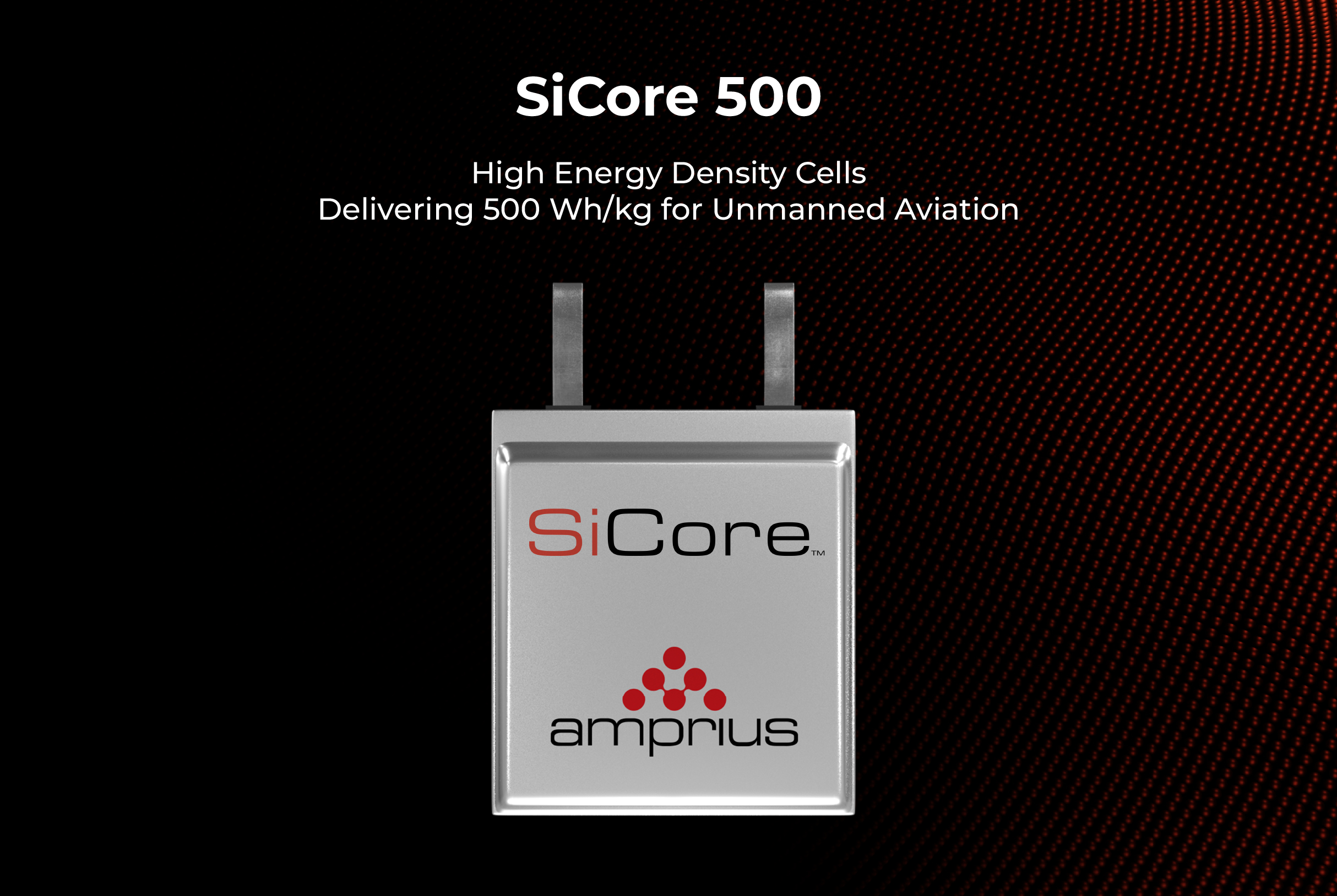
Amprius Unveils 500 Wh/kg Battery Cell for Long-Endurance Aviation
Amprius Technologies has introduced a silicon-anode battery cell capable of reaching 500 Wh/kg at a 1C continuous discharge rate, with the company targeting long-endurance aviation applications including high-altitude platform stations (HAPS) and fixed-wing drones.
The company says the second-generation SiCore cell differs from earlier Amprius batteries that exceeded 500 Wh/kg by being designed for production using conventional lithium-ion manufacturing equipment. Previous cells at this energy density relied on specialised processes and cell construction and were not produced at commercial volume.
The manufacturing approach is significant because increasing battery energy density is only one part of making higher-performance cells commercially viable. Using existing equipment and standard processes could reduce the need for additional manufacturing infrastructure and make it easier to move from customer qualification to larger-scale production.
Amprius expects the new cells to become commercially available in the fourth quarter of 2026. Initial production is planned at the company’s Fremont, California facility, with volume production expected to be expanded through its existing network of contract manufacturers.
The company is initially targeting aviation applications where battery weight has a direct impact on endurance, range and payload. HAPS aircraft, for example, need to store enough energy during daylight hours to support operations after sunset. Higher specific energy can allow aircraft to carry more energy without a corresponding increase in battery weight.
Amprius has supplied batteries to AALTO HAPS since 2018 for its Zephyr platform. AALTO, an Airbus subsidiary, is developing solar-electric HAPS aircraft for applications including connectivity and Earth observation. A 2025 Zephyr flight was reported to have remained airborne for 67 days.
The new cell will be offered in customer-specific formats as well as a standard small uncrewed aircraft systems pouch format defined by SAE JA1016.

