
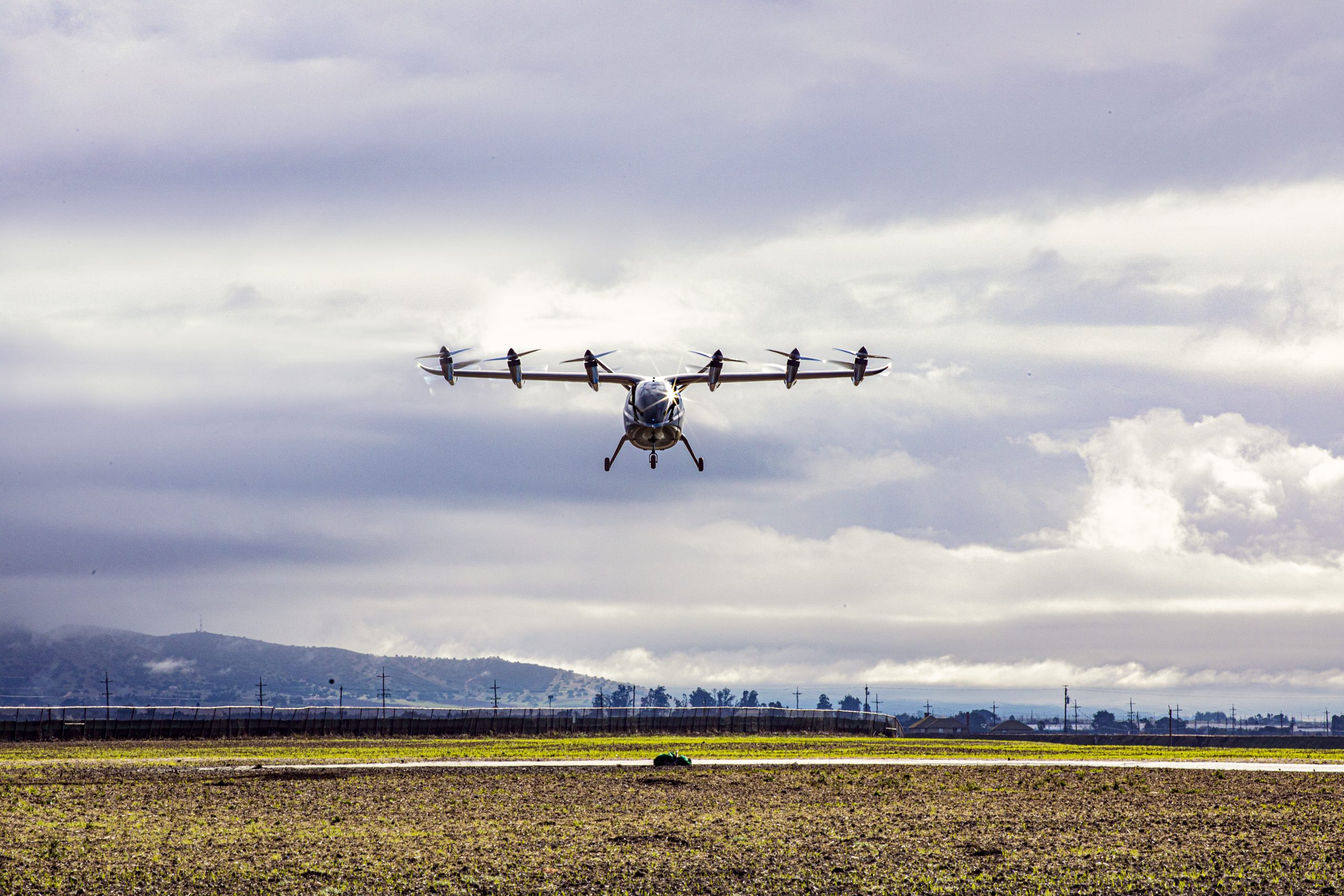
Archer’s eVTOL Aircraft Returns to the Sky
After the recent and surprising departure of Co-Founder and CEO, Brett Adcock, Archer remains on course, determined to gain full certification leading to the start of commercial flights in 2024 via its eVTOL named The Maker.
The craft’s first venture into the skies took place on December 16th, 2021, at 10.30am (PT) when it accelerated off the ground and successfully hovered in-place before returning safely. This also resulted in the checking of the company’s flight control system while in the sky and the end-to-end close of flight software.
Six months later, Archer has resumed flights to trial the first use of its tilt propeller system (TPS) for active control during hover. The website, flyingmag.com, spoke to Chief Engineer, Geoff Bower, who said, “We have now returned Maker to the air with an updated configuration that supports transition flight and the system performed as expected.”

Geoff Bower
He explained the craft remains on track to test full transition from vertical (rotor-borne) to horizontal (wing-borne) flight by the end of this year. Perfecting the transition phase is widely acknowledged to be among the most challenging hurdles in developing eVTOL aircraft.
Archer has announced a series of key data sets that its team will be gathering during these upcoming trials. They include flight mechanics model validation including trim motor RPMs and power draw as a function of airspeed; acoustic data; control system stability margins estimated using system identification methods; and processing data to improve simulation models of vehicle aerodynamics, battery performance and motor efficiency to match flight test data.
Last week, the company which is supported by United Airlines, announced it had hired esteemed aviation executive, Tom Anderson, as its new Chief Operating Officer (COO). Anderson arrives after serving with Airbus, Boeing, Virgin America, ATR Aircraft, and more recently, as COO at Breeze Airways.
“The Maker,” explains flyingmag, “is powered by an assortment of lithium-ion batteries and is designed to cruise at 130 knots with a range of 60 sm. Noise level is expected to be 45 decibels at 2,000 ft agl. It features a v‑tail empennage and a 12-tilt‑6 configuration that includes six prop-rotors to create thrust during horizontal flight.”
Archer has chosen Los Angeles and Miami as its two launch cities where the company has employed its own transport modelling software, Prime Radiant, to decide where to station its initial vertiport operations.
Meanwhile, website www.newatlas.com spoke with Archer’s Director of Business Development, Andrew Cummins, who commented, “We’re focused on a crawl, walk, run approach. In the early years, 2024–25, we’ll launch an initial network with up to five vertiports, just a handful, to prove the operation, prove the routes, prove the demand, and really show communities the benefits we can bring with this urban air mobility service.”

Andrew Cummins
The company has signed a deal to build rooftop vertiports on top of parking garages, although Cummins says the service is likely to begin a little more conventionally. “In the United States, there are over 5,000 public-use airports, and an even larger number of helipads. Some of these are under-utilised and we think may form a strong foundation in the early years. We’re also looking at other types of assets like rooftop decks and parking structures that we can retrofit.”
He continued, “There’s not a lot of difference between an existing heliport and a vertiport of the future with little retrofit and modification required. By sticking a charger on it, maybe a terminal facility for passenger comfort, maybe some line maintenance work and you change the use of that facility. We already have a lot of what we need to get this industry off the ground.”
Archer must then create its own end-to-end transport service, as well as a customer-facing app to make the process as easy as possible.
Cummins pointed out, “Just like any app on your phone, we’ll let you put in your destination, and then we plan a seamless journey for you, door to door. That includes the ‘first mile’ getting you to the vertiport, and whatever mobility option you’d like for the last mile to your final destination.”
He continued, “Right now, many cities in the United States have been built around vehicle ownership. We’ve built a lot of concrete, but our population growth has surpassed the capacity of that concrete. We think there’s a lot of potential here for urban air mobility to complement the existing infrastructure and ease some of the congestion on our roads, while also beginning the decarbonisation of aviation.”
(News Source: https://www.flyingmag.com and https://newatlas.com)
(Pics: Archer Aviation)

