
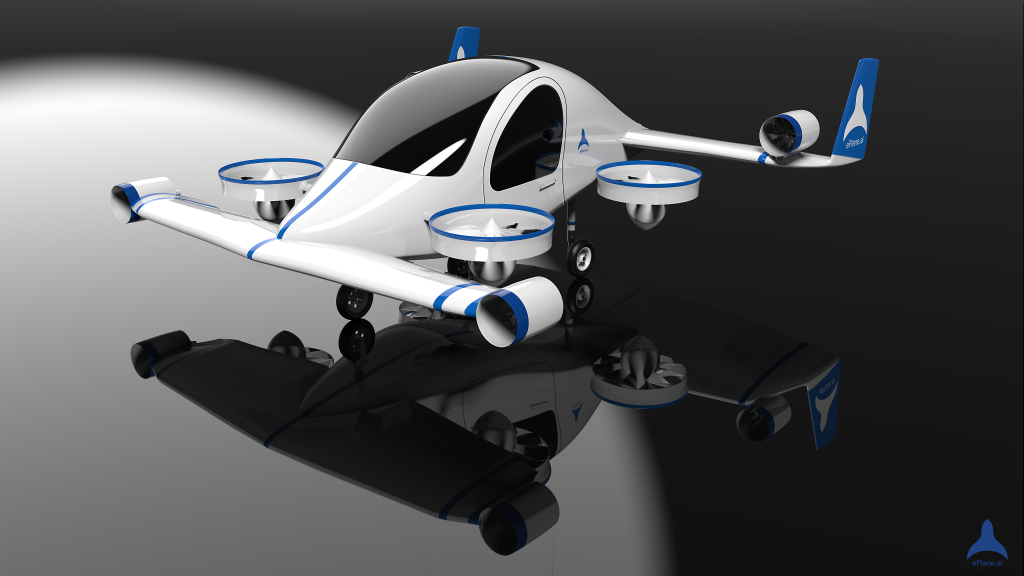
Indian startup ePlane reveals its eVTOL aircraft as it targets door-to-door city transport across Asia-Pacific region
The Asia-Pacific region is regarded by many in the eVTOL aircraft industry to be a key market and looks set to be where the first commercial passenger-carrying services launch in the near future.
With many companies already vying to get a foothold in this lucrative market, one company from India is aiming to be one of them. ePlane is the brainchild of Professor Satya Chakravarthy and Pranjal Mehta, with the business being set up at the Indian Institute of Technology (IIT) in Madras in 2019.
It is developing an electric flying air taxi — called the e200 — which ePlane says can provide ten times faster door-to-door travel at just 1.5x the price. The aircraft aims to replace luxury cars and helicopters, as well as road taxis for a similar price. Additionally, the e200 is also targeting cargo and industrial use cases.
Speaking to eVTOL Insights, Mehta talked more about the background behind setting up the company, the technical aspects of the e200 and the vision for the future.
He said: “We’re trying to build a compact taxi to enable door-to-door travel in cities. This is sort of a unique mission because most of the other companies — which are doing fantastic work — are building very large vehicles that will require a vertiport or helipad. It’ll be like a bus service in the air; not necessarily a personal door-to-door service or a ride-hailing Uber service.
“Satya has been teaching aerospace for 24 years and is a real expert. During his time at IIT, he set up a $30 million combustion research centre which is one of the largest of its kind in the world. Companies such as GE Aviation have been doing work out of this centre, but while this was going on, he realised the world was moving towards an electric future.
“We began talking in 2017 to scope what electric airplanes could do and realised they couldn’t travel very far; we couldn’t electrify the Airbus and Boeing’s of the world because battery technology wouldn’t allow us to do so. And if we were to develop an aircraft as small as a Cessna, it still wouldn’t travel very far.”
Mehta initially looked into setting up a helicopter taxi service company in his hometown of Bengaluru, to try and validate whether people would want to fly in cities. He had a small amount of success, before deciding to build smaller, sub-scale versions of the e200. Both him and Chakravarthy came up with a method of making extremely compact planes which can still go long distances.
“You have the wingless designs like EHang and Volocopter and the fixed-wing plus VTOL where the rotors aren’t tilting, e.g. Wisk,” Mehta said. “Then you have the next generation which is Joby Aviation and Archer tilting the rotors. So we wanted to see how we can avoid tilting, given that tilting comes with a certification challenge, and yet build something that is not too big because in India, we have a large population density. Space is a huge constraint.
“So we said ‘hey, let’s building something that is extremely compact, does not tilt yet gives you sufficient range.’ It’s about four metres wide, which coverts into six by six metres of landing space, and can go 200km with two passengers. I don’t think there is a company in this market which is building anything similar.
“Even though we’re building out of India, we’re not creating something which is a copy of what other companies are doing in the western part of the world. People usually expect us to build a cheaper version, but what we’re actually doing is going further by innovating on the technology and building something that suits the market.”
ePlane has said the idea of its service in India would be making 15km-20km trips across cities, which would offer commuters a sustainable option to ground transportation — especially in a country where its cities suffer from some of the world’s worst congestion. The company’s workforce has already tripled in size, with Mehta praising India’s efforts in the aerospace industry and its calibre of engineering talent.
“Some of the biggest companies in the world have their R&D offices here in India, including Boeing and Airbus. So the planes themselves are built in the USA, but a lot of the work on the aircraft is being done here which some people don’t know about,” he said.
“We went in and starting hiring these exceptionally good engineers, who had been contributing a very small part to a big plane. We flipped the script and said: ‘how would you like to contribute in a big way to a small plane?’ India has a good engineering talent and there is also a good amount of local infrastructure technology and supply chain available to build something like this.”
In terms of a roadmap, ePlane has already built small-scale prototypes but is currently working on a 75 per cent scale which is due to fly in the coming months. A recent surge in local COVID-19 cases has meant a lockdown is now in place in India, but Mehta is confident test flights can begin by August 2021.
A full-scale prototype design is also in development and on course to begin flying by January 2022, with work now under way with the certification authorities in India. Metha added ePlane hopes to achieve certification for its eVTOL aircraft by April 2024, and wants to collaborate with other certification authorities across the world — such as the FAA and EASA.
He said: “If we’re trying to build something compact, we should have a good reason to do it. Other companies want individuals to go from their homes to these vertiports, travel on the aircraft and then do the reverse journey. So it becomes a three-legged journey and that only makes sense when the middle leg leads to enough time saving for you to justify the cost and complexity of the journey.
“You’re not going to do a short distance, because you can just get in your car and drive. A five to 10km journey across three legs does not make sense. The flying taxi has to basically come as close to your home as possible and land either on the lawn, rooftop or driveway. And because our aircraft only carries two passengers, it has a maximum take-off weight of less than 1,000kg, so can land on any building without affecting its structural integrity.”
Looking back on how far ePlane has come along, and its vision to disrupt the eVTOL aircraft market in the Asia-Pacific region, Metha is optimistic and excited for the future. While the e200 will be piloted to begin with, the company hasn’t completely ruled out going down the autonomous route one day in the future.
“If you’re going to work to really tight deadlines, you’ve got to do things the regulators are comfortable with,” he explained. “It’s a well-known industry and regulators aren’t comfortable with doing autonomous certification just yet. But when the regulator allows it, we can do an autonomous version.
“The good thing about the Asia-Pacific region is if you take India and China, those two countries have a third of the world’s population. And if you include the rest of the market, that number will increase further. There are a few companies which are already creating awareness, such as SkyDrive in Japan, Hyundai in South Korea and Wisk in New Zealand.
“I’ve always believed competition is good, because it makes you work harder. But it also drives home the point to the regulator if you have hundreds of companies doing this, rather than one, they will want to move fast. It’s awesome to see so much happening in Asia and we’re excited to be able to get into this market.”
For more information about ePlane and its aircraft, visit https://www.eplane.ai/


