
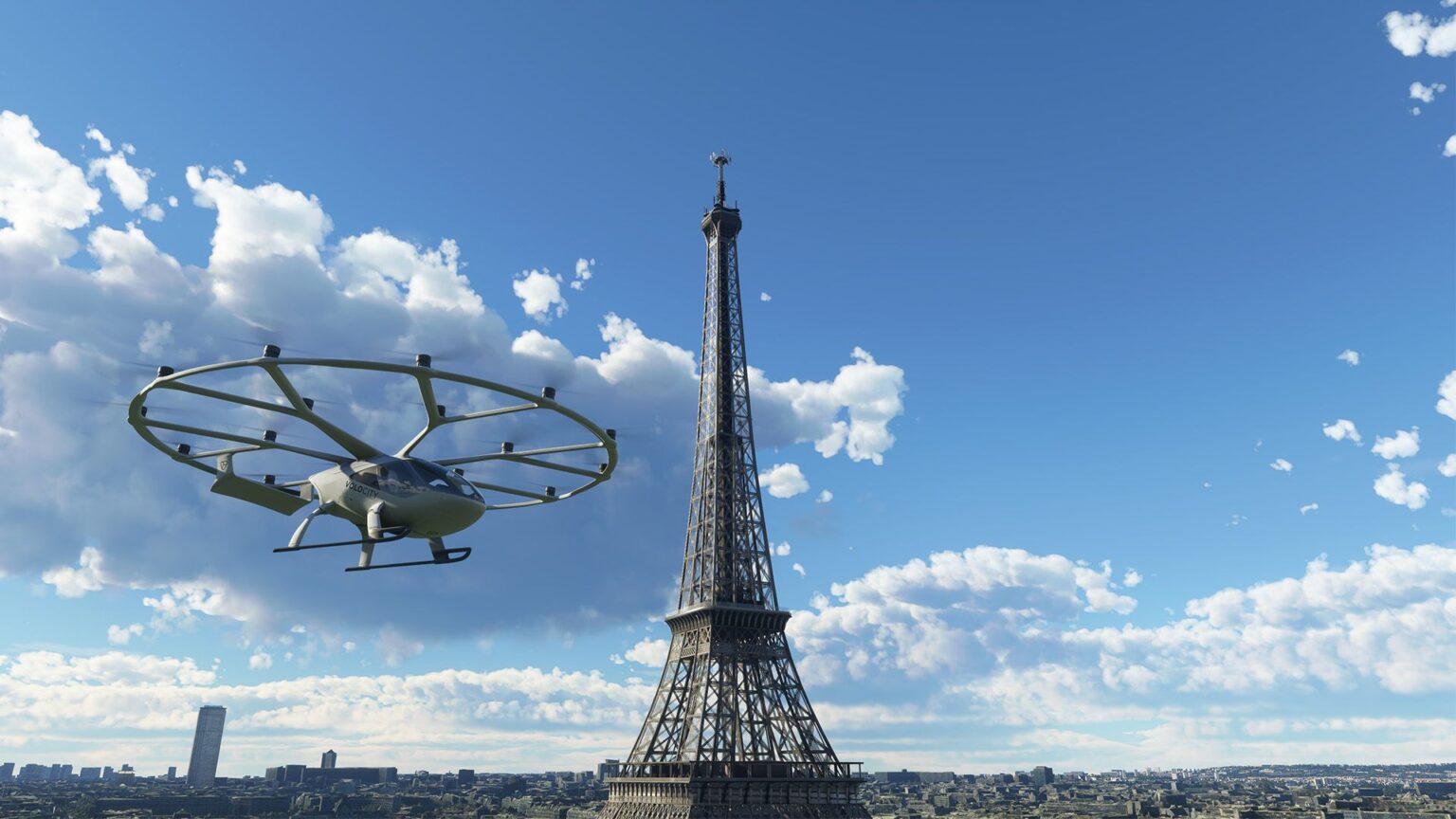
New Study: “Could Wind Blow eVTOL Industry Out of the Sky?”
A recent study looking at the meteorological conditions eVTOLs may face while flying through and above cities offers a chilling warning. Sudden and regular wind gusts can not only form around city buildings, but could be strong enough to destabilise a flying taxi with the potential of knocking it off course, even leading to a potential crash.
As any new industry develops, so potential problems manifest. For example, another recent study has shown the sound of an eVTOL may be magnified while taking off or landing at a vertiport or heliport due to an effect when noise bounces off the ground.
So, the wind problem comes as no surprise, especially as helicopter pilots have faced similar difficulties over many decades when flying through or above mountainous or hilly regions.
A recent paper by Australia-based ‘RMIT University’s Uncrewed Aircraft Systems (UAS) Research Team’, flagged up “the wind problem” after measuring the sudden gusts that form around city buildings.
Lead RMIT researcher and Aerospace Engineer, Dr Abdulghani Mohamed, who’s studied wind gust dynamics for over a decade, says this phenomenon needs to be fully understood and addressed before city skies embrace flying taxis and drones.


Mohamed comments that low-flying aircraft are at risk from gusts because they land and take off at low speed. The RMIT research revealed sudden wind can pose significant safety challenges for air taxis and drones in less than a second.
As a result, these aircraft will need more power for landing or taking off in cities compared with an airport or an open space. This is a major problem for electric-powered aircraft when landing, if the battery charge is depleted after a 30 minute or so journey. Particularly, if it is a delivery drone given its light weight.
Mohamed explains, “These aircraft need powerful motors that can rapidly change the thrust generated by the propellers to rapidly force the vehicle back on-course, a process which requires more energy.”
He continues, “Regulations and certification need to specifically address safe operation when traversing building flow fields.” And argues that site-specific wind simulations and measurements are essential to identify hazardous regions. “As we determine the location of vertiports, we also need to determine hazardous regions to avoid. This will enhance safety and reduce interruption of a fleet due to wind conditions.”
In some countries like Australia, it is not clear whether this responsibility falls under the jurisdiction of the air regulator, CASA, or the Bureau of Meteorology. However, air taxis will need to be provided with weather information at much higher resolution and faster rates than currently possible. This is critical for flight planning.

RMIT Research Team (Dr Abdulghani Mohamed in Pink Shirt)
Mohamed continues, “Purpose-built vertiports mean we can integrate geometric design features to reduce hazardous flow conditions from occurring, where the margin of error is much lower than at airports, where large aircraft can tolerate far stronger gusts. We don’t have that flexibility with air taxis in cities.”
He goes on, “Existing buildings can also be repurposed as vertiports, but may require modifications to improve the aerodynamics near the landing pads. The effectiveness of such design features can be assessed through either scaled experiments in wind tunnels or through full-scale measurements.”
Mohamed concludes, “Extensive wind flow mapping at full-scale will no longer be daunting in the future. We are continuing to develop our wind sensing drones – a swarm of drones instrumented with wind anemometers – to very accurately map around large infrastructure.”
The RMIT researchers say they will continue studying this wind phenomenon with an exploration of different building shapes that may minimise adverse effects. The team are also looking at the sensitivity of light-weight aircraft to gusts and turbulence, as well as flight-stability technologies.
This research was conducted in collaboration with the University of Maryland and Lehigh University and funded by the US Airforce Office for Scientific Research and DSI Group.
The Full Report
https://www.mdpi.com/2504–446X/7/1/22
(News Source:https://remit.edu.au)
(Top Image: “Will Volocity Face Windy Conditions over Paris Next Year?”)
(Other images: RMIT)

