
Vertiports: Building the Legal Infrastructure Urban Air Mobility Needs to Scale
Dr José Ramírez is a Spanish aviation and corporate lawyer with 28 years of legal practice and a member of the Madrid Bar Association (ICAM). He holds an MBA from ESADE, a Master’s in Aviation Management, a PhD in Airport Marketing, and is currently a doctoral researcher in EU aviation competition law. He advises internationally on drone regulation, cross-border aviation law, and European aerospace regulation.
Contact: jose.ramirez@icam.es
—
Cities across Europe are planning vertiport infrastructure. Aircraft developers are progressing through certification. Investors are committing capital. But beneath this momentum, a critical question remains unanswered: who is legally responsible when something goes wrong at a vertiport?
EASA published the world’s first Prototype Technical Design Specifications for vertiports in March 2022 and is developing a comprehensive regulatory framework under Rulemaking Task (RMT) 0230. The technical foundations are steadily being laid.
The Liability Question Nobody Is Answering
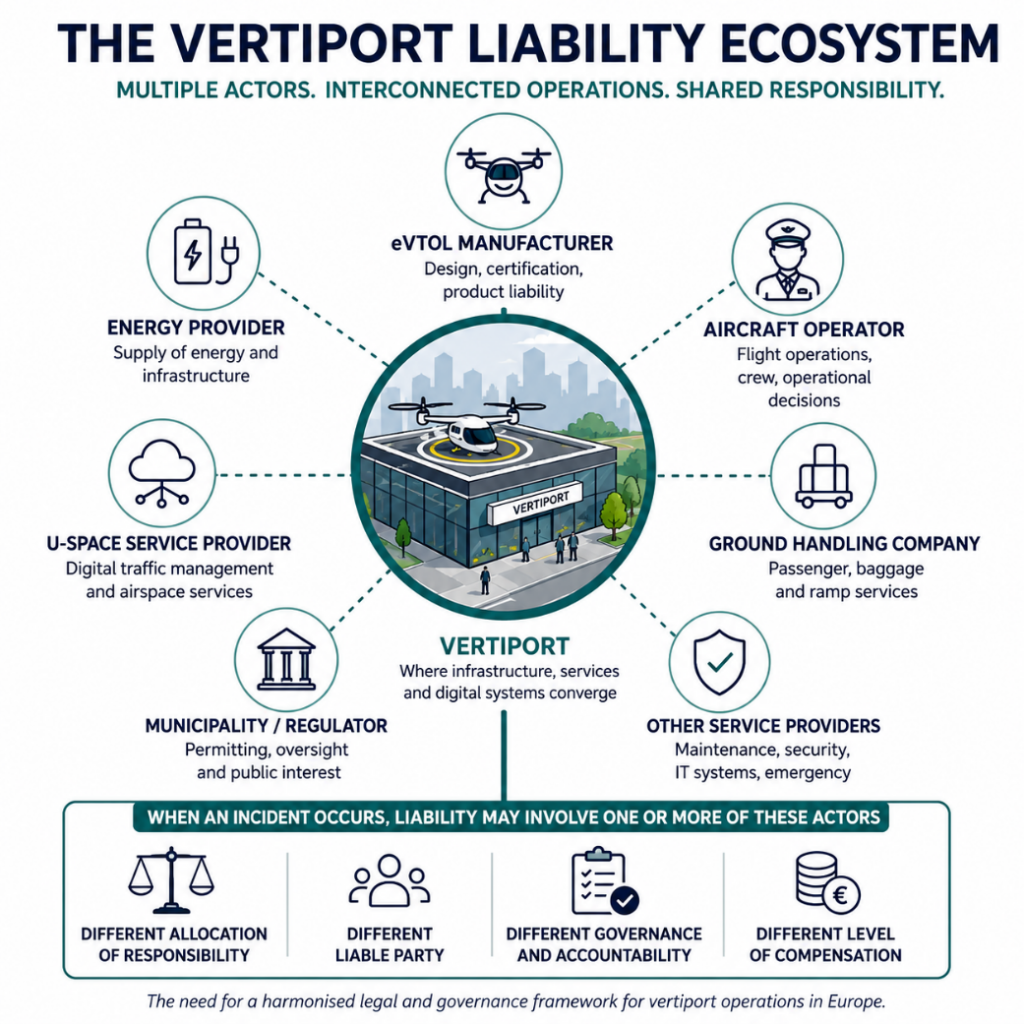
A vertiport is not simply a landing pad. It is a complex operational node where aircraft, ground infrastructure, energy systems, passenger services, digital traffic management, and emergency response converge. When an incident occurs (a landing failure, a battery fire, a ground collision, or a passenger injury), responsibility may involve any combination of the aircraft operator, the vertiport operator, the eVTOL manufacturer, the U‑space service provider, the energy supplier, or the ground handling company.
Yet despite the existence of harmonised EU aviation regulations, there is currently no comprehensive European framework specifically allocating responsibility and liability among the various actors within the vertiport ecosystem.
Instead, national tort law continues to fill that gap differently across Member States. As a result, the same incident at a vertiport in Milan could lead to a different allocation of responsibility, a different liable party, and ultimately a different level of compensation than an otherwise identical incident in Hamburg or Paris.
For cities considering whether to approve vertiport construction, that uncertainty is not an abstract legal issue. It is a planning risk that directly affects investment decisions, public procurement, and long-term operational governance.
Insurance Without a Map
Insurers face a parallel challenge. Vertiport operations combine aviation risk, infrastructure risk, energy risk, cyber risk, and public liability within a single operational environment, a risk profile that traditional aviation insurance products were never designed to address.
Without greater clarity regarding how responsibility and liability are allocated among the different actors operating within a vertiport, insurers face difficulties in pricing products that accurately reflect the underlying allocation of risk. The result, as increasingly seen in other emerging aviation sectors, is that legal uncertainty itself becomes part of the premium, raising costs for operators and potentially slowing commercial deployment.
The recently adopted Product Liability Directive (EU) 2024/2853, which expressly covers software and AI-enabled systems, further broadens the range of potential liability exposure for vertiport operators relying on automated ground management and digital traffic coordination.
The Governance Gap
EASA’s technical specifications address vertiport design: physical characteristics, obstacle-free volumes, visual aids, lighting, and emergency access. These are essential.
But they do not address who bears institutional responsibility for the safe operation of a vertiport as an integrated operational ecosystem. Who is accountable when charging infrastructure fails and an aircraft cannot divert safely? Who is responsible when a vertiport’s digital traffic management system conflicts with the U‑space service provider managing the surrounding airspace? Who ensures the integrity of operational data flowing between interconnected systems operated by different commercial actors?
These are governance questions, not engineering questions. And they remain largely unanswered.
What Needs to Happen
Three steps could significantly improve legal predictability for vertiport development.
First, EASA could consider complementing its work under Rulemaking Task (RMT) 0230 with guidance establishing minimum principles for allocating responsibilities between vertiport operators, aircraft operators, and digital service providers.
Second, municipalities approving vertiport construction need practical guidance on the governance and accountability frameworks that should underpin these facilities ‑before, not after- they are built.
Third, the insurance sector needs vertiport-specific risk categories that better reflect the unique combination of aviation, infrastructure, digital technology, and energy risks these facilities present.
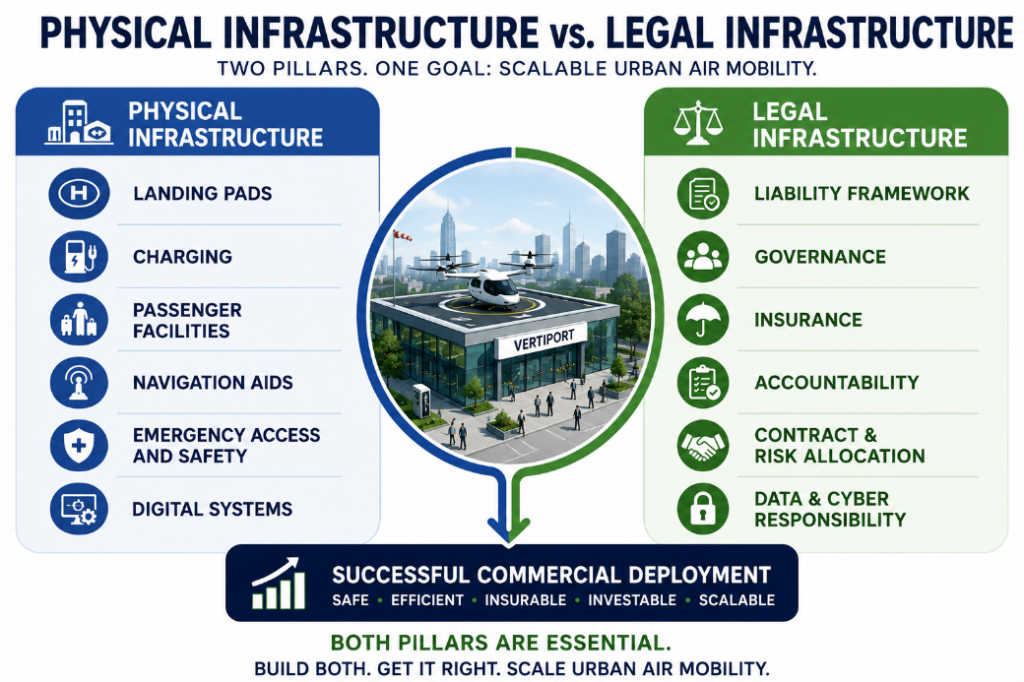
Cities and operators that establish clear governance frameworks early will attract investment faster, secure better insurance terms, and position themselves as preferred launch locations for eVTOL operators. Legal infrastructure is not a cost of doing business. It is a competitive advantage.
Vertiports are where urban air mobility meets the ground, literally and legally. Getting the physical infrastructure right is essential. Getting the legal infrastructure right will determine whether it scales.

