
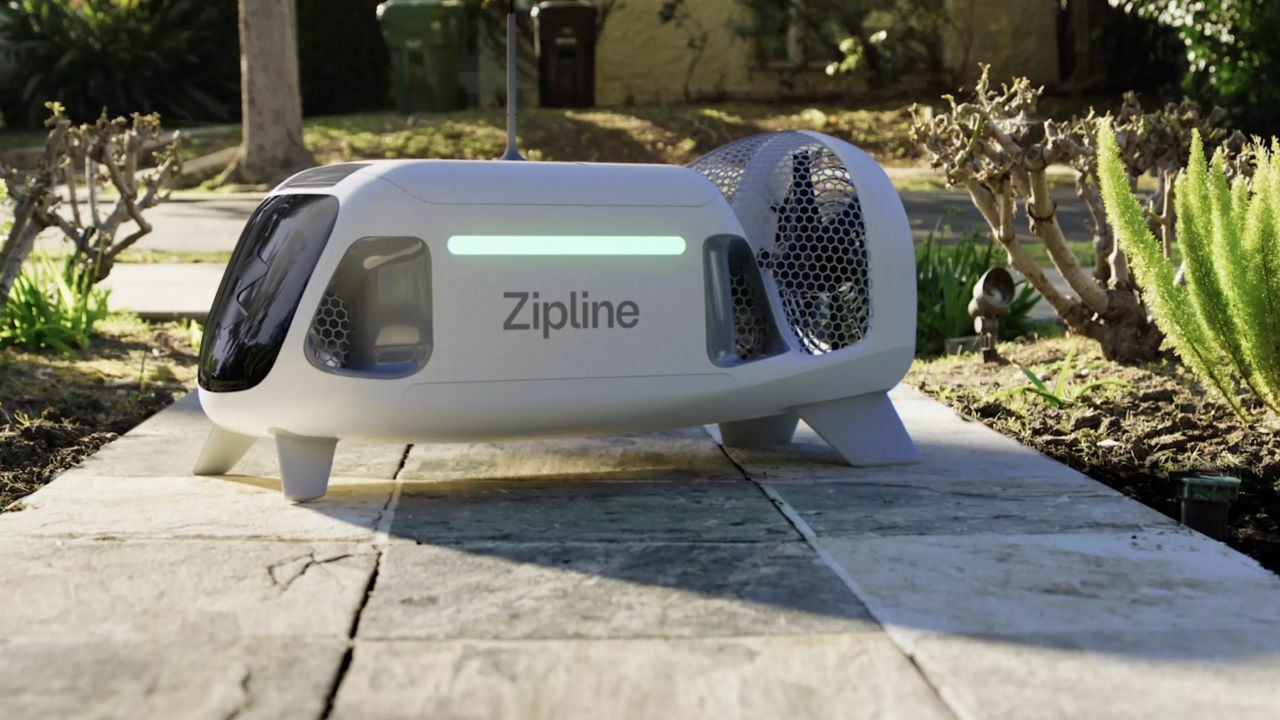
Zipline Unveils NextGen Autonomous Drone Platform, “Very Quiet, Very Precise”
Zipline has unveiled its NextGen Autonomous Drone Platform that, the company claims, “provides quiet, fast and precise delivery directly to homes in cities and suburbs.” Zipline also says the platform “is practically silent (designed to sound like wind rustling leaves), and is expected to deliver up to 7 times as fast as traditional automobile delivery, completing 10-mile deliveries in about 10 minutes,” reports a press release.
The drone delivery company has spent the last several years building and fine-tuning its next-generation technology, Platform 2 (P2), to provide “an optimal customer experience at scale.”
Unlike other drone services, Zipline’s (Zips) fly “more than 300 ft above the ground and are nearly inaudible.” When the Zip arrives at its destination, “it hovers safely and quietly at that altitude, while its fully autonomous delivery droid manoeuvres down a tether, steers to the correct location, and gently drops off its package to areas as small as a patio table or the front steps of a home.” This is made possible through major innovations in aircraft and propeller design.
Various businesses across the healthcare and restaurant sectors have signed on to use Zipline’s new home delivery service. For example, Sweetgreen is collaborating to develop its mission “of connecting people to real food in the U.S”, while moving closer to a pledge of being carbon-neutral by 2027. Sweetgreen customers are able to gain orders using 97 percent less energy than traditional transportation methods.
Jonathan Neman, Co-Founder and CEO of Sweetgreen, commented, “The future of delivery is faster, more sustainable and creates broader access, all of which provides improved value for our customers.” He continued, “Zipline’s sustainable technology and ability to reach customers quickly, with a great delivery experience, will help us give our customers what they want, when they want it.”
Another company primed to employ the service is Michigan Medicine. The pharmacy’s aim is to double the number of prescriptions it fills each year through Zipline. Other healthcare related companies on-board include Intermountain Health and MultiCare Health Systems who plan to deliver prescriptions and medical devices through a network of facilities including hospitals, laboratories and doctors’ offices.

NextGen ‘Zip’ Delivery Droid
Meanwhile, Zipline’s first customer, the Government of Rwanda, is to use the company’s new delivery service to enable urban aerial last-mile delivery to homes, hotels and health facilities in Kigali and elsewhere in the country.
Zipline’s platform includes dual-use docking and charging hardware; software that easily works with third-party inventory management and ordering systems; an intuitive app that allows order tracking down to the second; and an autonomy system that has already guided the flight paths of 40 million commercial miles.
Zipline ’s light docking and charging hardware can be attached to any building or set up as a freestanding structure. A Zip is loaded by a business’ employee who can send off orders in seconds, right from their location, without even having to leave the kitchen, pharmacy or doctors’ office.
The release explains, “Businesses can offer Zipline’s home delivery service in a variety of ways, including native integrations into apps and websites, white labeled opportunities, and by joining Zipline’s marketplace. Customers can make on-demand orders, or schedule the exact time they’d like their package to arrive, down to the second.”

Each P2 Zip has a 10-mile service radius while carrying a 6–8 lb payload for out-and-back deliveries from a single dock. Alternatively, it can also fly up to 24 miles one way from dock to dock, charging at each one, before picking up its next delivery. Because Zips can move from dock to dock, the drones are able to respond to peak order times, ensuring there’s enough capacity for an urgent prescription delivery, a weekday lunch rush, or a busy Friday pizza night.
Keller Rinaudo Cliffton, co-Founder and CEO of Zipline, commented, “Over the last decade, global demand for instant delivery has skyrocketed, but the technology we’re using to deliver is 100 years old. We’re still using the same 3,000-pound, gas combustion vehicles, driven by humans, to make billions of deliveries that usually weigh less than 5 pounds. It’s slow, it’s expensive and it’s terrible for the planet.”
He continued, “Our new service is changing that and will finally make deliveries work for you and around your schedule. We have built the closest thing to teleportation ever created – a smooth, ultrafast, convenient, and truly magical autonomous logistics system — that serves all people equally, wherever they are.”
Initially, Zipline is to conduct a series of trials this year involving more than 10,000 test flights using around 100 aircraft. The first actual customer deployment of P2 will follow shortly afterwards.

Zipline’s safety record has been proven over the past seven years of operations with more than 500,000 commercial flights. The company aims to complete 1 million deliveries by the end of 2023 and by 2025 expects to operate more flights annually than most airlines.
Its long-range platform, P1, has autonomously already flown 40 million miles worth of commercial deliveries through all kinds of weather without a safety incident, the vast majority of which were BVLOS flights.
For more information

