
AirIndex and Aeroberm™ Partner to Address the Hidden Infrastructure Crisis Facing Advanced Air Mobility
AirIndex and Aeroberm™ — a Skyportz Australia company — will work together to address what they say is one of the least-discussed but most consequential barriers to Advanced Air Mobility deployment; the gap between where helicopters land today and where eVTOL aircraft can safely land tomorrow.
The partnership will combine AirIndex’s authoritative audit of U.S. vertical-lift infrastructure with Aeroberm™ — the world’s first patented modular vertipad system.
The Data Problem
AirIndex’s independent analysis of the FAA’s Airport Master Record — the authoritative federal database of U.S. heliports — has found four systematic failures in the national landing infrastructure record.
Of the 5,647 registered U.S. heliports, 98.5 percent have never been independently field-inspected. The owners simply supplied the data. More than 1,121 hospital helipads operating today have no FAA registration on file within a nautical mile.
Facilities have moved — for example, from ground to rooftop — while the federal record updated only partially, leaving recorded elevations, approach geometry, and obstruction data quietly drifting from physical reality. And in some cases, the coordinates are simply wrong: one Nashville heliport has been plotted 48.5 nautical miles from its true location since 1979.
The consequence of these failures has been manageable in the helicopter era, where pilots exercise direct judgment about landing surfaces. It becomes acute in the eVTOL era, where automated and semi-automated flight operations assume the landing surface is exactly where the record says it is, exactly the size the record says it is, and clear of obstructions.
The Size Problem
Even where the record is accurate, the infrastructure itself presents a fundamental challenge. Of the 5,594 registered U.S. heliports with recorded pad dimensions, the median pad size is just 48 feet.
Under FAA Engineering Brief 105A — the current guidance document for eVTOL landing areas — a compliant final approach and takeoff (FATO) area requires a load bearing area approximately double the aircraft reference dimension, putting typical minimums at 100 feet and above.
More than half of all registered U.S. heliports are, on the basis of recorded dimensions alone, too small for eVTOL operations under current criteria. And those dimensions sit on top of a record that is 98.5 percent uninspected.
The assumption that existing helipads will simply become vertiports as air taxis arrive is not supported by the data. The infrastructure transition from helicopter-era pads to eVTOL-capable vertipads requires active engineering — not just regulatory redesignation.
Alan Holmes, Founder & CEO, Vertical Data Group / AirIndex, said: “The federal landing record was built for a world where pilots looked out the window and made judgment calls. Automated eVTOL flight assumes the record is right: the location, the dimensions, the obstructions. Our analysis shows it frequently isn’t. This partnership means we move from measuring the gap to closing it.”
The Downwash Problem
Size is not the only issue. eVTOL aircraft, just like helicopters generate aerodynamic forces on the landing surface in the form of downwash and outwash. Multi-rotor eVTOL configurations have been shown to produce downwash and outwash of greater velocities that extends significantly beyond the aircraft’s landing area footprint, creating hazard zones for ground crew, passengers, and bystanders.
The FAA’s own full-scale outwash measurements, conducted in December 2024, confirmed velocities at the pad perimeter exceeding the 34.5 mph threshold identified in Engineering Brief 105A as the threshold for significant hazard.
Vertiport designs that simply repaint a helipad “H” and call it a vertipad “V” are not solving the problem — they are inheriting it.
The Aeroberm™ Solution
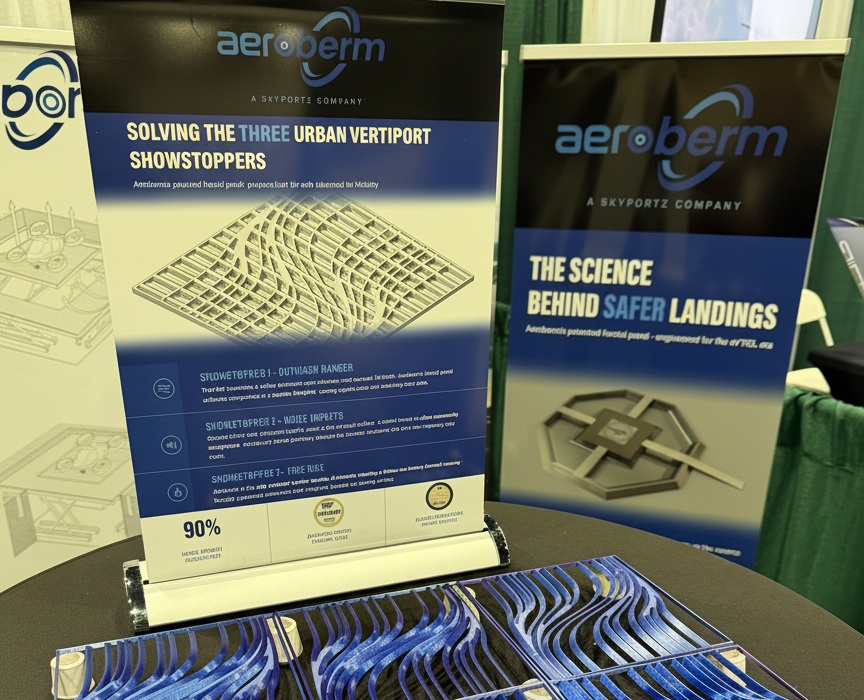
Aeroberm™ is the world’s first patented modular vertipad system, specifically engineered to address the three technical barriers that have blocked urban vertiport approval globally: rotor downwash and outwash hazard at the landing surface, rotor noise amplification in ground effect, and lithium-ion battery thermal runaway fire safety.
The Aeroberm fractal panel system — validated by Large Eddy Simulation CFD research conducted by Swinburne University of Technology, Australia— dissipates rotor wake energy approximately 90 percent faster than flat tarmac, significantly reducing outwash velocities at the pad perimeter and the hazard zone around landing operations. The system is modular and deployable on existing concrete surfaces without bespoke construction, making it a pathway to retrofit existing helipads that are physically adequate but aerodynamically unsuitable for eVTOL under current safety criteria.
For existing helipads that fall short of eVTOL dimensional requirements, Aeroberm’s modular system may offer a viable retrofit pathway — provided the underlying structure can carry the load and airspace is clear — delivering compliant infrastructure at a speed and cost that bespoke construction cannot match.
Clem Newton-Brown, Founder and CEO of Skyportz Australia and creator of the Aeroberm™ patent, said: “The AirIndex research makes something explicit that the industry has been dancing around. The existing helipad record is not a reliable foundation for eVTOL planning.
“And even where pads are real, inspected, and correctly recorded, most of them are the wrong size and none of them are engineered for the aerodynamic reality of multi-rotor eVTOL. Aeroberm was designed specifically for this gap.
He added: “The partnership with AirIndex means we can now identify which existing facilities are candidates for retrofit, what engineering intervention each one needs, and deliver a modular solution that meets the emerging regulatory standard at an affordable cost”
Industry Perspective
Rex Alexander, President of Five Alpha LLC, said: “The vertical flight data integrity issue is not unique to the United States; similar challenges have been observed in numerous countries around the world. It is also not an FAA-generated problem. The FAA has not been granted comprehensive federal oversight authority over most private-use aviation facilities comparable to its authority over certificated public-use airports. As a result, there has historically been limited funding, staffing, and regulatory incentive to systematically verify and maintain accurate infrastructure data for thousands of private-use vertical flight facilities.
“A significant regulatory gap exists because many private-use facilities that support commercial aviation activities, including hospital heliports and other facilities supporting commercial air operations, are not subject to comprehensive federal infrastructure standards or routine inspection programs. Consequently, the FAA generally lacks direct authority to compel private-use facility owners to comply with FAA heliport design guidance and infrastructure standards unless specific regulatory or operational circumstances apply.
“Until such time as Congress provides additional statutory authority and funding to address these issues, the FAA’s ability to systematically improve the accuracy, completeness, and verification of vertical flight infrastructure data will remain limited.”
The Partnership
The AirIndex–Aeroberm partnership combines AirIndex’s provenance-anchored, multi-source audited database of U.S. vertical-lift infrastructure with Aeroberm’s modular vertipad engineering to offer a systematic retrofit assessment and deployment capability for existing helipad operators, hospital systems, airport authorities, and AAM operators seeking to establish vertiport networks on existing infrastructure.
The partnership will initially focus on the United States market, where the AirIndex dataset provides full national coverage, before extending to international markets.


