
Alaska Airlines and ZeroAvia to develop world’s largest zero-emission aircraft
Alaska Airlines presented to ZeroAvia a Dash 8 Q400 regional turboprop that will be retrofitted with a hydrogen-electric propulsion system at ZeroAvia’s Paine Field research and development site.
High school students from Raisbeck Aviation High School, Washington State Governor Jay Inslee, Congresswoman Suzan DelBene and Snohomish County Executive Dave Somers participated in the formal handover of the 76-seat Q400 aircraft that will be developed by ZeroAvia.
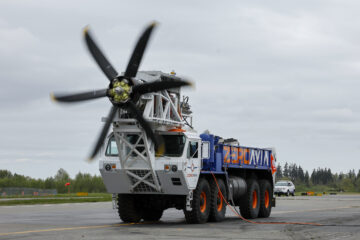
ZeroAvia also debuted its 1.8 MW modular electric motor system in a prototype configuration at the event, demonstrated with a propeller spin aboard the ZeroAvia’s 15-ton HyperTruck ground-test rig.
Combined with higher temperature PEM fuel cells and advanced power electronics, the motor is one of three key building blocks for enabling commercially-relevant hydrogen fuel cell engines in larger aircraft.

Alaska Airlines CEO Ben Minicucci said: “Alaska Airlines has defined a five-part journey to achieve net zero carbon emissions long-term, but we cannot get there alone. New technologies are required to make that future possible.”
Coupling ZeroAvia’s powertrain to the Dash 8–400 airframe will produce an aircraft around five times more powerful with fuel cell engine technology than has been demonstrated anywhere to date.
ZeroAvia founder and CEO Val Miftakhov added: “Launching this programme puts us on track for a test flight next year, and accelerates our progress toward the future of zero-emission flight for Alaska Airlines.”
ZeroAvia’s hydrogen-electric engine uses fuel cells to generate electricity from hydrogen fuel, before using that electricity to power electric motors which turn the aircraft propellers.
The certifiable ZA2000 system will include ZeroAvia’s high temperature polymer electrolyte membrane (PEM) fuel cells and liquid hydrogen fuel storage to deliver the necessary energy density for commercial operations of large regional turboprops.
Washington State Governor Jay Inslee continued: “Our state has a rich history of leadership in aerospace and we’re proud to be at the center of a technological revolution in zero-emission flight.”
Congresswoman Suzan DelBene concluded: “We must prioritise decarbonising the commercial transportation sector. The Alaska Airlines-ZeroAvia collaboration could revolutionise the aviation industry.”
The 1.8MW motor configuration consists of two ‘HyperCore’ modules, each consisting of 900kW permanent magnet radial flux motors at 20,000 rpm and providing 15kW/kg motor power density.
Last month, ZeroAvia partnered with Absolut Hydrogen to develop liquid hydrogen, production, storage and refuelling at airports for powering up to 80-seat aircraft by 2027.

