
Analysis reveals post-pandemic growth in Canadian business aviation market
New research by Horizon Aircraft has revealed that Canada is seeing strong growth in its business aviation sector. In 2022, there were 182,354 business aircraft departures in Canada, which was 35.63% more than in 2019 (before the pandemic) when the corresponding figure was 134,445. Globally, there was a rise of 16.78% in the number of business aircraft departures between these two years.
The study showed that the Canadian business aviation sector continues to grow in 2023. Between the 1st of January 2023 and the 1st of May 2023 there were 53,824 business aircraft departures in Canada; a rise of 2.85% over the same period from last year. The corresponding figure globally is ‑3%. Canada continues to be a thriving business aviation market.
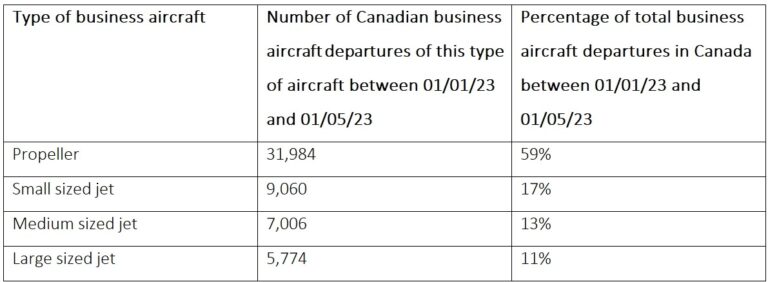
Of the types of business aircraft flown in Canada during the first four months of this year, 59% were propeller, 17% were small jets, 13% were medium sized jets and 11% were larger jets.
Brandon Robinson, CEO of Horizon Aircraft, said: “Canada’s business aviation market both directly and indirectly supports over 40,000 jobs, and contributes as much as $5 billion to GDP.
“Many business executives and high net worth individuals flew privately for the first time during the pandemic and now don’t want to go back to using commercial aviation. However, the biggest driver of growth has been the strong economic performance of Canada.
“The country has solid economic fundamentals, including robust population growth, a strong labour market, and a well-regulated and capitalised financial system. In 2022, Canada’s economy posted the fastest growth in the G7.”
The Horizon Aircraft Cavorite X5 eVTOL is built for longer-range regional passenger, cargo and special missions, and will fly at lower cost. It will have a maximum passenger capacity of four plus a pilot, a payload of 500 kg, and a range of 800 km with full fuel reserves.
Horizon’s technology allows the X5 to fly 98% of its mission low-drag like a traditional aircraft, making it easier to certify than radical eVTOL designs. The full-scale aircraft will be powered by a hybrid electric system that can recharge the battery array in-flight while providing system redundancy.
The X5 design has won several grants including a US Department of Defence advanced research and development contract award, being ahead with a large-scale prototype already flying.
Last month, Horizon Aircraft successfully completed initial transition flight testing of its Cavorite X5 half-scale eVTOL prototype at Ontario Tech University’s ACE Climatic Wind Tunnel in Canada.

