
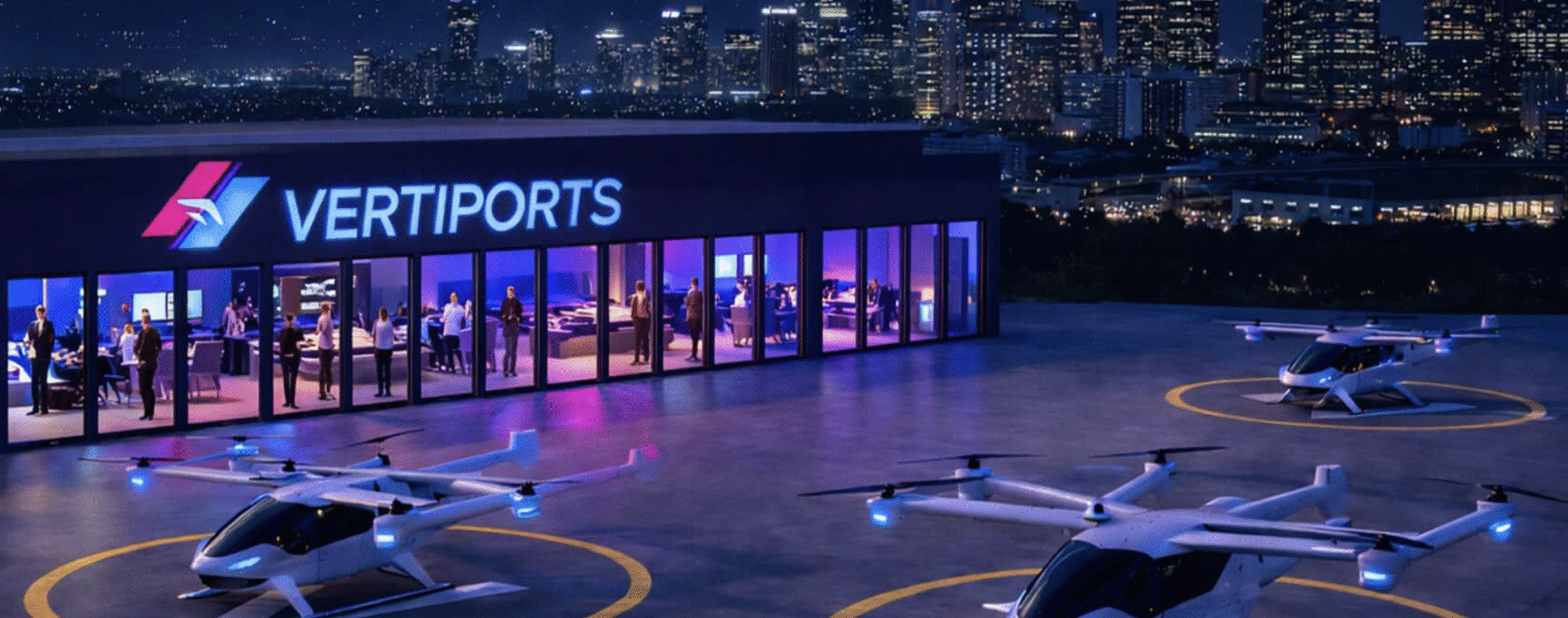
Building the Foundations of Advanced Air Mobility: An Interview with Michael Proffitt, Chairman of Vertiports UK
While much of the attention surrounding advanced air mobility (AAM) has focused on the aircraft themselves, Michael Proffitt, Chairman of Vertiports UK, believes the industry’s success will ultimately depend on the infrastructure supporting those vehicles.
Speaking on a recent episode of the eVTOL Insights Podcast, Proffitt explained that although aircraft manufacturers have made significant progress towards certification and commercialisation, the sector cannot move forward without safe and well-planned operating environments.
“We hear so much about the aircraft being developed,” he said. “There’s a lot of publicity, and there’s also been a lot of hype over the last few years. But it’s all beginning to come together now, and there are a number of very serious eVTOL manufacturers out there.”
However, he stressed that certified aircraft alone will not be enough to launch commercial operations.
“Once these aircraft are certified and mass production starts, it’s going to be impossible for these aircraft to operate unless there’s a safe environment to operate from. That’s where the vertiports come in.”
Although airports will play an important role, Proffitt believes the future network will extend well beyond traditional aviation infrastructure. Early services are expected to focus on air taxis before expanding into regional connections, making dedicated vertiports essential for delivering the speed and efficiency that the sector promises.
“The operations will not fly, if you’ll excuse the pun, if the infrastructure is not available,” he said.
Beyond physical landing sites, Proffitt emphasised that Vertiports UK is taking a much broader view of the ecosystem required to support commercial AAM operations. The company’s work extends beyond designing vertiports to ensuring that every element needed for successful operations is considered well in advance.
“We’re not just focused on vertiports,” he explained. “What we’re looking to do is create the whole ecosystem that goes around the successful launch of these operations.”
That ecosystem includes reliable charging infrastructure for electric aircraft, ensuring sufficient electrical capacity as operations scale, maintenance facilities, planning considerations, and the management of low-altitude airspace.
While initial operations may place relatively modest demands on the power grid, Proffitt noted that future growth will require careful planning to ensure energy availability keeps pace with increasing aircraft numbers.
One of the most significant challenges remains integrating eVTOL aircraft into the UK’s low-altitude airspace. Vertiports UK has been working closely with the UK’s National Air Traffic Services (NATS), while the Civil Aviation Authority continues to develop the regulatory framework needed to support these new operations.
“The whole infrastructure is going to be critical,” Proffitt said. “The airspace, I think, is still a key issue that has to be resolved.”
He also highlighted the practical considerations that potential vertiport locations must address, including planning permissions where permitted development rights do not already exist.
“What we’re trying to engage with airports and off-airport locations is saying that, as and when this comes live, all of these things need to be in place. We need to be working on it now to be able to have everything ready for when the mass production of these eVTOLs actually starts.”
A major part of Vertiports UK’s current activity involves conducting detailed feasibility studies across potential locations. Rather than simply identifying sites for vertiports, these studies assess how each location could fit within a wider network, analysing surrounding communities and identifying the most commercially viable routes.
“The feasibility studies are taking the location, analysing the location, analysing the area surrounding that location, and actually trying to work out where the 10 or 20 most significant routes would be,” Proffitt explained.
He believes this network approach is fundamental to making advanced air mobility commercially successful.
“There’s no point developing one vertiport in isolation,” he said. “When this gets up and running in the UK and across other countries, you’re going to have a network of vertiports. Obviously, you’ll be travelling from one vertiport to another.”
One example is the company’s work around Doncaster Airport, where future passenger and cargo operations present an opportunity to integrate vertiport infrastructure into the airport’s long-term development plans. Proffitt believes airports need to consider how eVTOL operations will fit within their broader masterplans rather than treating them as standalone projects.
“The work we’re doing on these feasibility studies is actually going in depth with the location to identify how the eVTOLs will actually operate,” he said.
Looking ahead, Proffitt also sees significant opportunities beyond passenger transport. Vertiports UK has increasingly expanded its focus to include drones, recognising that uncrewed aircraft may reach widespread commercial deployment sooner than passenger-carrying eVTOLs.
“We’re not just looking at the eVTOLs; we’re also now looking at drones,” he said. “This is another interesting development in this whole electric vertical take-off space.”
While challenges surrounding beyond visual line of sight (BVLOS) operations and low-altitude airspace remain, Proffitt believes drone operations, air taxis and regional passenger services represent successive stages in the evolution of advanced air mobility.
“The feasibility studies we’re doing are working very closely with the airport and surrounding destinations to build up a view of how the operations would start up and how they would develop over time.”
For Proffitt, the industry’s future depends not only on innovative aircraft but on creating the infrastructure, regulation and operational ecosystem that will allow those aircraft to fly safely and efficiently. As commercial eVTOL operations move closer to reality, he believes preparing that foundation today will determine how quickly advanced air mobility can scale tomorrow.

