
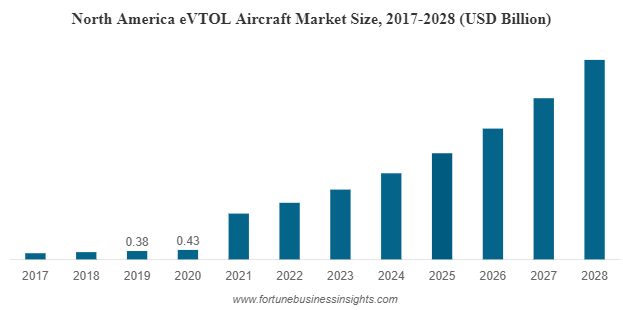
EVTOL Aircraft Market Size To Hit USD 23.21 Billion by 2028
According to Fortune Business Insights, the global EVTOL Aircraft Market Size is projected to reach $23.21 Billion by 2028, at a CAGR of 23.13% during forecast period 2021–2028.
Growing urbanisation, increasing traffic congestion, and the need for smarter transportation solutions are some of the major factors propelling the market forward with demand powered by increasing demand for urban air mobility, growing awareness regarding carbon footprint, and the need to cut aircraft operating costs.
The aviation sector suffered significant disruption during the COVID-19 pandemic, but investments remained strong in several regions. The list of key players profiled include Kitty Hawk, Lilium, Ehang, Volocopter, Bell Textron, Airbus, Beta Technologies, Joby Aviation and Urban Aeronautics.
Based on lift technology, the market is divided into vectored thrust, lift plus cruise and multirotor. By mode of operation, the market is segmented into autonomous, semi-autonomous and piloted.
In terms of range, the market is bifurcated into up to 200 km and 200–500 km, while on the basis of maximum take-off weight (MTOW), the market is divided into less than 250 kg, 250–500 kg, 500‑1500 Kg and greater than 1500 kg.
By propulsion type, the market is split into battery-electric, hydrogen-electric and hybrid-electric, while by application, the market is broken down into commercial, military and emergency medical service. Geographically, the market is segmented into North America, Asia Pacific, Europe and the rest of the world.
Major aircraft makers such as Airbus SE, Boeing Company, and Bell Helicopter, are accelerating ongoing eVTOL development programs. Automotive giants are also entering the space and in January 2020, Toyota invested $400 million in eVTOL startup Joby Automation.
The market in Asia Pacific will grow on account of growing investments by eVTOL companies, such as Ehang, in urban air mobility. Europe will record notable gains driven by government initiatives such as the Urban Air Mobility (UAM) Initiative.

