
“eVTOL Propellers Louder Over Ground,” Say Researchers From Bristol University
One of the eVTOL Industry’s major selling-points apart from its green credentials, is how quiet these new aircraft are compared, to say, helicopters. 100xs time quieter is the often used phrase. Researchers from Bristol University in the Aeroacoustics Department, decided to look further into the all-important noise issue. After extensive research, the Uni’s findings were published last week in the Journal of Sound and Vibration.
The team found clear differences in the noise characteristics of propellers when over ground, known as ‘Ground Effect’, compared to when operated normally. They noted an overall noise increase when measuring at angles above the ground, with hydrodynamic and acoustic interaction effects being a key factor to the overall noise trends.
The findings state, “It is hoped this research, tested in the National Aeroacoustic Wind Tunnel facility, can inform strategies to reduce the noise of aircraft.”

Propeller in Wind Tunnel (Credit: Liam Hanson)
Lead author, Liam Hanson of Bristol Department of Mechanical Engineering, explained, “In light of the need for greener aviation, there has been a push in this industry to develop electrified aircraft, where there are a lot of potential benefits. However, if urban air services such as on demand air taxis are to become a reality within city limits, engineers must tackle the issue of sound pollution, generated by propellers.”
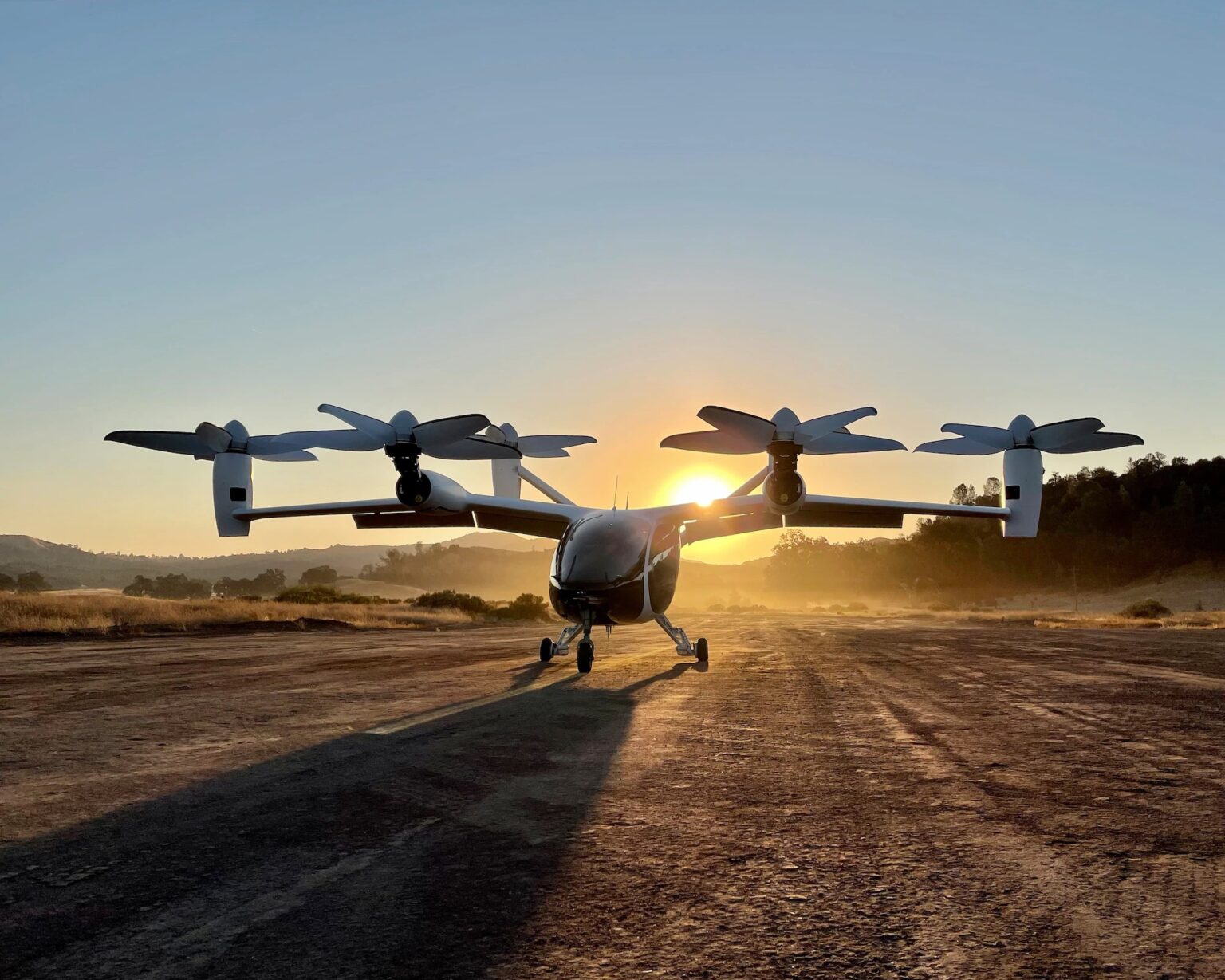
Companies like Joby place great pride in the quietness of its craft. Back in May, 2022, after two weeks of rigorous acoustic testing alongside NASA, Joby’s aircraft was shown to have met the revolutionary low noise targets the company set for itself.
The aircraft registered the equivalent of 45.2 A‑weighted decibels (dBA) from an altitude of 1640 feet (500 metres) at 100 knots airspeed, a sound level which Joby believes will barely be perceptible against the ambient environment of cities.
NASA engineers also measured the aircraft’s acoustic profile during planned take-off and landing profiles to be below 65 dBA, a noise level comparable to normal conversation, at a distance of 330 feet (100 metres) from the flight path.

(Credit: Joby Aviation)
This led company CEO and Founder, JoeBen Bevirt, to proudly state that its aircraft, even from close distance, sounded more like “the rustling of leaves”. He enthusiastically commented, “We’re thrilled to show the world just how quiet our aircraft is by working with NASA to take these measurements. With an aircraft this quiet, we have the opportunity to completely rethink how we live and travel today, helping to make flight an everyday reality in and around cities. It’s a game-changer.”
What makes Joby different from, perhaps, some of its rivals, is that “from day one, the Joby aircraft was designed with acoustics in mind, with the number of propellers and blades, blade shape and radius, tip speeds, and disk loading of the aircraft all selected to minimise its acoustics footprint and improve the character of the sound produced,” explains a feature on the Joby website.
It continues, “Each of the six propellers can also individually adjust its tilt, rotational speed, and blade pitch to avoid blade-vortex interactions that contribute to the acoustic footprint of traditional helicopters.”
https://www.jobyaviation.com/news/joby-revolutionary-low-noise-footprint-nasa-testing/
What the recent Bristol University research shows and, no doubt, confirms for some noise pollution experts, is that it is closer to the ground, where the primary sound occurs. This means that vertiports, converted heliports, drone hubs and other take-off and landing areas are where the primary acoustic footprint for Advanced Air Mobility (AAM) will occur and not in the sky when flying overhead.
The report states, “These aircraft can be broadly considered to fit under three different categories. The first is Electric Vertical Take-Off and Landing (eVTOL) aircraft which is focussing on Urban Air Mobility (UAM) applications such as air taxis, patient transfers, rooftop-to-rooftop trips within cities and airport transfers.
“The second category is Electric Conventional Take-Off and Landing (eCTOL) aircraft which is being developed for Regional Air Mobility (RAM). RAM focusses on cargo deliveries, short-range flights and passenger transfers from rural regions.
“The most commonly recognisable electric aircraft, small Unmanned Aircraft Systems (sUAS) or drones, can be considered the third category which focusses on videography, small package delivery and medical supply transfer.”
Mark Moore, CEO and Founder of Whisper Aero and an expert on eVTOL and drone noise, has been banging the drum on this exact point. In a major feature published in evtolinsights.com, back in early March, he said, “I admit I have strong views over aircraft quietness, but this is for a good reason. Community acceptance is critical if this new industry is to succeed.
“I have talked to cities about noise levels and what they will and won’t accept. The truth of the matter is, there’ll be quotas over how much noise a vertiport may accept. If noisy the aircraft will be allowed only a few operations. If really quiet, many more operations. Therefore, what revenue a company can attract is dependent on how quiet its craft is.” Adding, “By 2027/28 when companies begin scaling manufacturing, if they don’t have quiet aircraft, their business could be severely jeopardised.”
And this encapsulates the eVTOL and Drone Industries biggest challenge. It is not the noise in the air that may be the problem, but that created during the take-off and landing process. If air taxis and drones are to regularly fly over city centres and urban areas in the future, the placement of vertiports and drone hubs becomes critical. Yet, how can this be done where space is at a premium and potential areas are surrounded by many people.

(Credit: Bristol University)
For, as eVTOL and sUAS aircraft are taking off or landing from a vertiport or general landing pad, the propellers are likely to experience Ground Effect (GE), an aerodynamic phenomenon which changes their performance. This change via GE alters the acoustic performance of the propellers and causes complex interactions.
Hanson continued, “Until now, no literature existed for the problem of isolated propeller noise in Ground Effect. Our research sought to answer for the first time what happens to propeller noise while it operates in GE and what are the key acoustic and aerodynamic interactions which are most important to understand.
“We have comprehensively measured the noise of small-scale propellers during take-off and landing while interacting with the ground. It is clear we can expect louder eVTOL aircraft during take-off and landing if these complex interactions with the ground are not considered.” Based on their new understanding, the researchers are now conducting additional tests on different methods to potentially reduce the noise of the entire system.
One obvious step is to create vertiports and drone hubs high up in a city, to reduce the noise from the ground and why transforming existing heliports or creating new vertiports on top of high buildings is one potential step. As the report points out, “(It is about) either changing the design of the landing pads or altering the design of proposed aircraft architectures.” If constructed on the ground, then some form of acoustic dampening could be considered?

(Credit: Bristol University)
Already, drone delivery companies like Manna Aero and Wing have become aware of the noise problem when placing hubs close to buildings and people. The constant take-off and landing noise which some describe as sounding like the “whine of a mosquito” or the “buzzing of a swarm of bees” has led to complaints from the public. For as the report suggests “the smaller propellors lead to noise characteristics very different from the existing knowledge.”
In an ideal world, take away the propellor altogether and create a new form of silent transportation power. Unfortunately, that is not possible at this early stage of the eVTOL/Drone industry development.
Obviously, a lot more research must be done to find ways of lessening the noise footprint at vertiports and drone hubs, otherwise, public complaints may only increase as the industries expand.
For more information
Journal of Sound and Vibration
(News Source: https://www.bristol.ac.uk)
(Top image: Joby Aviation)

