
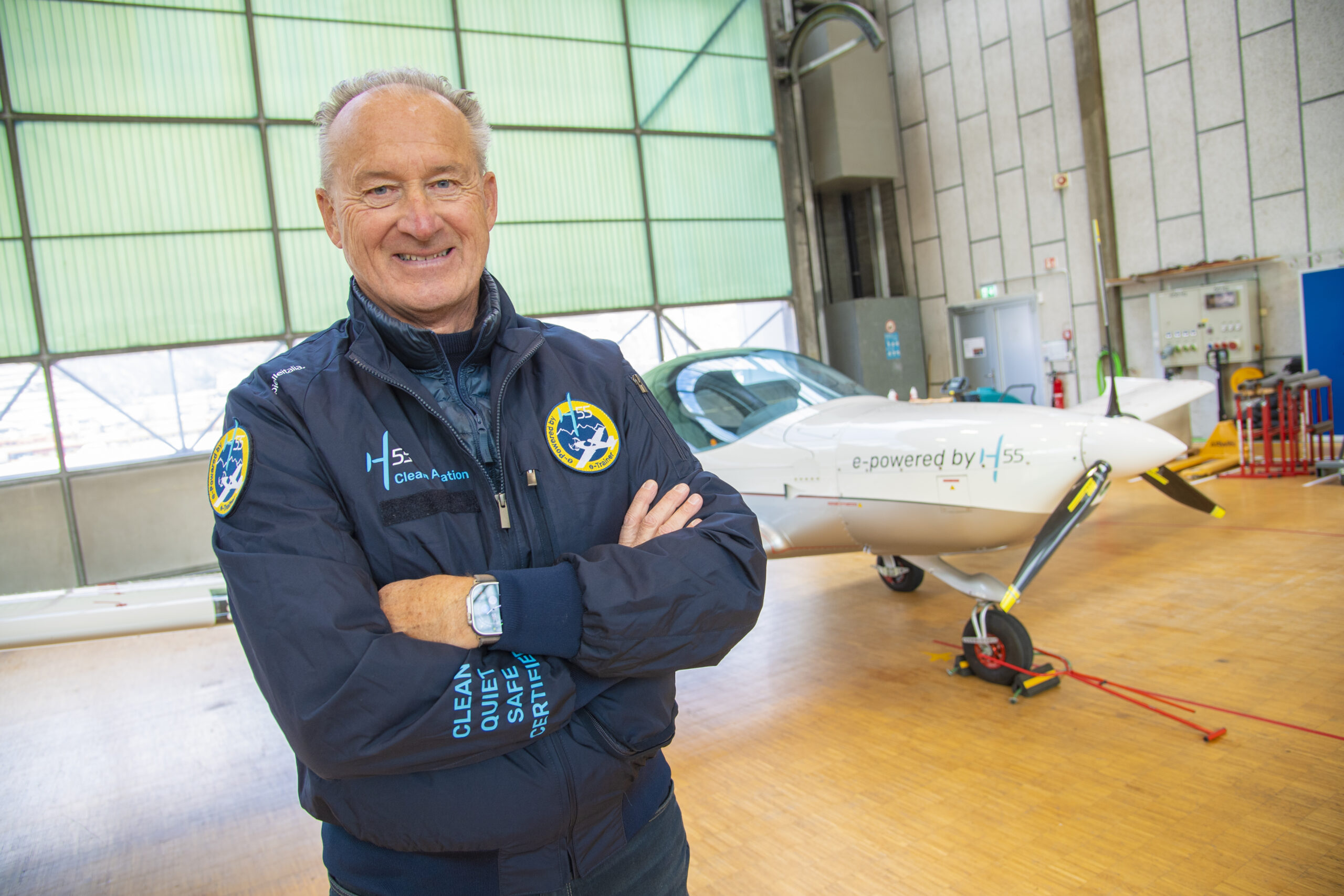
INTERVIEW: H55’s Andre Borschberg on Safety, Certification and the Reality of Electric Flight
Following H55’s announcement yesterday (Monday), eVTOL Insights Executive Editor Jason Pritchard was given the opportunity to speak with the company’s co-founder André Borschberg, who talked more about the latest milestone in its battery certification programme, why safety must come before speed and how collaboration will define the future of electric and hybrid aviation.
–/
As part of its test campaign, H55 produced more than 100 test articles drawn from its approved and audited product configuration.
The six-month effort covered environmental, safety, functional, and performance conditions under worst-case failure modes, including authority-witnessed thermal runaway tests without propagation. Collectively, these results confirm readiness for certification and industrial deployment, including:
- Completion of the certification campaign for propulsion battery modules
- Confirmation that H55 remains the only organisation holding both EASA Design Organisation Approval (DOA) and Production Organisation Approval (POA) for electric propulsion systems
- Production of series-manufacturing-conforming propulsion battery modules
- Completion of the first EASA-validated cell characterisation campaign for certified propulsion battery systems
- The safety demonstrated during testing completed in December 2025 is now being documented into final test reports, which H55 is submitting to EASA for formal acceptance in Q1 2026
After seven years of intensive development and testing, Borschberg believes its work could help unlock the next phase of electric aviation.
“We started dealing with electric airplanes at Solar Impulse,” Borschberg explained, referencing the historic solar-powered flight around the world completed in 2016. “But after that achievement, we decided to continue developing this technology with a strong focus on two things: certification and safety.”
According to Borschberg, the battery remains the most critical, and most challenging, element of electric and hybrid aircraft.
“Whatever solution you choose, fully electric, hybrid, or even fuel cell, the battery is always there,” he said. “And it’s the most difficult part to control, because it’s where the highest risks are, especially when it comes to fire.”
Seven years to reach certification readiness
By completing this regulator-approved propulsion battery module test campaign, H55 says it has materially reduced the primary constraint that determines which electric aviation technologies can commercialise. Formal demonstration of containment under worst-case failure scenarios materially reduces regulatory and insurance exposure, unlocking repeatable, certifiable deployment across aircraft programs, while ensuring aircraft-level safety.
With this achievement, H55 is transitioning from validation to scale. A single, certifiable Energy Storage System architecture can now be deployed across multiple platforms, allowing certification evidence to compound as revenue potential expands without proportional increases in development cost, supporting repeatable deployment across fleets and aircraft lifecycles rather than one-off programme deliveries.
H55’s newly validated battery pack has been designed initially for Part 23 fixed-wing aircraft, typically seating between two and 19 passengers. The certification campaign required not only a fully mature product, but also a production-ready manufacturing line, something Borschberg says is often underestimated across the industry.
“You cannot certify a prototype,” he stated. “You have to certify something that is already in production. That means you must fully develop the product and the production line before you even start the certification tests.”
That reality, he added, explains why the process took seven years.
“You never succeed the first time. We had several iterations before reaching this point,” Borschberg said. “But today, we have a battery pack that is extremely safe for aviation.”
A different approach to fire safety
One of the most notable aspects of H55’s technology is its approach to thermal runaway and fire containment. While many manufacturers aim to contain fires at the battery module level, H55 chose a more granular strategy.
“Most people try to contain fire within the battery module,” Borschberg explained. “That means everything inside the module can burn. As a pilot, I would not be very pleased to have a titanium box behind me reaching 1,000 degrees.”
Instead, H55 focused on containing failures at the individual cell level.
“We deliberately trigger cells to burn and then demonstrate that there is no propagation,” he said. “To do that, you need a very deep understanding of cell behavior — charged, uncharged, exploding, burning. It’s extremely complex.”
This philosophy, he believes, is fundamental to making electric aviation viable at scale.
“Fire containment is critical for all applications,” Borschberg said. “If you get that right, you establish the foundation for safety.”
Fixed-wing first, eVTOL next
While much attention in Advanced Air Mobility is focused on eVTOL aircraft, Borschberg sees fixed-wing aviation as the logical starting point for certified electric flight.
“A fixed-wing aircraft is simpler to certify,” he noted. “Especially when you take an already certified aircraft and modify it with electric propulsion.”
H55 is currently working closely with manufacturers and operators — including in the flight-training sector — to support first certifications and deliveries as early as next year in both Europe and the US.
“For us, the priority now is to help manufacturers certify their aircraft using our technology,” Borschberg said. “We’re not just developing systems — we’ve been flying electric aircraft since 2009. That experience is critical.”
He added that data gathered from certified general aviation aircraft will play a key role in unlocking more complex platforms.
“This will help authorities gain confidence,” he said. “If you want to bring large lithium battery systems onto transport aircraft, you must prove — with real data — that they are safe.”
Collaboration over vertical integration
Looking across the wider electric and eVTOL landscape, Borschberg believes the industry is beginning to reassess early assumptions around vertical integration.
“Many projects tried to do everything themselves — cells, batteries, motors, flight controls,” he observed. “That was understandable in the beginning, because there were few experienced suppliers.”
But he questions whether that approach is sustainable.
“The task is immense. It takes too much time and money, and it’s very difficult to be the best at everything,” Borschberg said. “I believe more companies are realizing that partnering with specialists is the faster path forward.”
H55, he hopes, can play a central role in that ecosystem.
“The battery will remain a core element of electric and hybrid aircraft,” he said. “By standardizing this part and bringing certified solutions, we can help accelerate the entire industry.”
As electric aviation continues its slow but steady progression toward commercial reality, Borschberg remains both realistic and optimistic.
“We’ve all been frustrated by the pace,” he admitted. “But reaching this milestone is a big step — and I truly believe it can help move the industry forward.”

