
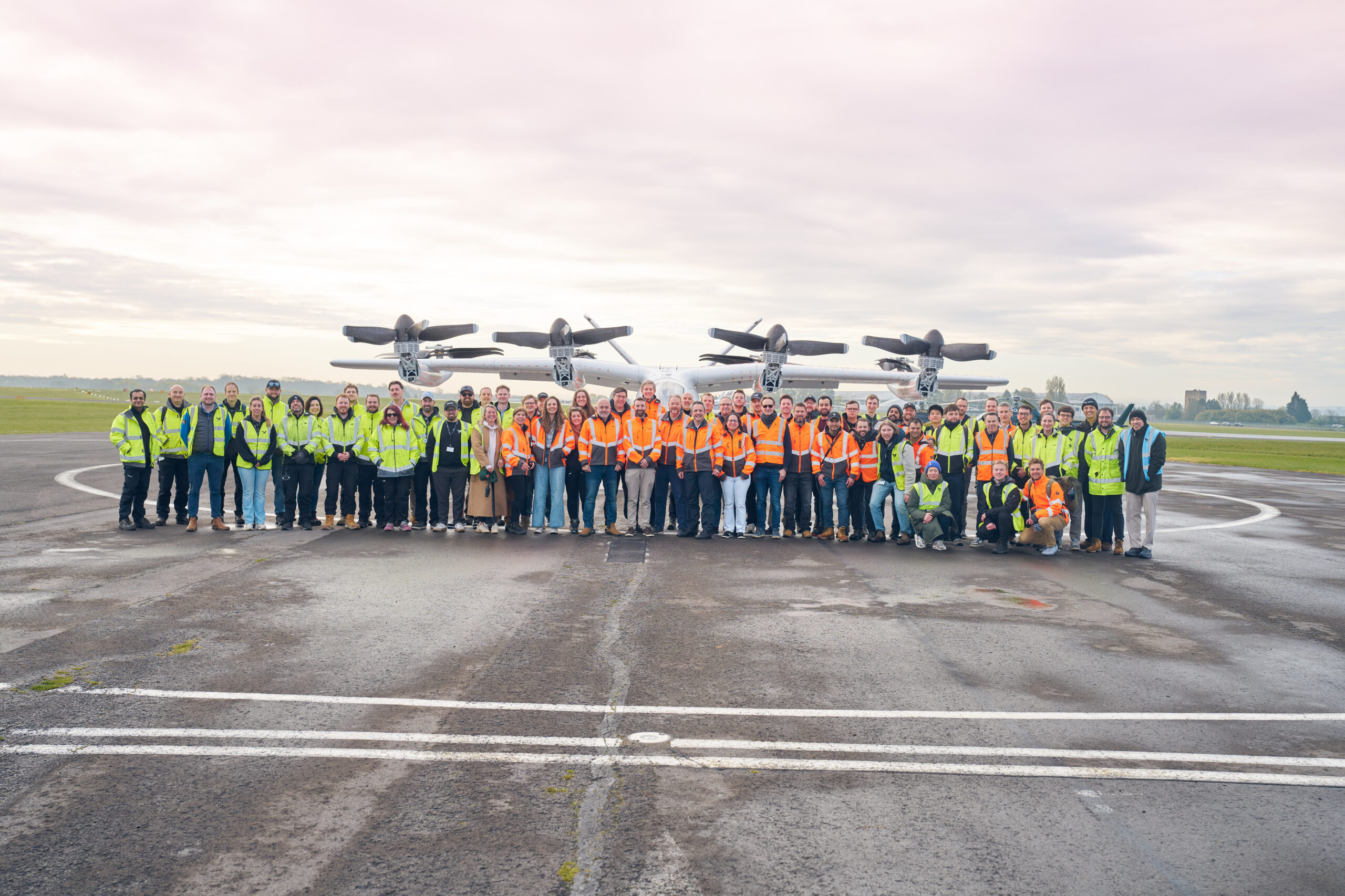
WATCH: Vertical Aerospace completes two-way piloted transition flight in a full-scale tilt-rotor eVTOL aircraft
Vertical Aerospace has successfully completed a historic two-way piloted transition flight.
On Tuesday of this week (April 14th), the company became the second globally to complete a two-way piloted transition flight in a full-scale tiltrotor eVTOL aircraft, and the first to do so under civil aviation Design Organisation Approval regulatory oversight.
Chief Test Pilot Simon Davies completed the flight, transitioning from vertical take-off to wingborne cruise and back to vertical landing, all in one continuous flight. This milestone builds on Vertical’s thrustborne transition on April 2nd and marks the completion of two-way transition, the defining capability of eVTOL aviation.
To put this into perspective, transition flight validates the technology which will enable Valo, Vertical’s commercial aircraft, to take off vertically from a city-centre vertiport or rooftop with passengers, fly efficiently at speed like an airplane, and land vertically at its destination without a runway.
The company says unlocks planned real-world routes such as Canary Wharf to Heathrow or JFK to Manhattan, making them operationally and commercially viable.
Stuart Simpson, CEO, Vertical Aerospace, said: “This is now the most significant technical milestone in our history. Full piloted transition is the most critical and complex challenge in eVTOL development, and we’ve achieved it under more rigorous regulatory oversight than anyone in the category.
“We’re not just participating in this industry — we are helping to define it. Our focus now is on executing our roadmap and bringing certified electric flight into commercial service.”
Path to Certification
As with all of Vertical’s flight tests since 2023, this milestone was achieved under the direct oversight of the UK Civil Aviation Authority (CAA), which is working in close collaboration with the European Union Aviation Safety Agency (EASA) toward Type Certification of Valo. Testing is conducted under Vertical’s Design Organisation Approval, a pre-requisite for entry into service.
With all phases of flight now proven, vertical take-off, wingborne flight and transition between the two, Vertical is moving into the next stage of certification testing.
This will include critical design review, when the aircraft design is locked, followed by the build of seven pre-production Valo aircraft in the UK for compliance and verification testing with the CAA and EASA.
Giancarlo Buono, Group Director Safety & Airspace Regulation at the UK Civil Aviation Authority, said: “New technology is unlocking new opportunities for the aerospace industry, and will reshape how people travel.
“This milestone for Vertical Aerospace shows how far and fast new aviation innovations are progressing.
“Effective and proportionate regulations are supporting groundbreaking innovation and putting new technologies in our skies. We will continue to work with and support the industry to ensure that emerging aviation technologies can develop safely.”
Vertical is targeting certification of Valo in 2028 to the highest safety standards in the category, with entry into service expected shortly thereafter.
The certification approach is designed to be transferable to other regulators, including the US Federal Aviation Administration (FAA), Brazil’s National Civil Aviation Agency (ANAC) and the Japan Civil Aviation Bureau (JCAB), supporting global deployment with airline and operating partners including American Airlines, Avolon, Bristow, GOL and Japan Airlines.
Steve Johnson, Vice Chair and Chief Strategy Officer, American Airlines, said: “Advanced air mobility represents a natural extension of American’s broader commitment to innovation and shaping the next era of aviation.
“As both an investor and long-term supporter of Vertical Aerospace, we share a clear ambition to make safe, scalable, and sustainable eVTOL flight a reality, and today’s news is a foundational step toward that end. Together, we’re not just imagining the future of travel, we’re actively building it.”
Bob Buddecke, president, Electronic Solutions, Honeywell Aerospace, added: “Successful transition flight represents meaningful progress not only for Vertical, but for the entire advanced air mobility industry.
“Our Compact Fly-by-Wire team worked closely with Vertical’s team to help enable the successful flight, and we expect countless more to come. Vertical’s progress underscores the strength of our joint engineering approach and the importance of disciplined system integration in bringing next-generation aircraft to market.”
A Major Opportunity for the UK
As Europe’s only eVTOL developer to achieve full piloted transition, this milestone reinforces the UK’s position at the forefront of next-generation aerospace.
Vertical expects its UK-based manufacturing and supply chain to support thousands of high-skilled jobs and significant export growth, with its ecosystem projected to grow to over 2,000 jobs by 2035.
UK Secretary of State for Business and Trade, Peter Kyle, said: “This is a fantastic milestone not only for Vertical, but for the UK’s position in the future of aerospace as we continue to lead the way on zero emission flight.
“Through our Industrial Strategy and the Aerospace Technology Institute we’re backing companies like Vertical who are demonstrating the kind of innovation, engineering excellence and export potential that can keep Britain at the forefront of the global aerospace industry, and create high-skilled jobs for local people.”
Progressing Key Strategic Milestones
Vertical will continue its focus on executing key strategic milestones over the next twelve months and beyond. These include public flight demonstrations, including at Farnborough International Airshow in July, progression of the hybrid-electric demonstrator, expansion of the Vertical Energy Center, advancement of the manufacturing facility, and production of the first full-scale Valo certification aircraft.

