
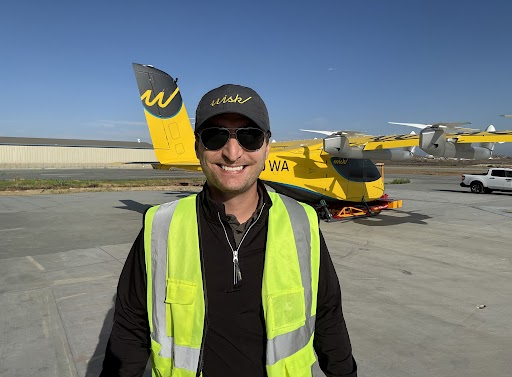
INTERVIEW: How Wisk is pacing investment for an autonomous aviation market
In the second article with Wisk’s Interim CFO Drake Berglund, he explains how the company balances autonomy development, production investment and the people behind its Gen 6 programme as the market evolves.
Keeping an aircraft programme aligned with an emerging market is a challenge Drake Berglund takes personally. For Wisk’s interim CFO, investment decisions affect engineering progress, suppliers and the people working to turn Gen 6 into a commercial product.
“In a new market with a new product, it’s critical to pace development with market maturity and make sure nothing gets out of sequence,” he tells eVTOL Insights.
That has sometimes meant slowing investment in tooling and scaled production facilities, with consequences that extend across the organisation.
“That’s been challenging, because changing the plan with a big team isn’t straightforward. You’re touching many people’s lives, so you have to make sure the plan is logical and explain it to a lot of people. You’re trying to ensure flexibility as the market pace changes while keeping everyone in sync.”
Protecting the autonomy programme
Wisk develops its autonomy systems in parallel with the aircraft, protecting resources for work that may be less immediately visible than a prototype taking shape.
“We established the autonomy workstream as essentially its own program within Wisk,” Berglund explains. “The Gen 6 Block Zero non-conforming prototype tests the airplane and is built to support autonomy, but the autonomy has been developed in parallel.”
“That means we can protect the funding and focus that otherwise might be taken by the more visible build progress of the aircraft. The autonomy effort includes testing and flying our hardware and software stacks on surrogate helicopters.”
Simulation is another significant investment. Systems engineering, safety analysis and software assurance work continue alongside prototype development, with the aim of keeping maturity aligned across technology areas.
“In my experience, it’s not a useful investment paradigm to let the airplane get overly mature relative to the systems, and here the systems include autonomy.”
Linking funding to meaningful milestones
System requirements, preliminary design and critical design reviews help Wisk decide when to commit further funding. Berglund says those reviews require a shared understanding of technical maturity across finance, engineering, programme leadership and the programme’s funder, historically Boeing.
“But it’s also important to have a flexible gate review process. There’s a version of gate reviews where, if you haven’t met every requirement, you have to go back and redo the work. That creates a delay, and in a high-risk, novel airplane program it’s really important to balance pace with discipline,” he says.
Wisk uses mitigation plans to address outstanding risks while allowing development to continue. Proceeding too quickly, however, can leave unresolved work that undermines later progress.
“You want to carry a little bit of risk where you’re not slowing the program down unnecessarily and you think you can mitigate it. But you don’t want to fly through milestones carrying so much technical debt that some systems have to go back and revisit the gate.”
Knowing when to invest in production
Production tooling brings the timing of investment into focus. Berglund describes a lead time of roughly 18 months, requiring coordination with suppliers and time for teams to install equipment and prepare to use it.
“When you’re building the early non-conforming airplane, you want tooling that isn’t fixed, tooling you can use a few times. Investing in tooling and molds that could be used hundreds of times at production scale would be the wrong allocation of investment at that point.”
Decisions require input across functions, with a clear record of what has been agreed and what might prompt a change. Berglund is candid about the difficulty of balancing long-term production ambitions with near-term technical needs.
“There’s a tension I haven’t always been successful in navigating: preparing for the rate we’re aiming at, versus targeting investment at the nearer-term deliverables that prove the product is technically mature in the first place.”
“Most importantly, you don’t want to overcapitalize or overspend on parts of the program where you still need to buy down technical and programmatic risk.”
Keeping resources flexible
Responding to those pressures requires adjustments throughout the year. Wisk has added employees and contractors in specific areas to help technical work catch up, while revisiting hiring plans, tool purchases and production scaling as the schedule evolves.
“It’s easy to depend on an annual planning process, but you also want shorter feedback loops, which include reallocating talent and an exception-based approach for when you need to surge capacity,” Berglund says.
“You’re not just planning annually, you’re asking where you need to adjust and surge focused resources, and that’s not only money but people, management attention, test facilities, and so on, so that every critical part of the program keeps pace.”
Acquisitions offer further flexibility. Berglund points to SkyGrid’s work on airspace automation and nearer-term revenue opportunities, alongside software verification company Verocel’s ability to serve Wisk and external customers.
“That means we can adjust where we spend engineering time and resources, continuing to cultivate near-term market and revenue opportunities while staying on the critical path of the airplane program.”
Certification and policy work remain protected investment areas, including engagement on FAA issue papers and means of compliance.
“Performance-based rules are critical, because the existing rules can’t comprehensively apply to this level of automation. Those have been investments we have been careful to protect.”
For Berglund, keeping those activities aligned demands continuing attention from the whole leadership team.
“Working closely with our chief engineers, program management, and the rest of the leadership team, we’ve iteratively adjusted hiring plans, production scaling, and tool purchases, so investments stay tightly aligned to the maturity of the program. Otherwise you risk significantly overspending and doing more rework than you would have with a measured approach from the beginning.”