
MightyFly Receives “First FAA Flight Corridor Approval for Large Autonomous Cargo eVTOL”
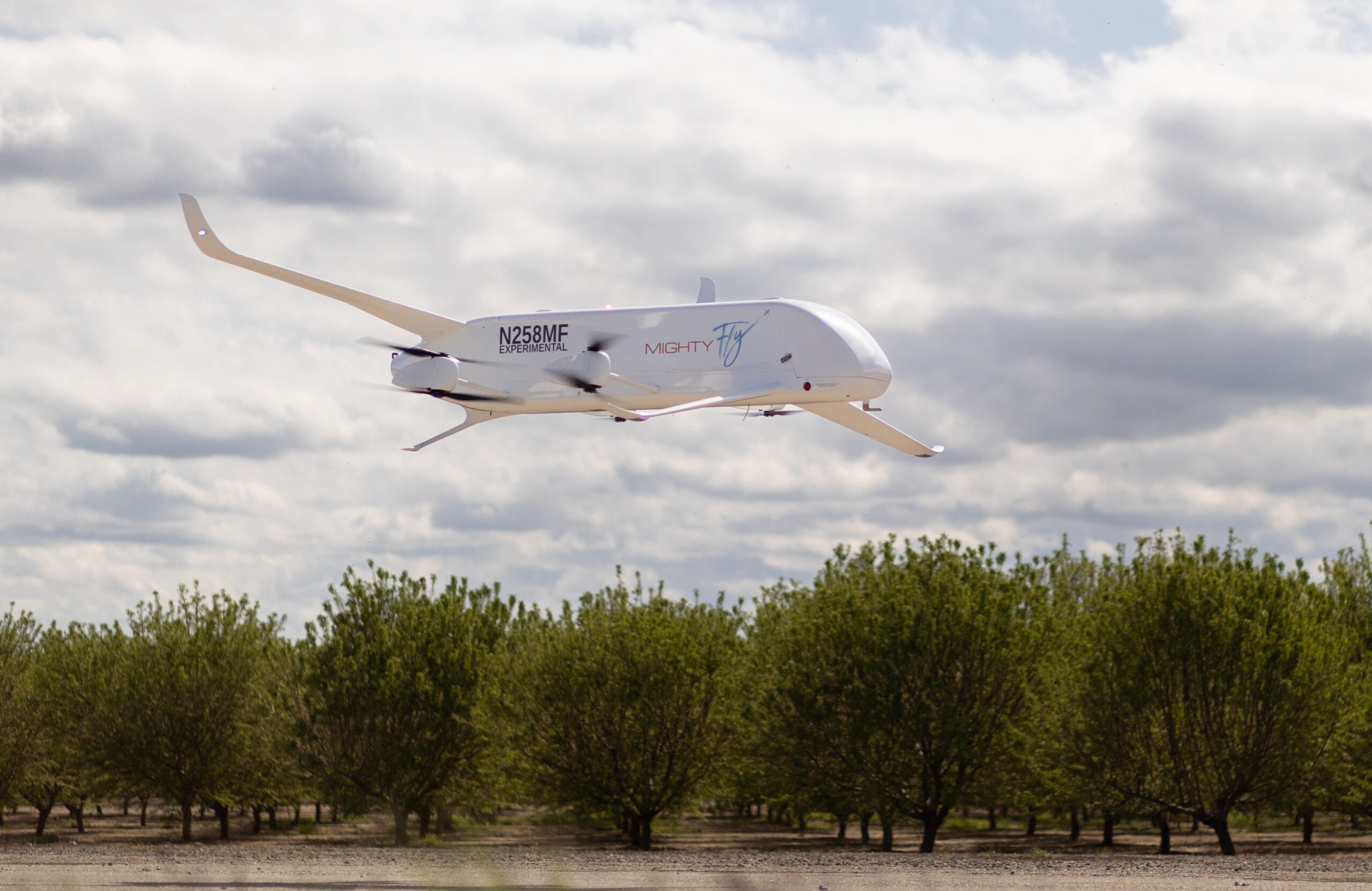
MightyFly announced this week it has become the first large autonomous cargo eVTOL company to receive an FAA flight corridor approval in the U.S, reports a press release. The company began flight testing its Cento aircraft in March in preparation for the flight corridor. It is making rapid progress with the program.
The release explains, “The FAA approval was confirmed via a Freedom of Information Act inquiry in late March based on certification on January 25th and includes the Certificate of Waiver or Authorisation (COA) for a flight corridor of up to 5,000 ft in altitude between the New Jerusalem and Byron Airports in California and a Special Airworthiness Certification (SAC) enabling the company to test Beyond Visual Line of Site (BVLOS) capabilities while using a chase airplane.”
This flight corridor unlocks the potential for MightyFly to advance its flight testing capabilities; perform autonomous A‑to‑B flights within the general aviation airspace; trial the aircraft; test long-range Command and Control (C2) datalink communication; and trial future Detect and Avoid system for Beyond Visual Line of Sight (BVLOS) flights.
MightyFly’s SAC market survey authorisation allows the company to begin demonstrating point-to-point autonomous delivery flights and carry out proof of concept (POC) programs with customers and partners. “This COA,” explains the release, “is a key enabler for MightyFly to position itself as a B2B expedited logistics industry disruptor.”
Manal Habib, CEO of MightyFly, enthused, “This is a solid vote of confidence from the FAA in our work and our ability to perform safe autonomous flights in the general aviation airspace. We now look forward to demonstrating point-to-point delivery flights with our partners in this space.”
The release continues, “This industry milestone was possible due to the maturity of MightyFly’s aircraft, the expertise of the team both in autonomous aircraft development and aviation regulation, and the company’s relationship with the FAA. MightyFly is first to receive this regulatory approval while being in its seed-fund stage, as compared to more highly funded autonomous cargo eVTOL companies with more than 10X the capital.”
On March 4th, MightyFly started flying its third-generation Cento autonomous cargo aircraft. To date, it has completed over 30 autonomous flights in a span of just a few weeks.
The test campaign is to incorporate A‑to‑B flights and showcase autonomous deliveries of various use cases. These include medical and pharmaceutical supplies, spare parts and manufacturing components, as well as fast-moving consumer goods.
The flight corridor enables MightyFly to prepare for two major upcoming public flight debuts. Under a contract with the Michigan Office of Future Mobility and Electrification, MightyFly is to publicly demonstrate point-to-point autonomous cargo delivery flights to partners and potential customers in Michigan.

Manal Habib
The company is also planning to demonstrate flights to the USAF showcasing its autonomous loading, unloading and balancing of packages capabilities.
For more information
(Images: MightyFly)
For the latest news, insights and content regarding the global Advanced Air Mobility market, please join the following eVTOL Insights channels: WhatsApp, Facebook, Instagram, Spotify, Apple Podcasts, YouTube, X and LinkedIn.
