
Ohio DOT unveils three-year Advanced Air Mobility Action Plan to accelerate operations in US state
The Ohio Department of Transportation (ODOT) has released a three-year Advanced Air Mobility (AAM) Action Plan, outlining how the state intends to turn years of research and testing into a scalable transportation and logistics ecosystem.
Building on Ohio’s 2021 AAM economic impact study and its 2022 statewide framework, the strategy focuses on six priorities: infrastructure, policy, testing and integrated operations, workforce development, funding, and public engagement.
A central element is a statewide digital network enabling aircraft operators, service providers and public agencies to securely exchange information. Connecting communications, tracking and traffic management systems is intended to support increasingly complex operations, including Beyond Visual Line of Sight flights.
The approach recognises that commercial deployment requires coordinated investment in physical infrastructure, digital systems, policies and partnerships. These foundations will support Ohio’s transition from individual demonstrations towards more connected aviation services.
Phase one: Planning and operational preparation — 2026–2027
The opening phase establishes programme priorities, stakeholder responsibilities and potential public-private partnerships. Activities include assessing air and ground infrastructure, helping airports plan for readiness, and initiating workforce and community engagement strategies.
Simulated flight testing and a formal concept of operations for extended-range BVLOS missions will help identify digital infrastructure requirements and assess safety performance before operational flight trials.
Phase two: Implementation and demonstration — 2027–2028
Market-led pilots will establish initial routes and collect evidence on safety, infrastructure, data exchange and commercial viability.
The mission focus includes conventional takeoff and landing aircraft carrying packages, medical specimens and specialist personnel. This would inform subsequent evaluation of vertical takeoff, short takeoff and uncrewed aircraft serving scheduled routes supported by automation.
Field experience will refine workforce requirements and test whether information-sharing systems can support expansion.
Phase three: Preparing to scale — 2028–2029
Lessons from demonstrations will inform policies, infrastructure investment priorities and the responsibilities of government, communities and industry.
Workforce programmes and regional coordination will expand, alongside preparations for a commercial digital network supporting broader operations. More complex demonstrations would explore urban integration and higher-density aircraft activity, supported by communications, surveillance, sequencing and weather services.
Progress will depend on safety, technology and market readiness, rather than a guaranteed commercial launch timetable.
For more information and to access the full action plan, visit DriveOhio’s website.
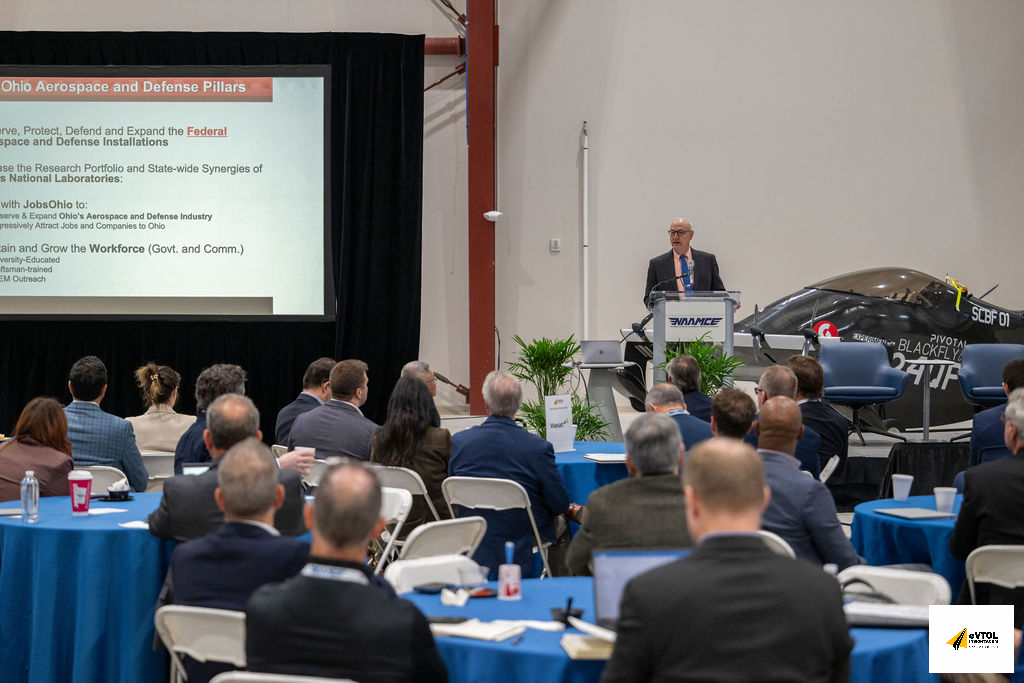
*Featured image is of Colonel Joseph Zeiss, who gave an opening address at eVTOL Insights’ North America Conference & Awards 2026, which took place at the National Advanced Air Mobility Center of Excellence (NAAMCE) near Springfield, Ohio.

