
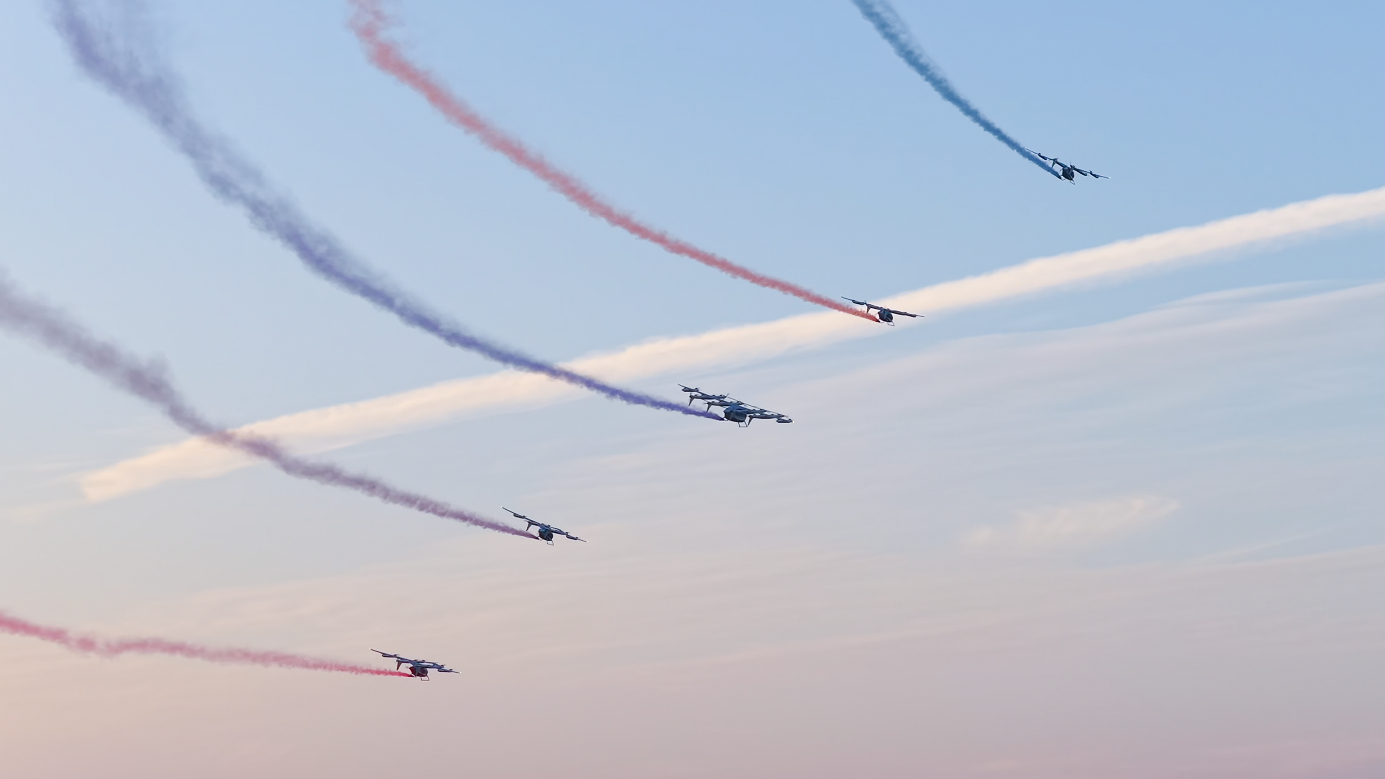
AutoFlight Completes Five-Aircraft Autonomous eVTOL Formation Flight
Chinese manufacturer AutoFlight says it has completed what it describes as the world’s first formation flight involving five electric vertical take-off and landing aircraft, demonstrating autonomous coordination between different aircraft models and weight classes.
The flights took place on 31 October and 1 November at the company’s Bailian Lake Flight Test Base in Kunshan, China. The formation comprised one five-tonne V5000 Matrix and four two-tonne aircraft, spanning three models: the V5000 Matrix, V2000CG CarryAll cargo aircraft and V2000CGF CarryAll firefighting variant.
The formation flew for 47 minutes, with the lead V5000 covering more than 133km. AutoFlight said all five aircraft operated autonomously throughout the demonstration, without manual intervention.
AutoFlight reported that the aircraft maintained stable flight and safe horizontal and vertical separation despite strong winds during the 1 November demonstration. Coordinating aircraft of different sizes and intended roles requires systems for route planning, flight control, communications and separation management.
The demonstration follows an earlier three-aircraft formation flight conducted by AutoFlight in May 2026. The latest exercise represents a further test of the company’s ability to coordinate multiple aircraft types within a single operation, with the added two aircraft adding a significant amount of complexity to formation flying.
AutoFlight said the work could support future autonomous operations involving larger numbers of eVTOLs, potentially linking longer-distance, regional and last-mile transport services. However, the demonstration was a controlled flight-test activity and does not in itself establish that the technology is ready for routine commercial operations.
The company has also been exploring links between air and water-based transport infrastructure. Visitors to the recent demonstrations were shown Sunship, its water-based vertiport on Dianshan Lake, which is intended to form part of a wider concept for integrating eVTOL operations with other transport modes.