
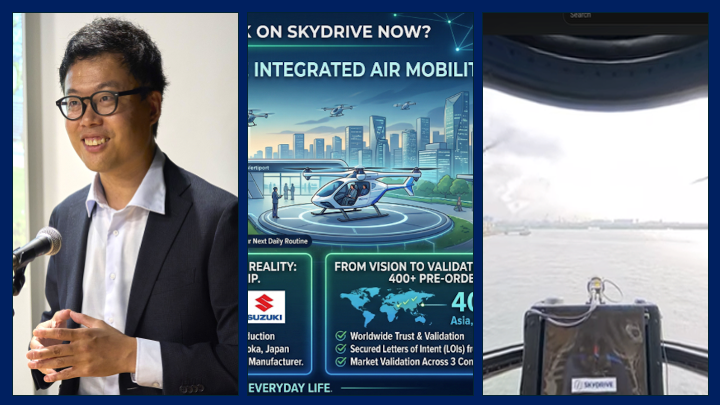
SkyDrive CEO Tomohiro Fukuzawa Shares Exciting Update of Company’s Continued Industry Progress
Japanese eVTOL OEM SkyDrive has released a message from its founder and CEO Tomohiro Fukuzawa, as he shares three important updates which provide a unique look at how the company is scaling its technology and business in 2026:
SkyDrive continues to make solid progress this year, after an exciting 2025 where Fukuzawa talked in more detail on a recent eVTOL Insights Podcast
–/
Solid Progress in Q1 2026 and Acceleration as a National Strategy
In the first quarter (Q1) of 2026, SkyDrive has moved forward at an unprecedented pace toward its vision of ‘bringing the air mobility revolution to daily life.’ The company has reported the key milestones have been achieved during this period:
1. A Major Leap Toward Practical Application: Success of the “Tokyo Demo Flight”
The demo flight conducted in the Tokyo Bay area in February captured significant attention both domestically and internationally.
In collaboration with the Tokyo Metropolitan Government, Mitsubishi Estate, and Kanematsu, we successfully conducted Japan’s first verification focused on ‘actual operations’, such as the automation and optimization of vertiport management, going beyond a mere flight demonstration.
This achievement was reported by media outlets worldwide, providing a concrete vision of a future where eVTOL aircraft are integrated into the urban landscape.
.2. Establishing Status as a National Strategy and Accelerating Public-Private Collaboration
eVTOLs (“Flying Car” to be called in Japan) have been officially selected as a key product and technology within one of the 17 Priority Fields of the Japanese Government’s Growth Strategy.
This signifies that our challenge is recognized not merely as a private venture, but as a core pillar of a national strategy driving Japan’s next generation.
Furthermore, with the Cabinet’s decision to position eVTOLs as sustainable infrastructure for regional revitalization and the shared vision at the Osaka Roundtable to operate “100 aircraft by 2035,” the roadmap for public-private integration is accelerating.
As a frontrunner in this industry, SkyDrive will continue to lead both regulatory design and social implementation.
3. Breakthrough in the Type Certification Process
In our ongoing efforts to obtain Type Certification in Japan (JCAB) and the U.S., we reached an agreement with the Ministry of Land, Infrastructure, Transport and Tourism (MLIT) on the General Certification Plan (GCP) this quarter.
This agreement establishes a definitive path toward certification and significantly reduces development risks. This progress within the Japanese regulatory framework also serves as a positive catalyst for our certification process in the United States.
4. Continuous Expansion of the Global Ecosystem
Our global expansion is gaining momentum. The company has made steady progress in Middle Eastern and Asian markets, advancing aircraft purchase agreements with AeroGulf Services (Dubai) and 7A Drones (Taiwan), while solidifying our foundation in North America through our partnership with Aeroauto.
Notably, the formulation of an emergency medical transportation route between remote islands in Taiwan exemplifies the profound social value—saving lives—that our aircraft provides.
From a “Visionary Concept” to a “Real-World Industry”
The activities of Q1 clearly demonstrate that eVTOLs are no longer a “imaginate vehicle of the future” but are evolving into a viable, real-world industry.
By expanding the options for aerial mobility, we can make daily life more convenient and enjoyable while alleviating social issues such as urban traffic congestion and providing support for emergency medical services. A key feature of SkyDrive’s multirotor eVTOL is that it does not require a runway for takeoff and landing, making it easy to install vertiports within our daily living spaces, such as city centers.
When seamless aerial travel becomes available right from your home or office, it will not only save time but also transform travel into an enjoyable experience.
To realize this future, the understanding and cooperation of stakeholders worldwide—including governments, municipalities, global business partners, and our future users—are indispensable. This global network is the key to creating a world where eVTOLs are a natural part of everyday life.

