Urban-Air Port collaborates with Coventry University on virtual reality to capture passenger experience
The Urban-Air Port (UAP) Air One vertiport technology features extensively in a new paper written by Coventry University, the first of a kind that uses human factors research and virtual reality (VR) technology to inform on the successful design of infrastructure to support future mobility.
The Air One vertiport built in Coventry City Centre in April served as a demonstrator of sustainable infrastructure for passenger air taxis and autonomous drones for advanced air mobility.
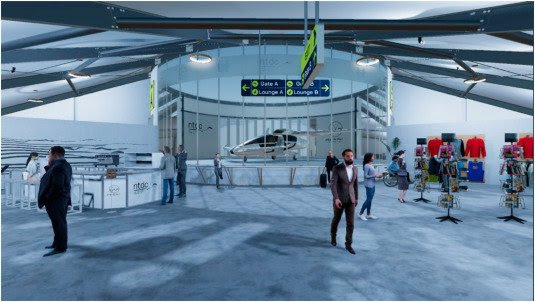
Air One captures the traditional airport environment and scales it down to fit within a condensed footprint, retaining key operational and passenger processing elements such as check-in and security, as well as retail and food and beverage areas to create an enjoyable traveller experience.
UAP developed the Air One design early in 2021 as part of a successful bid for UK Research and Innovation’s Future Flight Challenge Phase 2, working with a consortium whose members included Coventry City Council and Coventry University.
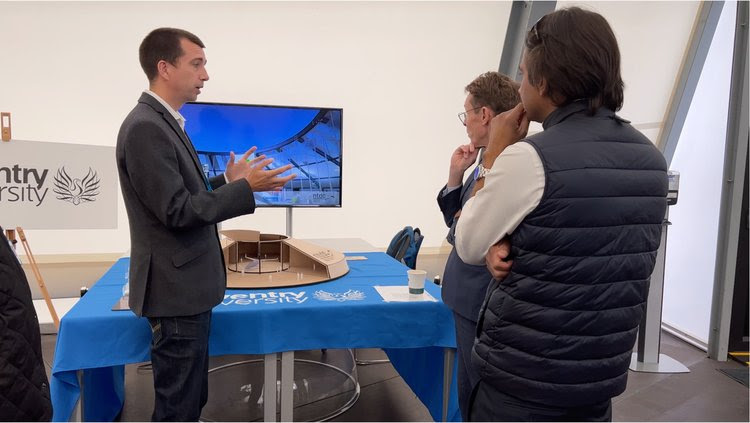
UAP collaborated with transportation designers at the University’s National Transport Design Centre (NTDC) to build an immersive VR environment of Air One, and provided Computer Aided Design (CAD) models of the infrastructure to create a 3D environment in which volunteers for the study could then navigate using a VR headset.
Conducted during the Covid-19 pandemic and under safely controlled conditions, participants in the experiment were given ‘customer journey scenarios’ to complete, for example, a visit the Urban-Air Port Café, buy a coffee and then go to a gate to board an eVTOL vehicle.
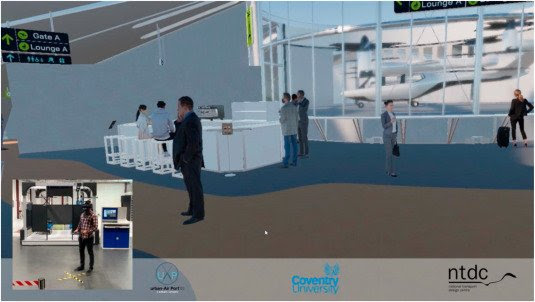
Users were then asked to navigate the virtual Air One using signage and wayfinding created by the NTDC. An analysis of the volunteers’ reactions and responses to the virtual environment was assessed to ascertain the level of accessibility and ease of navigation, providing an insight into the effectiveness of the vertiport layout and wayfinding system throughout the infrastructure.
As Urban-Air Port works closely with regulators and agencies on certification of vertiport design, human factors research plays an important role in enhancing the passenger experience and accessibility through wayfinding and navigation within future mobility infrastructure solutions.