
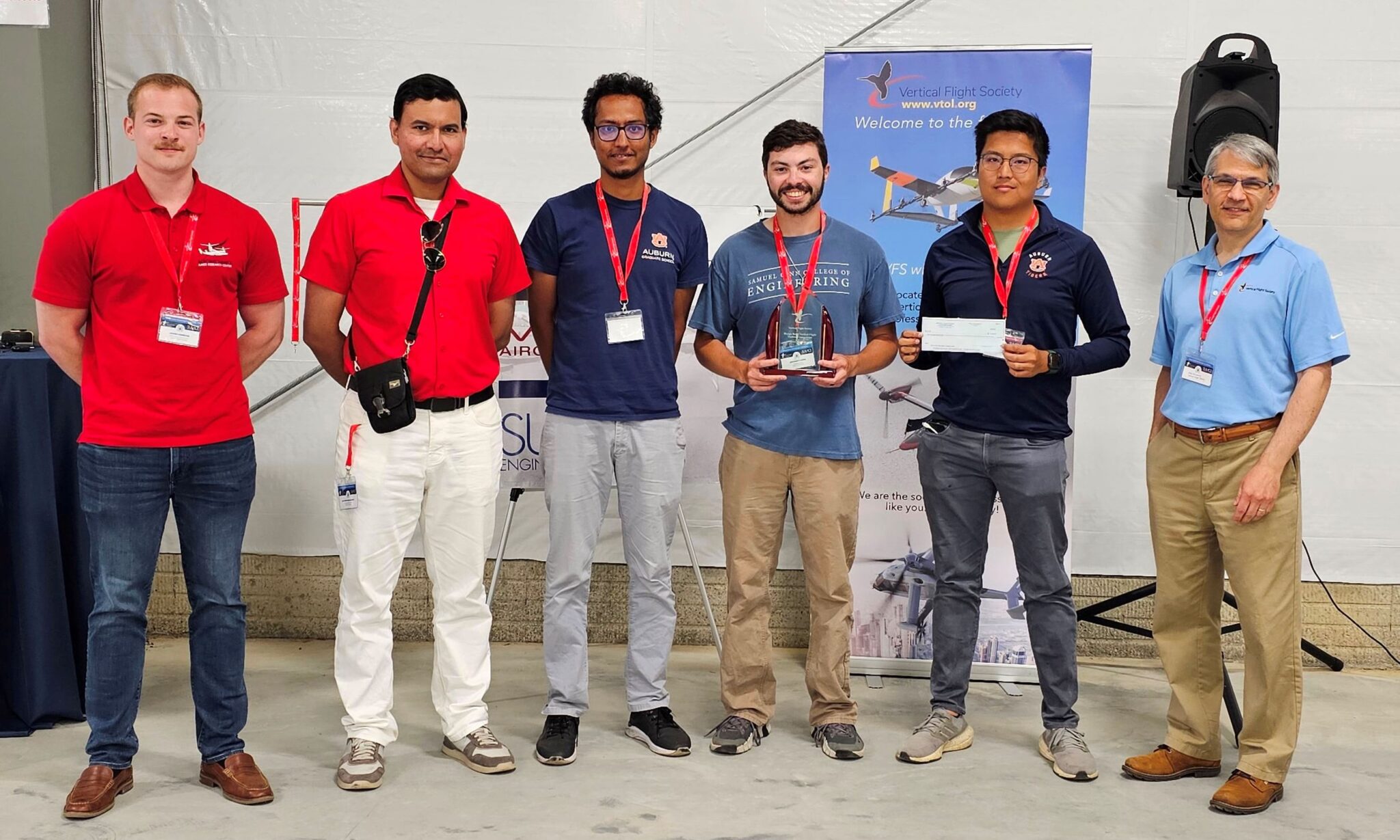
VFS announces winners of Design-Build-Vertical Flight Student Competition
The Vertical Flight Society last week announced the winners of its third annual Design-Build-Vertical Flight (DBVF) Student Competition. Auburn University took first place, University of Maryland took second and McGill University took third.
The annual remote-control, eVTOL DBVF competition seeks to encourage student interest in unmanned aircraft technology, and small air vehicle design and fabrication, and is designed to develop hands-on skills and familiarisation with eVTOL and advanced air mobility technology at the university student level.
VFS awarded a total of $5,000 to schools in the competition this year. The 2022–2023 request for proposal published in August 2022 challenged the teams to build an eVTOL aircraft weighing no more than 9 kg and capable of carrying a payload of at least 0.9 kg.
In addition, the aircraft had to be capable of flying manually and autonomously. Eleven universities from across North America and Europe entered the competition in September.
The teams with the top five ranked reports were awarded $300 each to help offset costs and competition travel expenses: Cooper Union, Delft University of Technology, University of Cincinnati, University of Maryland and University of Michigan.
Seven schools submitted a Final Technical Report submission on May 8: Auburn University, Cooper Union, McGill University, University of Maryland, University of Michigan, Vaughn College of Aeronautics & Technology and University of Wisconsin-Madison.
Five schools made it to the final round. In addition to the three winning teams, Michigan and Vaughn also attended the DBVF competition fly off, and University of Michigan received an honourable mention.
Auburn University completed all aspects of the competition, including completing circuits under both manual control and fully autonomous flight. The flyoff was hosted this year by SURVICE Engineering’s Applied Technology Operation.
“The long-range endurance course in this year’s event pushed teams to consider out of the box UAS configurations,” said Dr Jason Cornelius of NASA Ames Research Center, who volunteers as the VFS DBVF Program Director.
“Combining challenging tailsitter and lift + cruise configurations with high on-site winds presented a true test environment for the students.”
VFS director of strategy Mike Hirschberg added: “Every one of the teams had to overcome formidable obstacles in this competition, including workload, manufacturing challenges and numerous crashes.”
In June 2022, the VFS announced the winners of its second annual Design-Build-Vertical Flight (DBVF) Student Competition, supported by ARL, and sponsored by Survice Engineering and Wisk Aero as Gold and Bronze sponsors.

