
What Happens If AAM Actually Works? Thought Leadership from Andrea Wu of Urban-Air Port
This feature has been worked on with Andrea Wu, CEO of Urban-Air Port and are her words.
–/
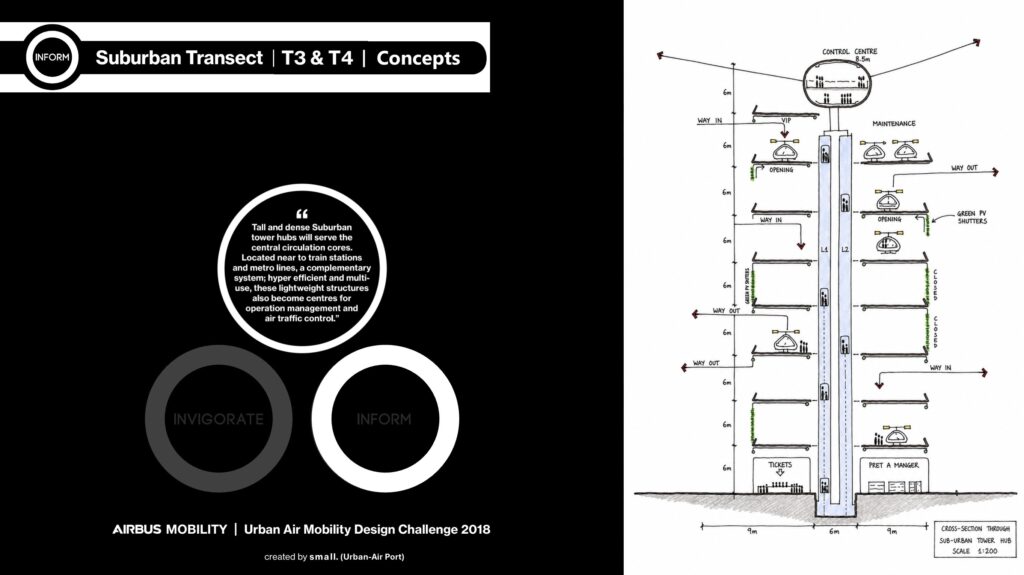
I recently came across a sketch Urban-Air Port produced for Airbus back in 2018 as part of an international design competition exploring how Advanced Air Mobility (AAM) might integrate into future mega cities.
At first glance, it looks ambitious — a vertical mobility hub designed to support high volumes of autonomous flight in dense urban environments.
We never imagined cities would suddenly be filled with vertiport towers — the sketch was intended to provoke a bigger question:
What happens if AAM actually works at scale?
Back in 2018, much of the industry was still emerging. Many of today’s companies did not yet exist, but the ambition was already clear: meaningful passenger volumes, urban integration and entirely new mobility networks. Forecasts, business models and eventually billions of dollars of investment into eVTOL manufacturers all relied on one core assumption — scale.
Coming from architecture, transport and large-scale infrastructure delivery, our instinct at Urban-Air Port was to think beyond the aircraft itself. Because if those assumptions around scale proved true, infrastructure would also need to evolve.
Not a handful of aircraft movements per day, but meaningful throughput, passenger flow, energy demand, operational resilience and — critically — a commercially viable transport layer embedded into everyday city life.
Our sketch was less about predicting the future and more about testing an assumption:
If AAM genuinely scales, what kind of infrastructure will it require?
Looking back, perhaps one of the clearest lessons from AAM’s first decade is that building entirely new mobility systems is significantly harder — and more interconnected — than many initially expected.
Not necessarily a failure of ambition, but perhaps an underestimation of what it actually takes to build an entirely new ecosystem.
What some describe as AAM “slowing down” may simply reflect the natural transition from early-stage possibility into implementation.
One of the biggest shifts over the last decade has also been how the conversation around infrastructure evolved.
In the early days, infrastructure often meant physical vertiports — landing pads, passenger terminals and site locations. Yet as the industry matured, it became increasingly clear that infrastructure was always broader than that.
Operations. Logistics. Energy. Launch and recovery. Resilience. Autonomy. Systems integration.
Increasingly, the conversation shifted from where an aircraft lands to what is required to make entirely new forms of mobility actually work.
That shift becomes particularly visible once ideas move beyond renderings and into real deployment.
For Urban-Air Port, building and operating Air One in Coventry — the UK’s first operational vertiport demonstrator — brought many of those realities into focus: operational flow, utilities, public acceptance, safety, regulation and commercial viability.
There is a meaningful difference between imagining future mobility systems and physically operating them.
Interestingly, some of the capabilities developed through AAM may also find earlier adoption in adjacent sectors than originally expected.
Autonomy, distributed operations, deployable infrastructure and systems integration are increasingly relevant not only to passenger transport, but also cargo, maritime operations, remote logistics, emergency response and dual-use applications.
If the first decade of AAM revealed anything, it may be this:
Breakthrough technologies rarely scale in isolation.
As markets mature, the conversation naturally expands — from proving what the technology can do, to understanding the wider system required to support meaningful scale