
Unisphere publishes Global Icing Report; why it is essential to better understand air taxi service icing conditions
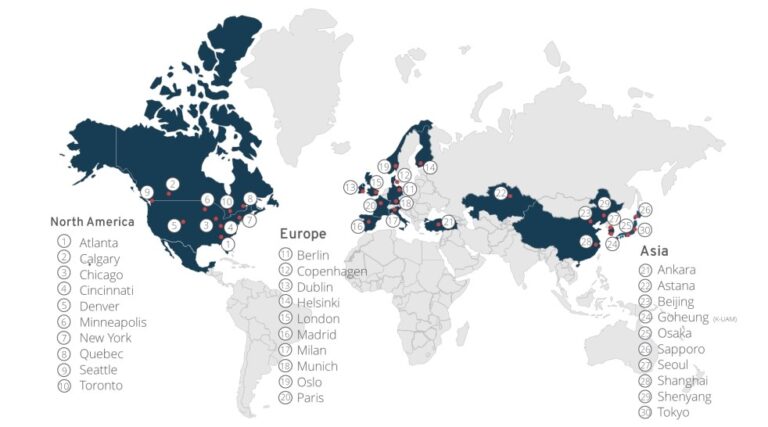
German based Unisphere has published its ‘Global Icing Report for Air Taxi Services’, examining 30 urban air mobility cities using the location of main train stations since they represent a connecting point for mobility.
The study found that strong local effects of icing frequencies between locations are visible even on smaller distance scales within countries like Japan for example. The influence of daytime and night time must be examined in depth since there can be large differences in icing conditions.
As part of an introduction to the report, it says: “Firstly, as the name implies, eVTOLs are electrically powered, which has certain drawbacks, because batteries have a lower energy density than kerosene. As a result, most are not equipped with de-icing systems because it adds weight, which limits the aircraft’s range, and the system itself requires limited energy.
“Secondly, because eVTOLs are smaller than commercial aircraft, icing that forms on the airframe has a greater impact than from conventional aviation. In other words, 1 cm of ice on an eVTOL has a much greater impact on aerodynamics than on an airliner. As a result, the pilot has less time to react to icing.
“Thirdly, due to aerodynamic effects in the area of the propulsion system rotors, icing effects occur at temperatures above zero degrees Celsius, caused by the fact that the rotors generate a low pressure that can lead to a drop in temperature. Similarly, icing can occur on the aircraft at two degrees Celsius and high humidity for example.
“Fourthly, eVTOLs are planned to operate at lower altitudes where the temperature is more moderate than at high altitudes. Because warmer air can contain more moisture in absolute terms, severe icing is more likely to occur than at altitudes where airliners operate.”
Some of the analysed locations revealed high percentages of icing conditions over several months which results in a strongly decreased service availability for aircraft without de-icing systems.
To read the report in full, please click here.
–/
Unisphere’s co-founder and CCO Christoph Selig was a recent guest on the eVTOL Insights Podcast Series, where he talked more about the report and its findings. The episode will be released soon, so keep an eye on our website and social media channels.

