
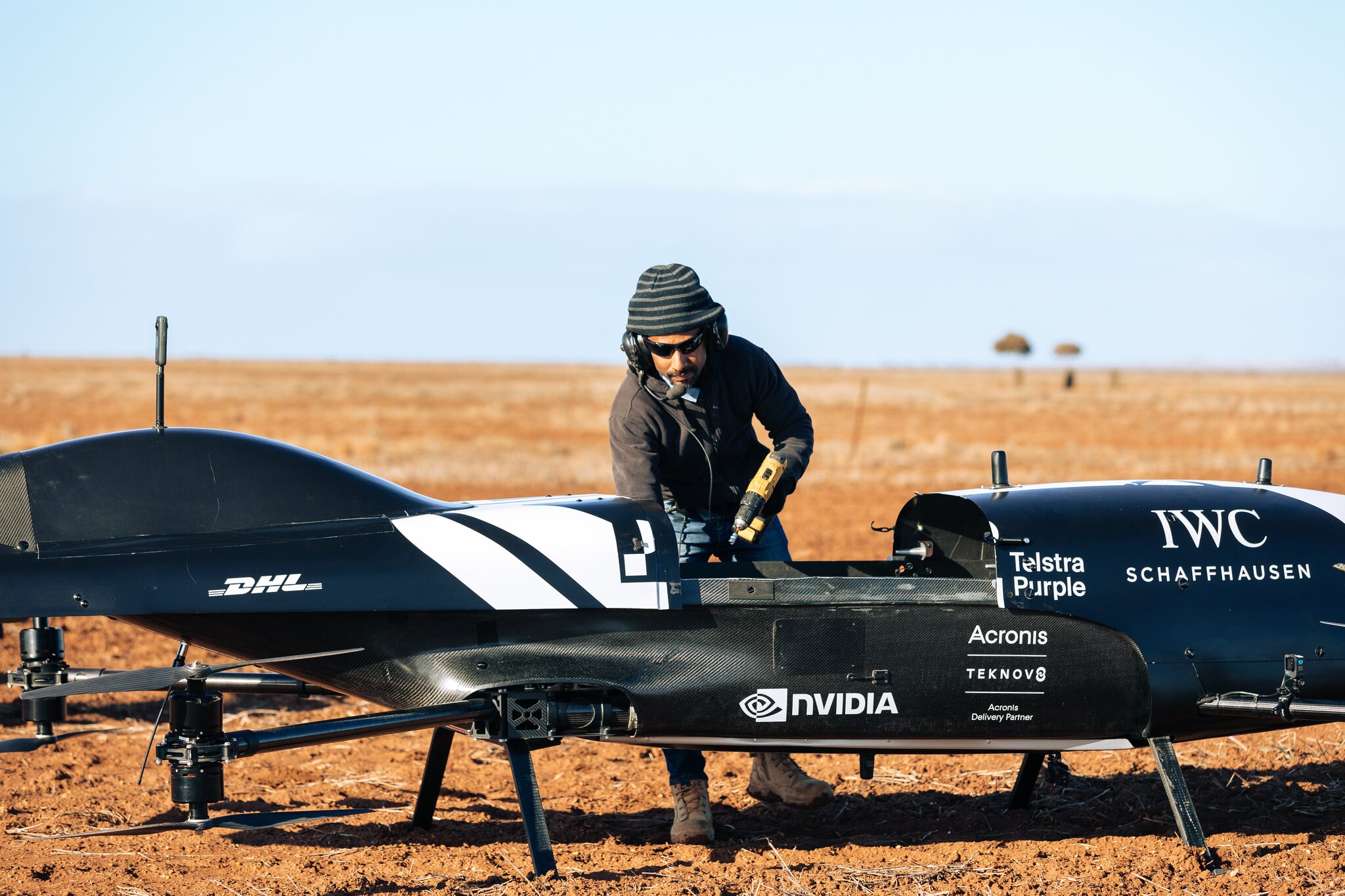
Airspeeder pilot Zephatiali Walsh beats Fabio Tishcler in inaugural EXA remotely piloted race
Airspeeder pilot Zephatiali Walsh beat fellow-competitor Fabio Tishcler in a tense and close inaugural EXA remotely piloted race in the salt flats of South Australia, the first time the two pilots were given full licence to race their 4.1m long eVTOL race-craft.
This skill and commitment was on show from the very beginning, with three overtakes in the first lap alone, the most daring manoeuvre of which was rewarded when Zephatali overtook Tischler who had gone wide at Turn 1, just one metre below his fellow competitor.
Walsh commented: “As pilots, we have been developing this sport behind the scenes over hundreds of hours of simulator, engineering and testing work and as soon as the lights turned green, we became racers competing for a place in the history of this sport.
The circuit race took place over a 1km digital sky-track, with the competition played out in two sessions, the first of a series of EXA remotely piloted races that will serve as the development and feeder series for the Airspeeder fully crewed Grand Prix starting in 2024.
EXA Remotely piloted races will soon feature a much wider grid of pilots including Bruno Senna, former F1 and World Endurance Racing star, where digital sky-tracks and a light approach to infrastructure means racing can take place in a range of locations from marine to forest and desert settings.
Beyond making motorsport history, Alauda Aeronautics, the technical team and manufacturer of the pioneering Speeders that compete in EXA and Airspeeder races has created an engineering and digital ecosystem for electric flying car (eVTOL) racing.
This technical accomplishment is delivered by a team drawn from some of the most celebrated names in Formula 1, motorsport and advanced aerospace development, including multi-World Championship winning engineers from Ferrari and development talent from Boeing, Airbus, McLaren, Jaguar Land Rover and Rolls-Royce.
They had to build Race control stations, pilot control stations, cutting edge 5G networks, Augmented Reality (AR) Sky Tracks, an engineering and team control station, akin to that seen in elite traditional motor racing.
This starts with the 4.1 metre flying racing car (eVTOL), a carbon fibre construction full-scale racing quadcopter delivering 320kW, equalling an Audi SQ7 performance SUV, but the Audi weighs 2,500kg while an Airspeeder racing craft (without pilot) weighs just 130kg. It can lift more than 80kg, with acceleration from 0–62mph taking 2.8 seconds and can climb to 500 metres.
Alauda has collaborated with Telstra Purple, Acronis and Amazon Web Services to create the digital architecture that will drive the 5G enabled infrastructure needed to ensure the safe management of autonomous and piloted eVTOL vehicles in urban environments.
Alauda’s timekeeping partner, IWC Schaffhausen, and Airspeeder teams were also able to draw upon expertise from Acronis and Teknov8 in securing and managing vital telemetry and race data.
The staging of the race was supported by the Government of South Australia, which extends to co-funding Alauda Aeronautics hyper-factory, a place where the world’s best performance flying cars will be built alongside space-craft, satellites and aircraft.

