
Ampaire Wins $9 million Award From ARPA‑E for SCALEUP Project
Electric aviation developer Ampaire has been awarded $9 million from the US Department of Energy’s advanced research unit, ARPA‑E.
The agency’s SCALEUP program will fund the development of key hybrid-electric subsystems that can be produced in volume and meet the standards of the FAA and other certifying authorities.
Ampaire CEO Kevin Noertker said: “Ampaire has been flying and refining hybrid-electric prototype aircraft since 2019 and the next step is to develop a fully-integrated propulsion system, the AMP-H570, that meets strict certification requirements.
“SCALEUP will be central to supporting this process at Ampaire and contribute to the certification of the nine-passenger Eco Caravan. The ARPA‑E award is a validation of Ampaire’s methodical, building-blocks approach to aircraft propulsion development.”
The award follows accomplishments that include the first flight of the Eco Caravan, a global support agreement with Air France Industries KLM Engineering & Maintenance (AFI KLM E&M) and orders from airline operator WingTips, and sustainable aircraft financier MONTE.
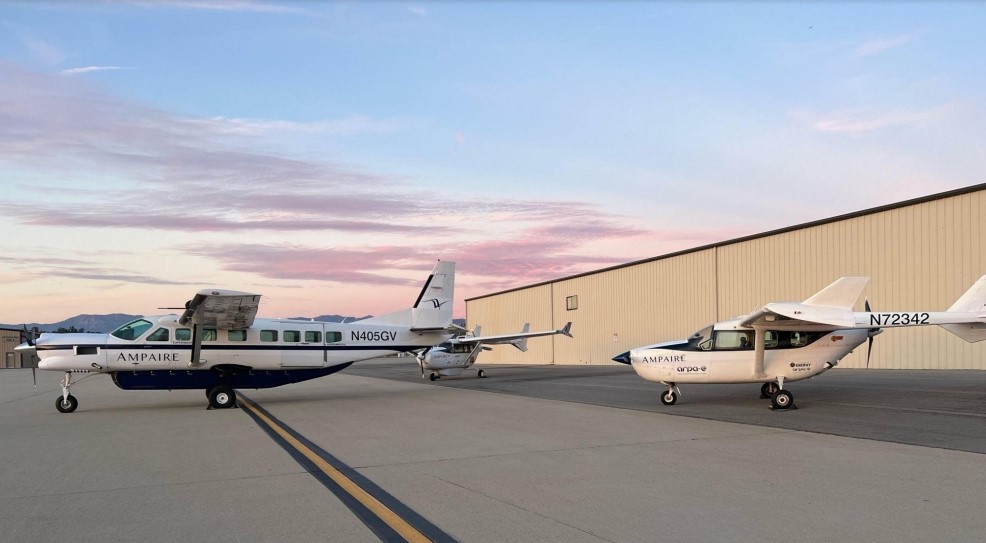
Ampaire operates two Cessna 337 Skymaster aircrafts upgraded to hybrid-electric operation that reduces fuel consumption and emissions by up to 70 percent. One is Ampaire’s market-survey demonstrator, the other a technology testbed called the ARPA‑E Bird.
Under ARPA‑E’s CIRCUITS program, the testbed has been used to evaluate prototype components and systems from Ampaire and other ARPA‑E contractors. While these systems were not designed to meet FAA certification requirements, they advanced Ampaire and industry knowledge that will lead to certifiable designs.
New systems will be designed for volume manufacturing and will reduce cost, increase reliability and incorporate the safety features necessary to pass regulatory certification tests.
SCALEUP funding will be devoted to developing certifiable subsystems in three areas:
● the powertrain control (PTC) to manage power from both the Ampaire powertrain combustion and electric sources,
● the propulsion motor drive that conditions power to the electric propulsion machinery, and
● the integration of the thermal-runaway-protected energy storage system.
A prototype Eco Caravan made its first flight on a fully integrated hybrid-electric propulsion system one week ago and a second production-conforming Eco Caravan will fly next year with plans to complete the certification of the Eco Caravan in 2024. It preserves the nine-passenger payload capability of the Grand Caravan and significantly improves range with a reduction in fuel load beyond 1,000 miles.
It is equipped with high voltage charging plugs but can also recharge its batteries using the on-board engine, so the ability to operate independently of ground charging is critical for deploying the Eco Caravan while ground infrastructure is developed.
Back in June, Ampaire was one of more than 40 of the world’s leading electric aircraft developers presenting at the 16th Annual Electric Aircraft Symposium (EAS) hosted by the Vertical Flight Society (VFS).

