
Robotics company FANUC on why it is well placed to help the eVTOL aircraft and UAM markets
As the momentum continues to gather pace in the eVTOL aircraft and Urban Air Mobility markets, more companies from outside this space are looking in with real interest as they ponder whether to enter this lucrative industry and help play a part in its success.
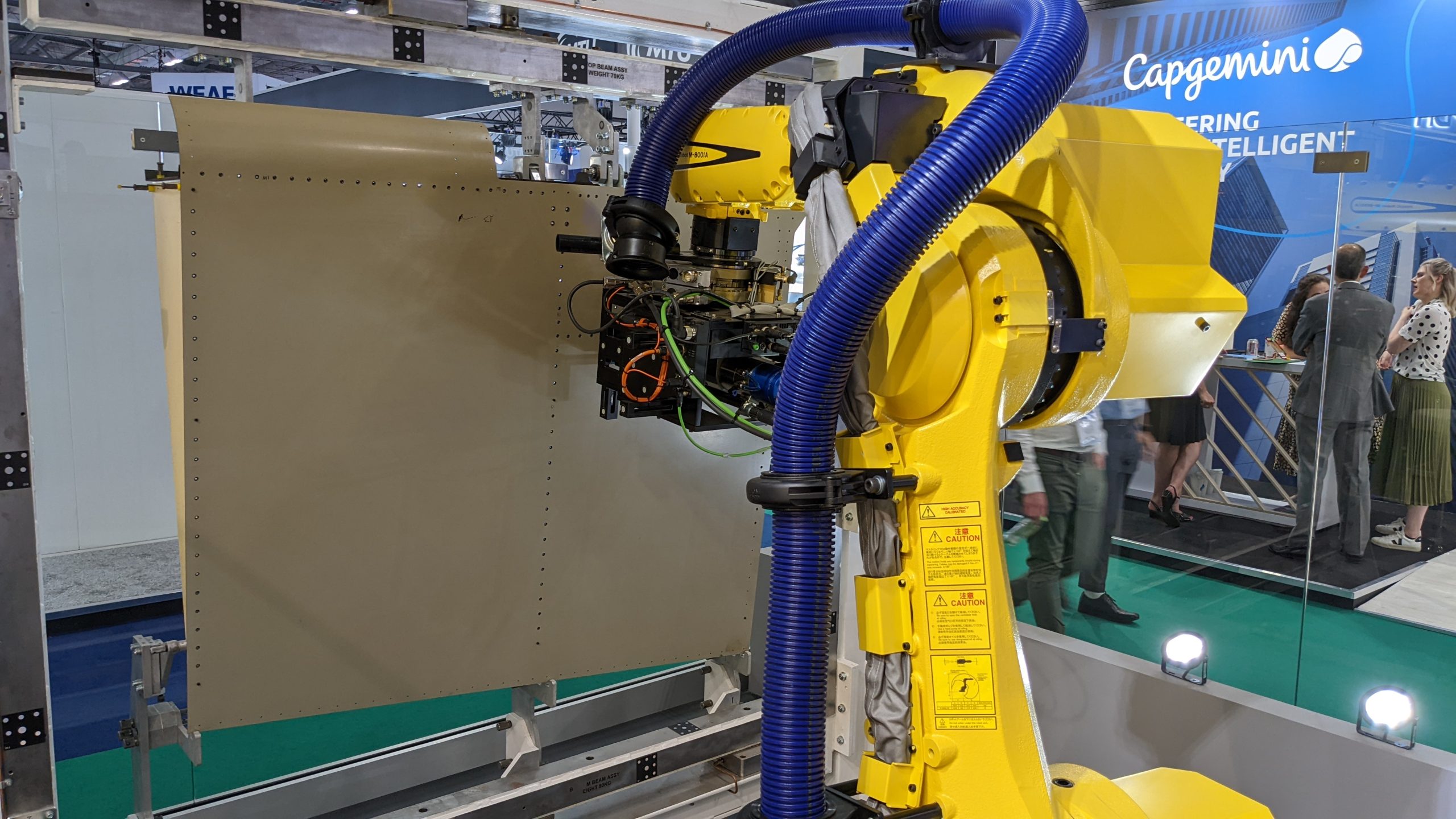
One of these companies is FANUC, the Japanese robotics and automation specialist. It brought a selection of its automated solutions to the Farnborough Air Show last month, with the distinctive yellow stand showing examples of its robots working on drilling and welding applications.
eVTOL Insights spoke to Bob Struijk, FANUC’s European Vice President, to get more information about the company, the products it is working on but also what value it can bring to the eVTOL aircraft and Urban Air Mobility markets — especially when it comes to the aircraft production and manufacturing process.
Can you tell us a bit more about FANUC?
Bob Struijk: “We are a Japanese company founded in the late 1950s by Dr. Seiuemon Inaba, the pioneer of CNCs (computerised numerical controls), which are like PCs for machine tools.
“We have a 60 per cent market share of the worldwide CNC market; most machine tools have FANUC controls and motors.
“Twenty years later, in the 70s and 80s, we entered the robotics market, which was driven by the automotive industry. It had numerous manufacturing applications that were ripe for automation, so it was a good marriage.
“Since then, we have partnered with some of the biggest brands in the industry to bring our technology to market and today, we have the largest range of robots in the world. We manufacture over 9,000 units a month, and it is still not enough. The demand for robotics over the last 10 years has been increasing steadily, but after COVID-19 it has been steep; China, the US and Europe, all markets are ramping up.
“This is partly being driven by a shortage of labour, especially since COVID-19 when some workers were forced out of their jobs as a result of strict social distancing measures. Subsequently, many have decided not to return and instead want to do something else with their lives – they don’t want to stand behind machines or work on a production line all day.
There is also the fact that robots provide consistency and precision. A robot can work 24/7 and still complete its task perfectly – the quality output of drilling and riveting done by our robots is evident. These tasks are still done by hand in some factories, but they are cumbersome.
“The worker has to manoeuvre a heavy gun but still maintain precision, which may be possible for the first couple of hours but after that, the quality goes down because the employee becomes tired. A robot never gets tired. Of course, it needs to be set up well; that’s the trick with automation. You need good controls, but once it’s set up correctly, off it goes!”
Now we’re back to in-person events, how has it been at Farnborough?
BS: “This is the first time we’ve exhibited at Farnborough, because we felt we needed to go out and really show the market what these machines can do. People talk a lot about robotics, but not many have been exposed to it. Plant and factory managers know about it, but the immediate day-to-day issues often take priority over the mid to long-term planning.
“We’ve had many people come to our stand who work in construction, parts and engineering and they’ve been very enthusiastic about what they see and our robots’ capabilities. On display, we have some of our bigger robots which are in a fixed cage, can work at high speed and carry very heavy payloads. Of course, these need safety fixtures in place, because you do not want your workers to come in contact with one.
“But also on display are our collaborative robots (cobots). They are built with softer areas of contact and operate at a slower pace. When a worker comes into contact with a cobot, the cobot will immediately stop, which allows for safe co-working.
“What are humans good at? We have eyes to see, hands to feel and touch, can easily combine and recognise things, and can carry out very difficult tasks that may not be obvious for a robot. But we’re not so good at repetition and maintaining a high standard of quality for a long time. Equally, we’re not great at lifting things and putting them into a machine; and more importantly, people do not want to do that kind of job anymore.
“This is where cobots come in. Another good thing about them is their ease of programming. It’s like using a smartphone; you move the robot into position and tell it to do different tasks. You can programme it in 10 minutes.
“In the past, the belief was that robots are only suitable for large operations. Maybe that was true in the 80s and 90s, but not anymore. Cobots can be easily programmed offline and moved around to work on different machines, and, depending on the application, they often don’t need to be fenced off, so there are a lot of benefits to them.”
With all this in mind, what value can FANUC bring to the emerging eVTOL aircraft and Urban Air Mobility markets?
BS: “We can bring a lot. eVTOL aircraft are the next frontier. Look at the Tesla car; it might look like a normal car on the outside but inside it is totally different. From the manufacturing perspective of an electric vehicle, you have a battery pack and the powertrain is completely different. Plus, there is no gearbox. So, while there are some similarities, there are also lots of new things that we need to bring into this market.
“We are already supporting electric vehicle manufacturers and hope to do the same with eVTOL aircraft in the future, because, like electric cars, they have lightweight materials, carbon fibre, plastics and are electrically driven. The manufacturing side of these aircraft is different to that of an Airbus A320 or Boeing 737, but we are ready for that.
Are there any challenges that we need to address when it comes to robotics and automation?
BS: “There are many challenges. For example, if you want to complete a specific insertion of metal parts, it can be difficult for a robot to do. But with software and floor sensors, we can really meet those assembly challenges. We also have our own vision systems (2D and 3D); everything is integrated into our robot control. We pride ourselves on developing solutions to the customer’s challenges.
“We also use our own manufacturing platform as an R&D testbed. Our robots are born in our factories and are in turn made by other FANUC robots. In our manufacturing facilities, we have 5,000 robot workers and only 600–700 human workers. The ratio is almost 8:1, so our employees have been redeployed to more value-added tasks. We’re constantly developing our offering to further automate our own factories – and if it’s good enough for us, then it’s good enough for the market.
“At our UK HQ in Coventry, we have the facility to carry out a lot of demos and testing. Customers come to us with issues and say, ‘we can’t do this or that’, and ‘do we need this particular system?’. We may not have the answer immediately, but we’ll often say, ‘let’s investigate – bring your materials and products and let’s do some testing.’ Once we can understand the customer’s challenges, it is often quite easy to come up with a solution.”
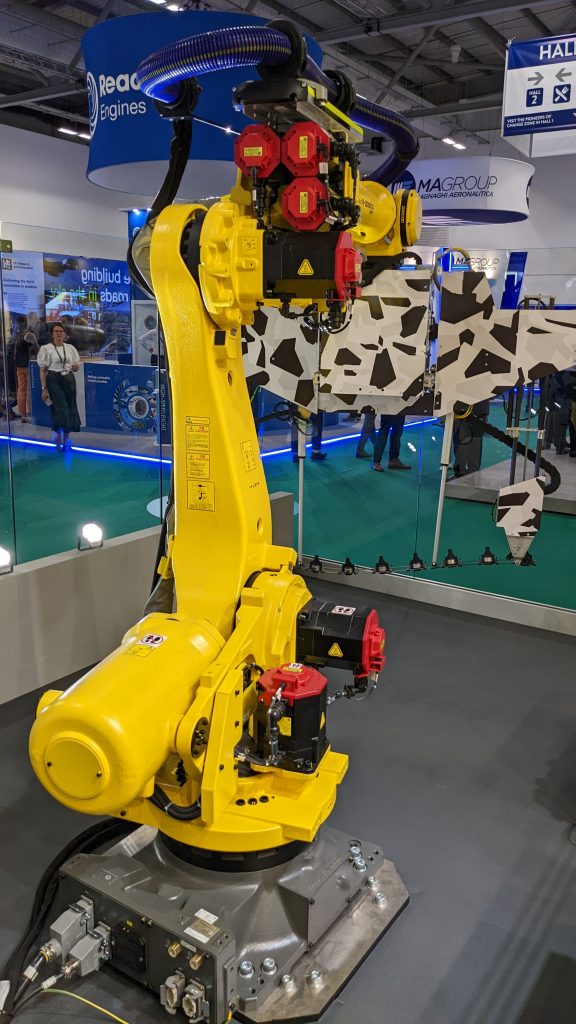
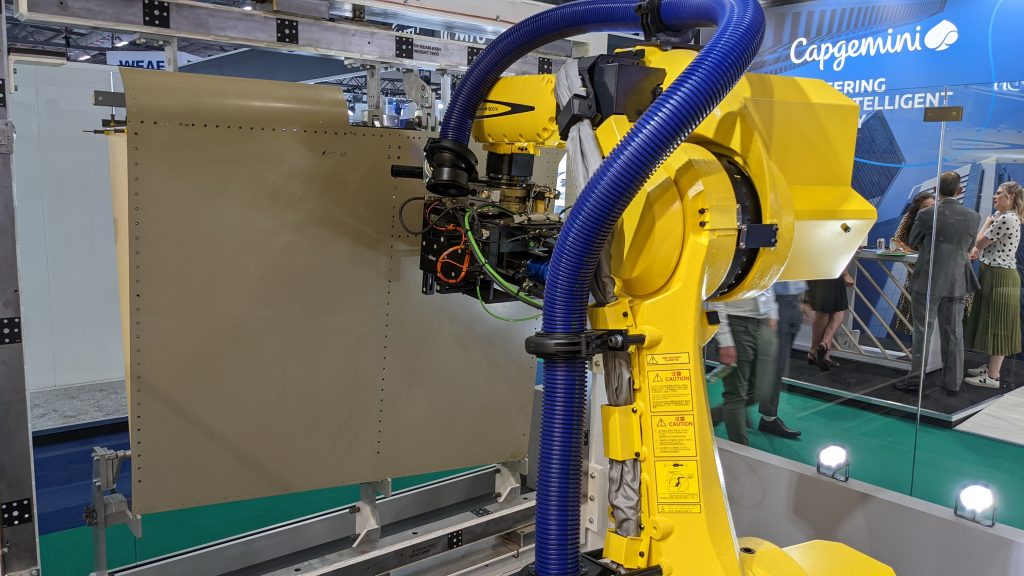
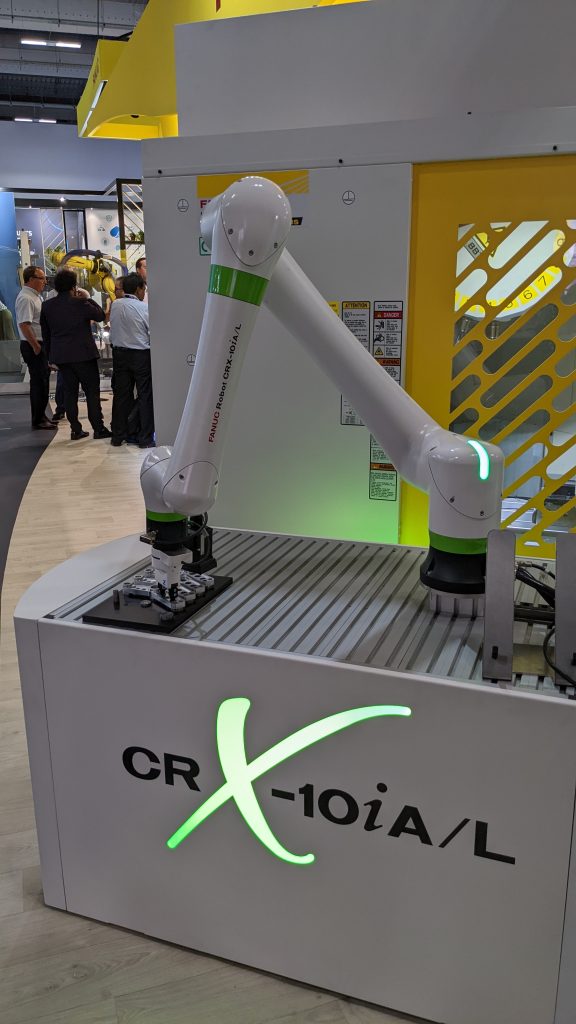
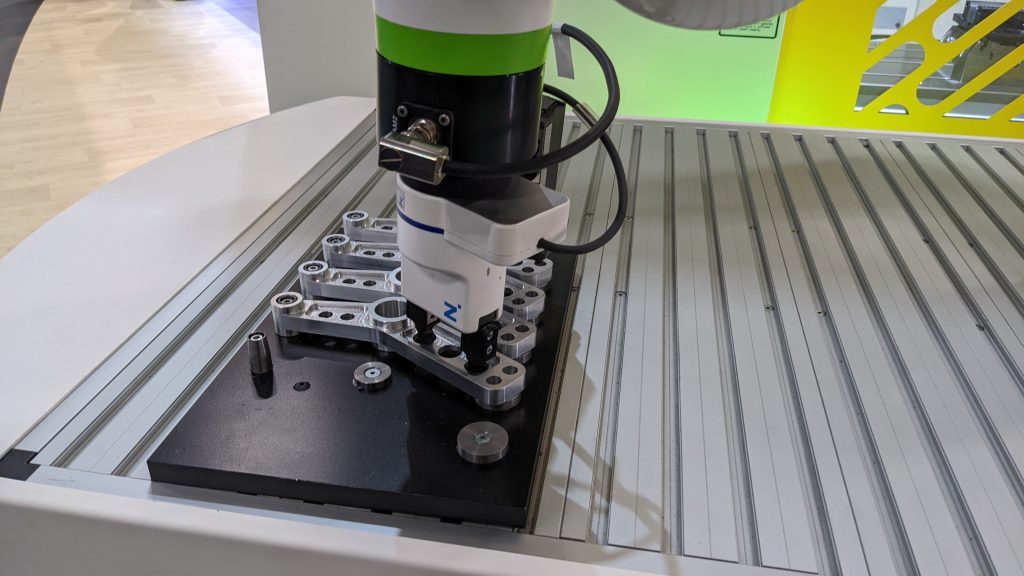
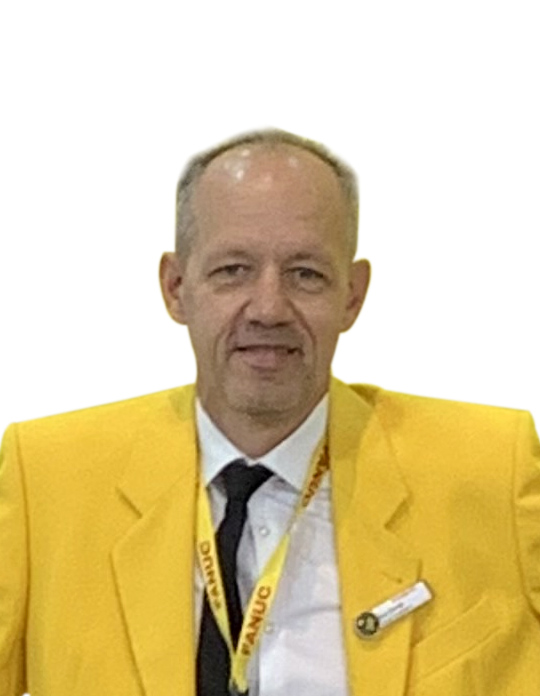
From top L‑R: FANUC’s automated robots on display at Farnborough, while the white robot is one of the company’s collaborative cobots. Bottom right is Bob Struijk, FANUC’s European Vice President.

