
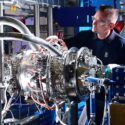
Rolls-Royce: Successful First Fuel-Burn For Hybrid-Electric Engine
A new Rolls-Royce small gas turbine, specifically developed to power hybrid-electric flight, has successfully completed its first fuel-burn, reports a press release.
The engine design incorporates a novel combustion technology to produce ultra-low emissions and the trial “confirms the effectiveness of the compact, power-dense turbine that will be integrated into a light-weight turbogenerator system,” says the release.
The turbogenerator is being developed for the Advanced Air Mobility (AAM) market to include both eVTOL and eSTOL aircraft for Urban Air Mobility (UAM) as well as commuter aircraft for up to 19 seats. The gas turbine under test also has potential applications for helicopters, auxiliary power units (APU) and defence markets.
Matheu Parr, Customer Director, Electrical of Rolls Royce, commented, “The first fuel burn of our brand-new small gas turbine is a significant leap forward with successful stages throughout the test from light-up to the pull-away of the system. This significant achievement follows the fast-paced development time of the new gas turbine from concept freeze to ‘pass to test’ in under 2 years.”
He continued, “The turbogenerator system will enable our customers to extend the routes that electric flight can support and means more passengers will be able to travel further on low and potentially net zero emissions aircraft.”

This system “will complement Rolls-Royce’s electrical propulsion portfolio by delivering an on-board power source with scalable power offerings between 500 kW and 1,200 kW enabling extended range on sustainable aviation fuels and later, as it becomes available, through hydrogen combustion, explains the release.
It continues, “The development brings together Rolls-Royce’s capabilities in designing compact and lightweight high-speed rotating electric machines, and highly efficient gas turbines combined with the expertise to integrate them on a system and platform level.
“Test facilities and equipment, comprising 14 subsystems in total, were designed, procured and built – or adapted – by a global team in a record time of just under a year. The test set-up comprises commodity components such as valves and hoses, and bespoke subsystems such as the fuel injection systems, oil and ventilation systems, engine mount and water brake that were tailored to the specific test requirements for this new technology.”
Matheu added, “With this achievement we have proven we can apply our expertise to novel designs and are able to test them on a very quick timescale. This capability will help Rolls-Royce to deliver the products that can help us on our path to net zero within the ambitious industry timelines of the Advanced Air Mobility market.”
Please Watch Video
The release explains that the turbogenerator can be used “in serial or parallel hybrid applications. It is well suited to recharge batteries as well as provide energy to electrical propulsion units directly and therefore enables aircraft to switch between power sources in flight.” The R&D is being partially funded by the German Ministry for Economic Affairs and Climate Action.
For more information
(Images: Rolls-Royce)

