
TompAero takes flight with aviation-first approach to autonomous eVTOL development
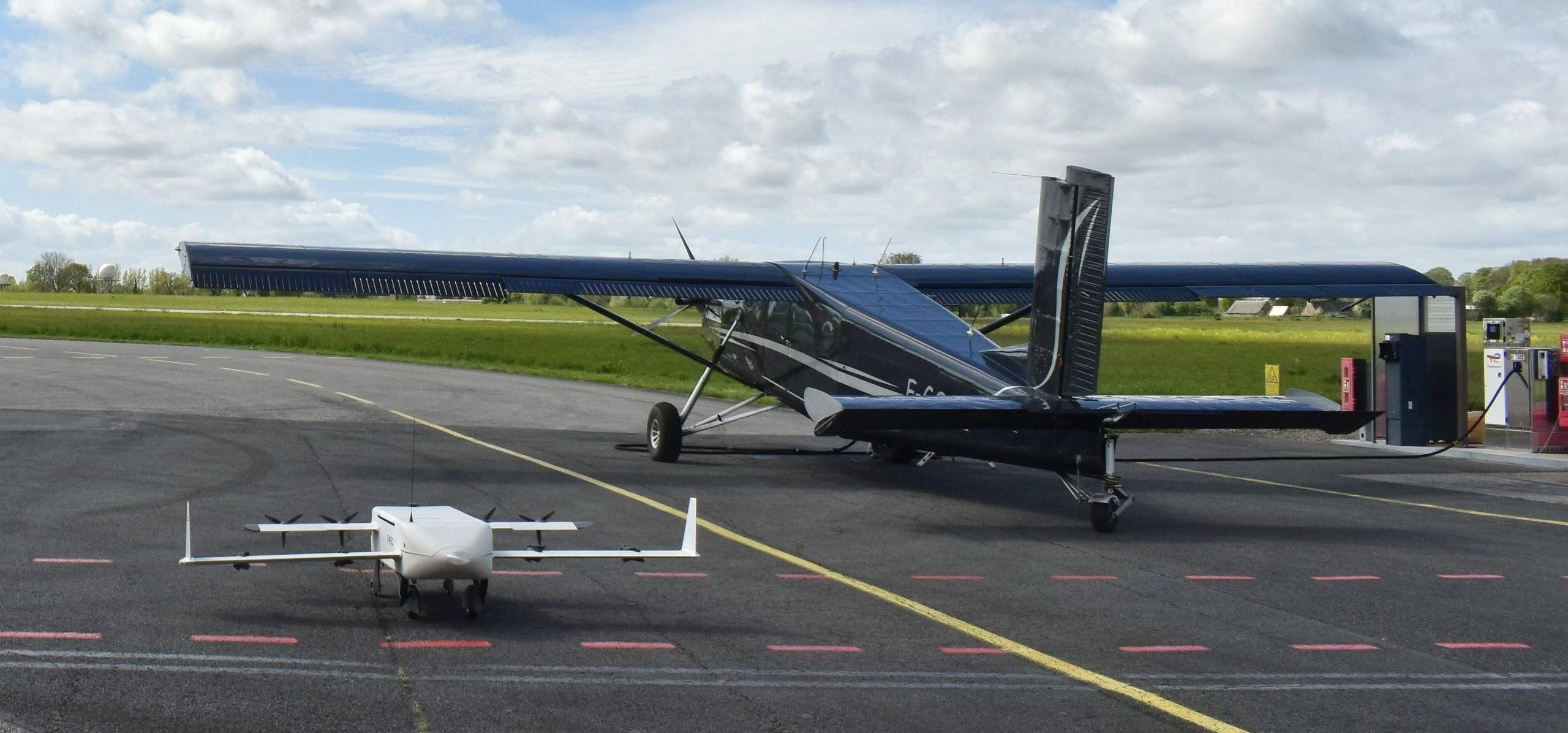
French start-up TompAero has begun flight testing its full-scale prototype as it develops a new class of small, autonomous aircraft designed to bring zero-emission air transport into existing aviation infrastructure.
Flight testing its full-scale prototype marks a significant milestone for the start-up as it moves from development into a structured flight-test programme.
The company is developing the FSC – or ‘Flying Suitcase’, a small eVTOL aircraft designed around a combination of modular cargo capability, aviation-grade safety principles and embedded autonomy.
Speaking exclusively to eVTOL Insights, TompAero co-founder Tommaso Passerin d’Entrèves explained that the company has deliberately taken a different approach from many emerging unmanned aviation and eVTOL developers.
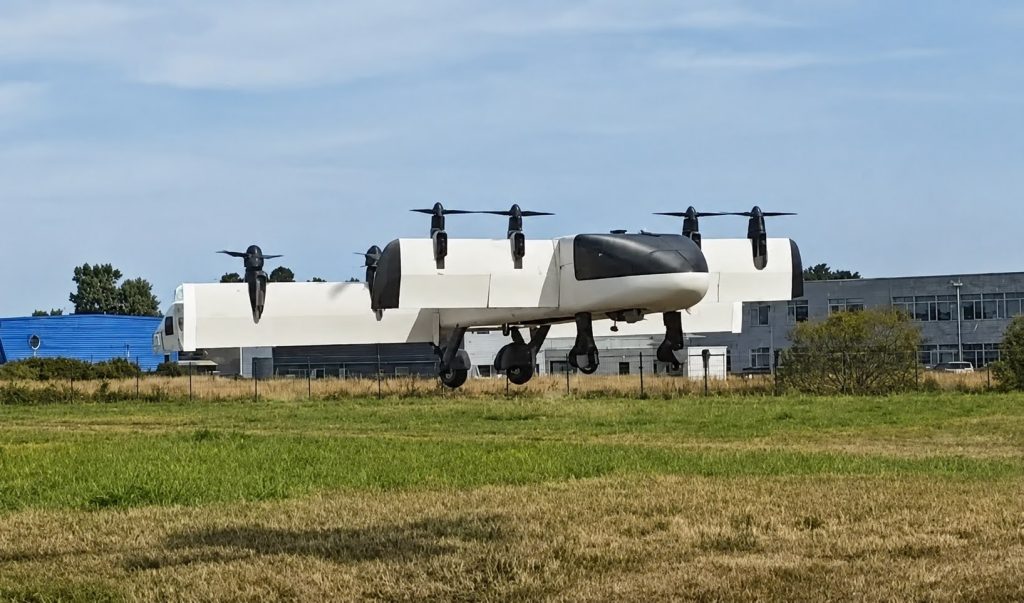
“Since then, we finished building our self-funded prototype. What we do is tackle the aircraft and the autonomous systems together,” he said. “Right now, we have begun the flight testing of the prototype named FSC‑X here at our headquarters in Brittany, France, and we also have the autonomous system that is about to start flying on a manned platform.”
The strategy is to develop the aircraft and autonomy separately before integrating the two, allowing TompAero to prove safety and establish reliability at each stage of development.
“The whole point is to move forward with the design of the aircraft and the system separately until we can at least prove sufficient reliability to put the two things together,” Passerin d’Entrèves explained.
An aviation-first approach
While the FSC occupies a space between conventional drones and larger passenger-carrying eVTOL aircraft, TompAero is keen to emphasise that it was not designed as a conventional drone scaled upwards.
Instead, the company has sought to take the principles of certified aviation and apply them to a smaller, unmanned aircraft.
“What makes it very different is that it wasn’t designed like a larger drone. It was designed like a proper certifiable eVTOL, including many safety features that I would very much like to see on larger passenger-carrying aircraft that I don’t see,” Passerin d’Entrèves said.
“It was really designed from aviation legacy, scaled down, just removing the crew, but everything else – the certification objectives and the safety features – are all there.”
The objective, he added, is to ensure that the aircraft can eventually become part of the existing aviation ecosystem rather than requiring an entirely separate operating environment.
“The whole point is to send this into proper aviation without recreating it. We want it to be 100% natively compatible with legacy aviation,” he said.
That philosophy also explains why TompAero is not primarily focused on achieving the highest possible performance figures.
The current prototype has an approximate 45 kg maximum take-off weight, a 15kg payload capability, eight motors producing a combined 20kW, a targeted cruise speed of approximately 90 knots and around one hour of range.
“Most of the effort is not made to have the best performance. It’s made to have the best safety and certifiability, because that’s what will give us access to proper utility. We are not racing the performance race. We are racing the safety one and the certification one.”
A different role for eVTOL technology
Rather than developing a passenger-carrying aircraft, TompAero has identified applications where a relatively small autonomous aircraft could provide capabilities that are currently difficult, expensive or time-sensitive to deliver.
Emergency response, critical cargo and specialist logistics are among the areas the company is targeting.
“The aircraft’s name is FSC – Flying Suitcase. Basically, everything that you can fit in a suitcase, in a luggage, in a cabin-luggage type form factor, will fit inside,” Passerin d’Entrèves said.
“The cargo bay is a completely segregated and independent module. It’s up to the customer – we can design many different types of cargo bays. We take care of having it fly properly and safely, but what it does is actually very bespoke and very custom.”
TompAero has already developed concepts for refrigerated modules for applications including organ transportation, blood bags and medicine, alongside a module designed to support airdrop missions for defence and emergency response.
The company is also exploring industrial applications, where the FSC could act as a flying testbed carrying sensors or other systems.
“We’ve started discussing with large industrial groups that see our aircraft as flying testbeds as well, because within those modules you can fit whatever type of sensors or systems that you need to fly to actually test,” he said.
The modular concept is intended to make the aircraft as versatile as possible while avoiding the need to develop a bespoke aircraft for every potential application.
“We are looking for a type certification. It’s very long and very costly, so we need to design a single type of aircraft that is as versatile as possible, so that it can adapt to as many missions,” Passerin d’Entrèves explained.
“That means that some missions we haven’t thought about so far, and that don’t make a full market, could still be reached. In our case, it will only require a bespoke module, not a bespoke aircraft.”
Flight testing moves forward
TompAero has now completed the first flight of its full-scale prototype and is progressing through a structured flight-test programme.
The initial phase has focused on vertical take-off and landing, with the company awaiting the necessary authorisations to begin horizontal flight testing from an airport.
The next major milestone will be transition testing, which is expected to be particularly significant given the FSC-X’s dual tilt-wing configuration.
“We are following a proper test programme,” Passerin d’Entrèves said. “We started with VTOL flights so far. We expect to get the authorisation to begin horizontal flights from the airport we are based at, and then the first transitions early next year.”
Alongside the aircraft programme, the company is preparing to begin testing its autonomous system on a manned platform.
This reflects TompAero’s belief that developing the aircraft alone is only part of the challenge. For the company, making an autonomous aircraft capable of reaching the location where it is needed, when it is needed, is equally important.
“As much as it’s about the aircraft itself, where we have competitors, it’s about how we can manage to have the aircraft available and reach the place it has to reach in time,” Passerin d’Entrèves said.
“You can build the best aircraft, but it’s still forbidden to reach the place it has to be when you need it and where you need it. That’s another problem, and that’s a problem that comes from the moment you’re unmanned.”
Autonomy designed around existing airspace
TompAero’s autonomy strategy is therefore being developed with conventional aviation operations firmly in mind.
Passerin d’Entrèves describes the company’s approach as embedded autonomy, with the objective of making the unmanned aircraft operate as closely as possible to how an aircraft with a human pilot would behave.
“We are using technology so that the unmanned aircraft behaves just as if it had a human pilot on board,” he said.
The company is also seeking to distinguish between genuine autonomy and systems that are simply unmanned or pre-programmed.
“Some people call autonomous what is unmanned. Some people call autonomous things pre-programmed. We call autonomous what is actually autonomous,” Passerin d’Entrèves said.
“So you can put it into airspace, and it can discuss over VHF radio with the traffic controllers and with the other pilots. We are trying to pick up as much information as possible from the airspace — information that’s already there, but that’s currently only used by human pilots — and factor that into flight planning and the autonomous systems.”
The approach is informed by the founding team’s aviation backgrounds, which include three private pilots and a co-founder who is also an air traffic controller.
“We kind of know what could be acceptable by our friends in manned aviation, and what would not be acceptable,” he said.
For TompAero, the ultimate ambition is therefore not to create a separate unmanned aviation ecosystem, but to develop an aircraft capable of operating within shared airspace.
“We decided from the start, from the inception, to go 100% the aviation way, not the drone, not the robotics way, and the shared-airspace way, because that’s what we’re looking for,” Passerin d’Entrèves said.
“It will take time and money, but we would like to offer a proper solution that does not require you to segregate the sky between unmanned and manned.”
From a quiet development phase to the next stage
TompAero’s progress comes after a deliberately low-profile development period. Unlike many start-ups in the Advanced Air Mobility sector, the company has not focused heavily on exhibitions, public demonstrations or promoting early-stage concepts.
Instead, the team has concentrated its resources on developing and flying a physical prototype.
The company believes this approach has allowed it to focus on gathering real-world data and progressing the technology rather than simply presenting future concepts.
As the FSC‑X enters its next phase of testing, TompAero is now beginning to introduce its work to a wider industry audience and is currently fundraising to support its continued development.
For Passerin d’Entrèves, the company’s emergence comes down to a simple objective: identifying where aviation currently has gaps and developing a tool that can address them.
“We all come from legacy aviation. We know what aviation is great at doing already, and we kind of identified what’s missing with aviation,” he said.
“In our case, there’s no proper aviation tool that allows you to carry, with zero emissions and cost-effectively, some small items that still require air transportation or speed.”
With its first prototype now flying, TompAero’s next challenge will be to demonstrate that its aviation-first philosophy can translate from engineering concept into a reliable, certifiable and genuinely useful autonomous aircraft.
For a company that has so far chosen to keep its work largely away from the spotlight, the FSC-X’s first flights could mark the beginning of a much more public chapter in TompAero’s development.

