
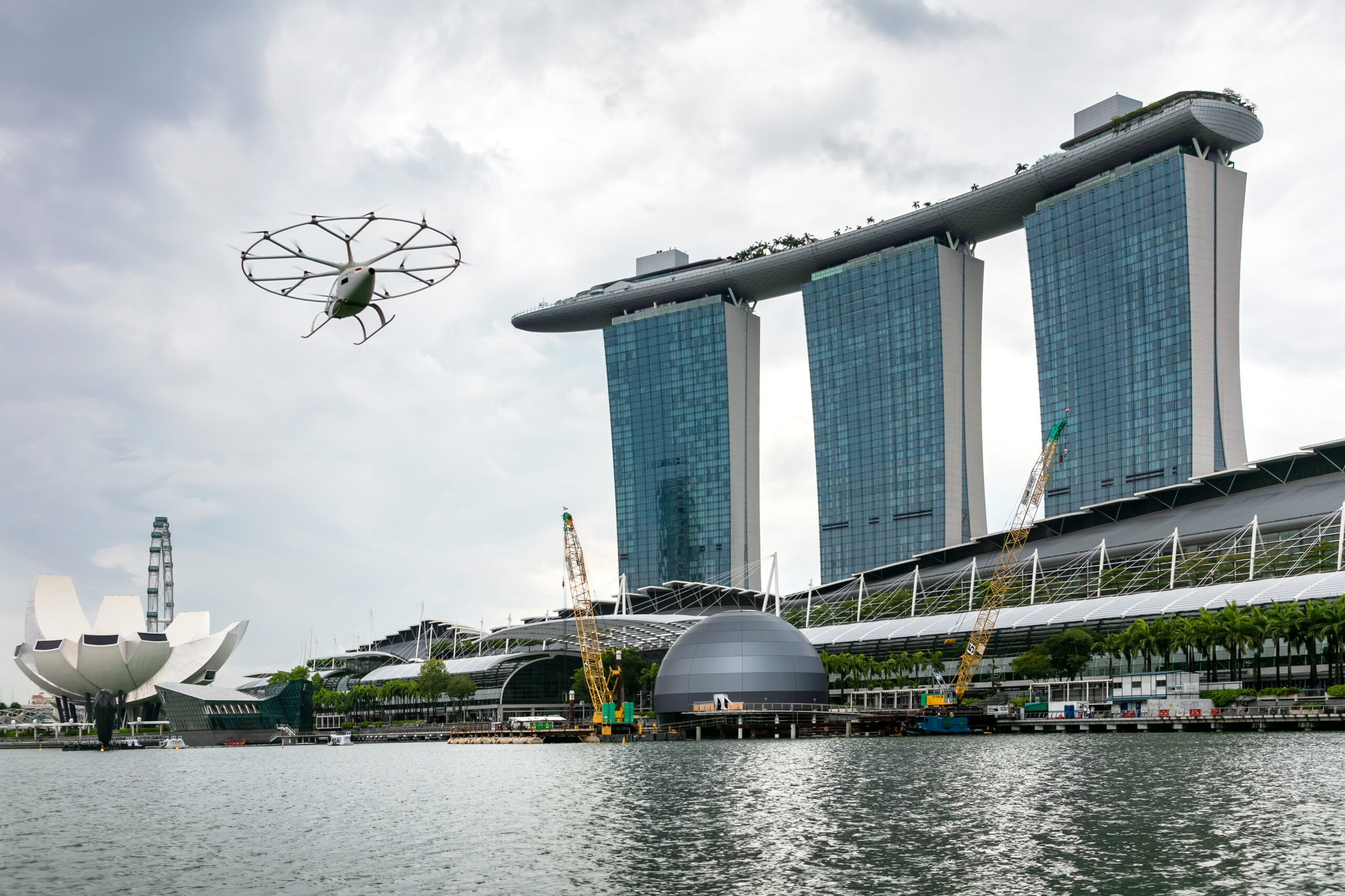
Volocopter Suffers Two Recent SetBacks as Company Vies to Pioneer the Emerging eVTOL Industry
It is never easy to be a pioneer in an emerging new market, especially one like the eVTOL industry. Setbacks are common, disappointments the norm, and German-based Volocopter suffered not one but two last week.
On Friday (November 17th), news broke that Volocopter’s plans to begin a 15 minute air taxi flight in the Marina Bay area of Singapore, early next year, alongside the hiring of key staff, has been put on hold — indefinitely — as the German company cannot secure local partners to share the large funding required for such an enterprise.
straitstimes.com quoted a Volocopter spokesperson, “We will continue to look for local cost-sharing partners and Singapore remains our Asia-Pacific headquarters. Once these partners have been found, we will reconsider the launch timeline in Singapore.”
The spokesperson explained that its commercial operations rely on the cooperation of cities. This requires the adaptation or construction of new infrastructure, route and regulatory planning, and the development of a digital network. Adding, “We are prioritising cities that can accelerate (these) aspects, and adjusting our global business strategy and timeline accordingly.”
Volocopter is unable to specify the amount of funds needed to launch the Singapore operations, pointing out that “different markets have varying situations and partners.” To begin commercial air taxi services in the city, the company said “it would require a complete urban air mobility ecosystem, including aircraft, infrastructure and connectivity.”

Singapore
While Volocopter has already attracted close to USD750 million investment via five fund-raising rounds, Dr James Wang, director of the Electric Vertical Take-off and Landing Research and Innovation Centre at the Nanyang Technological University, believes to successfully develop an air taxi company from scratch, it is necessary to secure funding of at least USD1 billion which includes recruiting experienced aircraft designers and building strong links across the supply chain network. As important as the financing, there is also the required support from both local government and the public for such an innovative project.
Two days later another setback occurred, when Volocopter’s future “jewel in its crown” flights over Paris during the Olympic Games, next July and August, has hit a major stumbling block.
The French Capital’s councillors have reacted to the idea with a stunning negative reaction, calling the plans as “Absurd” and an “ecological aberration.” Dan Lert, a Deputy Mayor of the Consul de Paris, went even further describing such flying taxi operations as “a totally useless, hyper-polluting gimmick for a few ultra-privileged people in a hurry.”
The Autorité Environnementale Française had already expressed its reservations about the scheme. It said an impact study for an experimental vertiport on the Seine, at the quai du port d’Austerlitz, was “incomplete”, and raised concerns over sound and visual pollution, energy consumption and ground and airborne safety risks.
The intention is to fly five to ten eVTOL aircraft during the 2024 Olympics, (consisting of three connection journeys and two round-trip tourist flights) in and around the capital, including a shuttle service from the airport to the city centre, cutting a 45-minute journey to 10 minutes, for a price of EUR110 per person. Another flying taxi will be taking off and landing from a barge on the river Seine.

Opposition to the plans is, seemingly, across the board from members of the city council. Parti Socialiste councillor, Florian Sitbon, commented, “To save a few minutes for a few wealthy people in a hurry, who are ignorant and contemptuous of the climate emergency, we would be polluting the atmosphere and destroying the sound environment.”
Meanwhile, the mayor of the 15th arrondissement, Republicain Philippe Goujon, reiterated his ambition to close the Issy-les-Moulineaux heliport completely, a major proposed takeoff and landing hub for the project.
Changer Paris councillor Claire de Clermont-Tonnerre added, “The consumption of these flying machines, nearly 190 kWh per 100 km, is two to three times higher than that of a combustion-powered car to transport a single passenger.”
And continued, “It’s a new use that we absolutely don’t need…, just as we’ve seen with self-service scooters.” While Communist councillor Jean-Noël Aqua pointed out that passengers would have to pay “the modest sum of EUR140 for 35km.”
The Aéroports de Paris (ADP) group, along with German manufacturer Volocopter and the Ile-de-France region, have always stated the plans “are an experiment with a new mobility offer in very dense urban areas.”
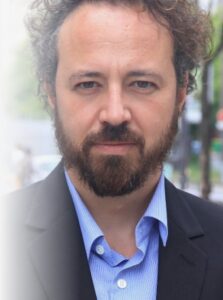
Florian Sitbon
So what can be learned from these setbacks?
The delay in Singapore is understandable and can be put down to present financial factors. Volocopter has stated that because of global uncertainties, both geopolitical and economic, it was fully expecting that fund raising would be more challenging, especially given the monetary risks involved in such a new and commercially untested market. This is a high risk investment.
And unlike other global city regions, Singapore does not have the same dire need for air taxis as roads are not as congested as those in some other cities. Singapore is a city, a nation and a state, and is only about 275 square miles, smaller than the State of Rhode Island, and inhabited by just five million people, where the distance from one end to the other is not significant, given the country’s size.
Dr Wang points out that “investors may not see a high return on their investment in Singapore’s air taxi sector, compared with the profits they could earn from cities with greater traffic congestion.”
Assistant Professor, Terence Fan, a Transport Specialist from the Singapore Management University, agrees saying a sizeable local demand and many daily journeys would be needed to simply cover the costs of such operations.
As air taxis can travel only along fixed routes from one vertiport to another, passengers may still have to journey by land to get to their destinations, and why Dr Wang believes that air taxis could be more useful connecting Singapore to cities close by. Even then, cross-border flights from Singapore to say Indonesia and Malaysia “are still full of obstacles” because “there are no present and clear regulatory guidelines for such services.”
This leads to an obvious question: Has Volocopter chosen the wrong region? Surely, India might be better where road congestion in major cities is far worse and where there is a greater population.

Rendering of the proposed and controversial floating vertiport at Quai d’Austerlitz ( Source: Ae Opinion 2023–46)
As to Paris, socialist politics combined with a degree of ignorance seems apparent. It is easy for the eVTOL industry to remain in a bubble as it speeds along with its development like some crazed racer, attempting to beat all opposition to the finishing line. Yet, if you don’t gain the confidence of the public first and, more importantly, local councils who may decide whether the eVTOL industry will fail or succeed, all the hard work and effort could come to nothing.
Education, education, education.
The Parisien cynicism and cheap jibes are understandable. For those from the political left, all they see is yet another capitalist creation aimed at the wealthy. Although, for the Parti Socialiste councillor, to state, “To save a few minutes for a few wealthy people in a hurry, who are ignorant and contemptuous of the climate emergency, we would be polluting the atmosphere and destroying the sound environment” is bizarre and shows how little is understood about air taxis. “A few wealthy people in a hurry” is a fair comment. Until the aircraft become autonomous, prices will be high, but as the industry points out, no higher than the cost of an Uber Black. Criticism of the aircraft “polluting the atmosphere and destroying the sound environment” is utter piffle. If anything it is the other way around.
Education, education, education.
Surely, what Volocopter and its supporters must now do is to invest a large sum of money to intensely educate both the Paris councillors and public. The Olympic Games is just eight months away. The notion that the city will ban Volocopter from flying at the Games will be a major setback for the industry. Yet, despite the present scale of opposition, the scheme could still go ahead. The Ministry of Transport is set to make a decision “at the beginning of 2024.” It is likely they will be more favourable to the idea.
For more information
(News Source: https://www.straitstimes.com/https://www.thelocal.fr)
(Top image: Volocity Flying Over Marina Bay, Singapore — Credit: Volocopter)

