
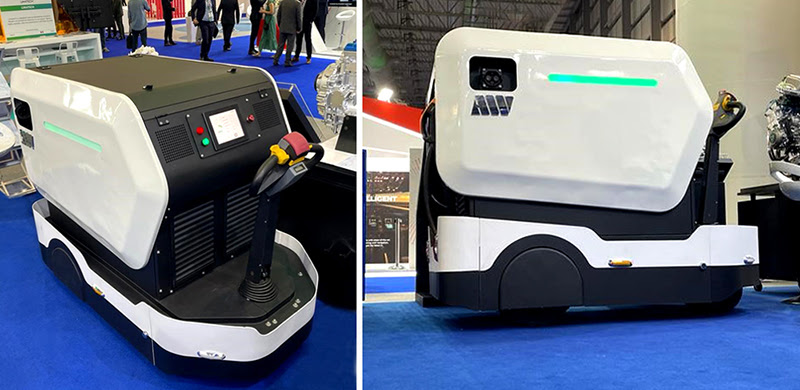
VoltAero’s universal mobile charger for its Cassio electric-hybrid unveiled at last week’s Dubai Airshow
A universal mobile charger for VoltAero’s Cassio family of electric-hybrid airplanes and other electric aircraft was unveiled by the company at last week’s Dubai Airshow.
Capable of delivering energy to recharge the Cassio 330 in approximately 30 minutes, the charger uses a smart combination of supercapacitors and batteries for a power output of 100 kw. As part of the unit’s ‘intelligence’, it can be programmed for autonomous deployment to a designated location at an airport or landing zone for aircraft recharging.
This intelligent charging unit is part of VoltAero’s strategy to create the infrastructure for its Cassio airplane family, which begins with the five-seat Cassio 330. The charger also will be offered for applications with other e‑aircraft and eVTOLs.
Jean Botti, VoltAero’s CEO and Chief Technology Officer, said: “This latest development underscores how VoltAero and its partners already are taking steps beyond our development of the breakthrough Cassio family to evolve an optimized infrastructure that will support the e‑aircraft sector.”
In addition to the intelligent charger unit’s world debut at last week’s Dubai Airshow, the VoltAero display in the Dubai World Center included Kawasaki Motors’ four-cylinder and six-cylinder internal combustion engines for the Cassio aircraft’s electric-hybrid propulsion module.
These engines will be able to operate with hydrogen, with VoltAero targeting a Cassio 330 electric-hydrogen demonstrator for 2025.
VoltAero’s Cassio family will be a highly capable and reliable aircraft product line for regional commercial operators, air taxi/charter companies, private owners, as well as in utility-category service for cargo, postal delivery and medical evacuation (Medevac) applications.
Cassio aircraft will utilise an electric motor in the aft fuselage-mounted hybrid propulsion unit for all-electric power during taxi, takeoff, primary flight — if the distance traveled is less than 150 km — and landing.
The hybrid feature – with the internal combustion engine – comes into play as a range extender, recharging the batteries while in flight. Additionally, this hybrid element serves as a backup in the event of a problem with the electric propulsion, ensuring true fail-safe functionality.

